Regulating the Internet in the skies

If you’ve been following technology in the airline sector for the past few months, you’ve probably heard that a number of airlines are getting ready to integrate wireless internet into their fleets. Earlier this month, Jetblue launched service (albeit limited) in one of their jets, and Virgin America, American Airlines and others have similar plans for the first quarters of next year.

With added flexibility in the skies, however, comes a higher probability of abuse. Earlier in a discussion about cell phone usage in the sky I pointed out that with wireless internet will come the ability to Skype and VOIP from above. In such close confines, both internet phone calls and browsing create tons of privacy and etiquette issues. Is it possible for a businessperson to sit between two people and jabber about confidential company information at top volume? Sure. Is it ethical? Probably not. What about the kid looking at graphic internet content while sitting next to a family in the back of the plane?

To curb some of these issues, airlines are taking a variety of defensive steps. Some, like Qantas, are blocking questionable sites completely so that they can’t be visited from above. Others have chosen to let the populous govern itself, pointing out that they can’t control the magazines or books that people bring on the planes either. I like this idea a lot, but when I think about all of the numbskulls out there, I don’t think it will end up working. Maybe we’ll get lucky.

Me? I just want to check my gmail and get my reading done. I’m looking forward to the wifi, even if it is regulated.
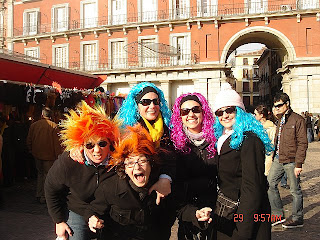
Christmas in Madrid, where’s your wig?

One of the strangest things people do in Madrid for Christmas is wear crazy wigs around the city. What’s stranger is that nobody really knows why!

For the last 30 years or more, Plaza Mayor has been home to a Christmas market with over a 100 stalls that sell all sorts of things: miniature statues of Jesus and the Virgin Mary; novelty gift-wrapping material; carnival accessories like tinsel wigs, rainbow wigs, Afro wigs, assorted head-boppers, mad glasses with flashing lights or with eyes springing out — the list is endless. I think the carnival stuff, although sold pre-Christmas and worn throughout the festival, is mainly for New Year’s Eve.

Go there after 6pm pre or post Christmas and Plaza Mayor is a jolly circus of people of all sexualities and walks of life frolicking around the area being merry, encompassing and radiating the joy of Christmas in the capital. There is a great video that captures this spirit, you can check it out here.

Needless to say, there is Christmas activity all over the city, but Paseo Castellana, which is the business high-street of Madrid is one of special interest. It’s decorated with lights and huge sparkling Christmas trees, all so magnificent that there is a special bus that takes you along the route just to see them all. Also this year, 60 international artists have sculpted structures from ice that represent Madrid like the Puerta de Alcala, or the Santiago Bernabeu football stadium.

It’s cold here but not excruciating so everyone’s on the streets in holiday mode — it’s a great time to be in Madrid.

Merry Christmas!

A ride on London’s ‘booze bus’

I knew London threw some pretty wild parties from my summer there, but do they really need an ambulance dedicated to treating the city’s drunks? The “Booze Bus” — or “Vomit Comet” — is a “drunks-only” ambulance that is dispatched during times of heavy drinking, “such as the World Cup, Gay Pride and the festive season,” according to the BBC. That seems like they’re just asking for trouble.

Of course, you could say the supply (of drunk people) is already there, and the good people manning these psuedo-ambulances are just meeting the demand (of driving aforementioned drunkards to the hospital). Or could you make the argument that having this “booze bus” makes people more likely to party hard and get out of control?

Here are some samplings from a random night on the bus:

  • “A scantily-clad 21-year-old woman lies motionless with one arm attached to a saline drip. She was found lying unconscious near a West End club …”
  • “Another seat is occupied by a 60-year-old man, found outside Holborn Tube station, whose silver hair is matted with a layer of thick, crimson blood.”
  • “And there was Sally, a 24-year-old accountant, who was struck by a glass … left a shard embedded in her forehead.”

Umm … ouch. I don’t know what else to say.

Christmas Eve in Denmark: Bask in the glow

In elementary school in the U.S., and I’m sure in elementary schools pretty much everwhere, there are the chapters of social studies books that present a sampling of holiday traditions in other countries. One of my favorite things about traveling is finding out which things hold true outside the pages of a book–and which are sometimes true, but not always the way that is pictured.

My Christmas spent in Denmark was my first Christmas away from home–it could have not been more perfect. It was social studies book perfection. One thing I found out is that Danes really do hold hands while they sing carols and dance around a live Christmas tree that has real candles lit all aglow. The candles are only lit on Christmas Eve.

My Danish family (I still call them that years later) had a pitcher of water close to the tree in case it caught on fire. Besides dancing around the tree, we also wound our way through the house. It was wonderful. I remember feeling safe and loved. This YouTube video is not of my family, but of a family who lives in Svendborg. Still, the look and feel is the same. Notice the garland of the Danish flags. My family’s tree had these as well as paper hearts like the one in the picture. Click on it and it will take you to the Web site with instructions. This video is less than a minute long, but you’ll get the idea.

Shutting down Amsterdam’s debauchery

Back in September, we brought you the news that one-third of Amsterdam’s red-light district will be shut down and transformed into housing. Now it seems the transformation will be even more drastic than previously thought. A wide swatch of the district will be replaced by “chic apartments, upmarket shops, galleries of high-quality hotels, and restaurants.”

The clean-up apparently has the full backing of the city, right up to the mayor. He said the city doesn’t want to completely ban prostitution; they just want to make it more discreet and limited to a couple of blocks. But it sounds like this could be more than just the usual back-and-forth on prostitution. As part of the plans, Amsterdam wants to “restore a number of historic buildings and reverse the decline of a large central area where brothels, sex clubs, and the coffee shops that sell marijuana line the city’s canals.”

On the upside, now the city wants to devote resources to restoring historic buildings, which is at least better than putting up more drab public housing or such. I may be reading too much into this, but looks like they want to take the Amsterdam out of Amsterdam.