Flying Kites Adventure Challenges: Give back on your next trip

Travelers looking to add a new dimension to their next journey may want to check out the Flying Kites Adventure Challenges, which are a series of great adventure travel opportunities that allow you to visit some fantastic destinations, while raising funds for charity at the same time.

Organized by Flying Kites, a non-profit that is dedicated to improving the standards for childcare in some of the poorest nations in the world, the adventure challenges are an intriguing prospect to say the least. The process starts with travelers selecting their adventure of choice from a list of five options. From there, they pledge to raise a certain amount of funds for Flying Kites, and once they reach that goal, the entire trip is payed for including airfare, guides, accommodations, and so on.

The list of challenges include climbing Mt. Kilimanjaro in Africa and trekking to Everest Base Camp in Nepal, both of which require a $6000 fundraising goal. There are also two options for surfing in Nicaragua with an 8-day itinerary costing $2300 and a 10-day version requiring a $2500 commitment. Photographers and wildlife enthusiasts will no doubt be intrigued by the Kenya Film Expedition, which comes with a fundraising target of $7500, while runners and endurance athletes will want to compete in the North Face Endurance Challenge this May.

The fundraising goals are certainly reasonable, and attainable, for anyone who sets their mind to it. Most of those trips can obviously be done for less money on your own, but in this case, you not only get a fantastic travel experience, but also the added benefit of giving a little something back in the process. Great adventure travel combined with the chance to improve the lives of children in the places we visit? Sign me up!


Flying Kites – Adventure Challenges – Kilimanjaro/Nicaragua from Flying Kites on Vimeo.

Safety concerns drive travelers to cruise vacations

Say what you will about cruise vacations, they have been scoring bonus points with travelers recently as ships were easily moved away from scheduled stops in Nagasaki, Japan. One by one, cruise lines have come and gone from other troubled areas of he world too like Mazatlan, Mexico and troubled Egypt before that. The moves illuminated once again the simple fact that unlike land-based travel options, cruise ships are mobile and can be moved out of harms way.

At a cruise industry conference in Miami this week, the topic of safety kept coming up time and time again. Cruise line executives, without hesitation, all agreed that safety is number one on their list both at sea and ashore when guests get off the ship.Avoiding possible problems in Japan may seem an easy task, simply steer the ship in a different direction. But a whole lot more goes into those decisions that you might imagine.

Passengers choose a cruise for a number of reasons, one of which is the itinerary. When trouble ashore makes sailing elsewhere the right thing to do, that does not mean everyone is going to be happy about it. In the case of the massive earthquake and resulting tsunami in Japan, the choice was clear and there was no advance warning. Passengers on board may have been disappointed but even the most surly cruise passenger would just need to understand and go with it. The same can be said for the Egypt problem when unrest caused ships to change itineraries there too.

In Mexico the situation is a bit different as cruise lines have to look at what is happening ashore each and every week. After ships pulled out of Mazatlan earlier, the Mexico government officials and tourism people rushed to speak to executives from the Florida-Caribbean Cruise Association (FCCA) about the problem and what they were going to do about it. They told the cruise lines that extra security would be in place and that they had addressed the problem.

The problem is, as one cruise line executive told me, things change from week to week. “One week we pull up to the dock and it is lined with police…everywhere in the port there are security people all over the place. The next week, nobody.”

That’s a problem for the cruise lines who (rightfully) demand a safe experience for passengers disembarking at any given port. That same cruise line exec told me emphatically “We have GOT to provide a safe method of travel and consistently safe ports”

Another factor cruise lines have to consider is resupplying the ships. When ships change ports, a number of things already in motion before arrival have to be altered. Vendors had been scheduled to deliver food and supplies, those are needed and will have to be sourced elsewhere.

Can you imagine making a grocery list then going to the grocery store and it is closed? You have GOT to have this stuff so you go to a different grocery store, one unfamiliar to you so the whole process is not as efficient but you make do. Cruise ships don’t have the luxury of simply being able to make do. They have a lot of passengers on board who will need the stuff they were going to get. They also can’t just hope for a good parking spot at the dock like you might have imagined you would get heading over to that other grocery store. Ships are assigned berths and being able to have a place to park the ship is important.

The ship might have been refueled at that canceled port too and will surely need that fuel at some point. Unlike people in cars might do, ships can’t run down to “E” on the fuel dial and expect good results. That’s playing it a bit too close when you are responsible for many passengers in your care. Ships carry extra fuel just for reasons like this but eventually have to be refueled.

Other normally routine matters have to be addressed too and a change in the ships itinerary affects those as well. Making it all work happens behind the scenes without us knowing and in most cases, without rescheduling or rearranging affecting the on board experience. Shore excursions booked through the cruise line are canceled automatically and payments refunded. That’s the easy part. Setting up excursions for a new, unscheduled port at the last minute is another challenge they face.

The good news is that every cruise line has systems in place to handle every possible contingency when a port has to be changed. In the olden days, that mostly happened when a weather related event or some mechanical problem with the ship made modifying the itinerary the logical choice.

The bad news is that these days, an ever-changing world where security concerns keep coming up seems to be affecting itineraries much more often. The cruise lines will do their best to modify an itinerary in a way that provides the “best possible safe itinerary” that cruise line executive told me. Cruise passengers can be confident that where they may sail to is safe. Still, many are disappointed when changes are made to a vacation they may have been planning for years.

One primary factor of travel that those disappointed cruise passengers don’t get is the nature of travel.

Travel of any kind is a game of chance at best. Be it hiking, backpacking, a road trip or some other form of travel, unanticipated delays, problems, revolutions, or changes of different kinds happen. They just happen. In today’s world, they seem to be happening more. Having an open mind and going with the flow or “not sweating the small stuff” is a quality all cruise passengers need to have more than ever. Make that number one on your next packing list.

As safety concerns drive travelers to cruise vacations, look for the mix of people you see on ships to change if you pay really close attention. It will be interesting to see if traditional travelers, concerned about safety, sail and blend in with the typical cruise passenger, an animal that is getting harder to define anyway or if their addition will have an effect on that traditional cruise passenger.

Flickr photo by Tom’s Shots

Photo of the day: Rosendal, Norway


Norway is a place I’d like to go. To be fair, I’m a travel writer. I’d like to go most places. Scratch that. I want to go everywhere. But Norway seems particularly enchanting to me.

When photographer, Ben Britz, first began traveling, he traveled in the most frugal ways possible. While in Norway back in 2005, he traveled only with a backpack. With a small tent for sleeping and a thumb in good shape for hitching rides, he explored Norway. As a note for those looking to camp in Norway, here’s a tip: in Norway it’s legal to camp anywhere you want (except for farmland or cities), even private property, as long as property owners cannot see you.

Thankfully, he managed to find room to pack his camera and took this shot.

Want us to feature one of your photos for Photo of The Day? Go ahead and submit your shots to the Gadling Flickr Pool.

Retail therapy: Istanbul ShoppingFest begins March 18

Every year, many people visit Istanbul to shop in the historic Grand Bazaar to haggle over carpets, Turkish tea glasses, and souvenir t-shirts. But most locals do their shopping in Istanbul’s many malls, markets, high streets like Istiklal near Taksim Square and Bağdat on the Asian side, and neighborhoods such as posh Nişantaşı and funky Çukurcuma. This year, from March 18 to April 26, travelers can take advantage of the best of all worlds with the first Istanbul ShoppingFest, also celebrating the 550th birthday of the Grand Bazaar. For 40 days, shoppers can get special discounts and win prizes, shop late into the night (with bigger discounts after 10pm), and be entertained with performances and events. Each Saturday, one mall each on the European and Asian sides will stay open until 2am, and all malls will be open until 11pm daily during the fest. In addition to sale prices, foreign travelers can get tax back on purchases at various malls around the city and enter raffles with each 40 TL (about $25 USD) spent.

Already established in India, Singapore, and Dubai in usual sale seasons, Istanbul’s promotion will hold a special draw as discounts will apply to new season merchandise and take place over several major holidays including Easter, Passover, and Iranian Nowruz. With this festival, Turkey hopes to carry over some of the momentum from last year’s European Capital of Culture designation, and become the destination of choice for travelers from nearby countries such as Russia, Iran, Ukraine, Azerbaijan, Saudi Arabia, Greece, Rumania, Syria and Iraq.

Check out more details and events at www.istshopfest.com and follow their Facebook page and Twitter @istshopfest. See also the March issue of Time Out Istanbul in English for feature guides to the fest and the Grand Bazaar.

[Photo courtesy Flickr user antonystanley]

Rome – 3 days in Italy

With the bustle of a large European metropolis and the detritus of a monumental past, Rome delights with a frenetic pace and antiquities lurking innocuously around each bend in the road. Here, history has been built on top of history for thousands of years. Seeing bankers in candy red Alfa Romeos zipping by millenia old ruins frames the endurance of this old city. Each sediment in time is visible and speaks to the ancient tale of decaying empire and modern function. The past is everywhere. You may be taking a stroll to sample some Trippa for a late lunch and accidentally stumble upon the Pantheon. There is a certain beauty to this unplanned chaos, and the overlapping of ages is historical mayhem at its most charming.

Rome is estimated to have been settled over ten thousand years ago. It has been a destination for a very long time. It is said that all roads once lead to this settlement on the Tiber. Thankfully, getting to Rome is inexpensive care of European budget air lines. Easyjet flies to Rome from several European cities such as Paris, London, Berlin, and Amsterdam for under $200 round-trip. Three days is plenty of time to see the highlights of Rome, but budget more time to truly understand this storied destination.

%Gallery-119063%

Day 1 – Roam the streets of Old Rome

One of the most amazing qualities of Rome is the integration of the ancient city into the modern metropolis. Most ancient sites beautifully disturb the modern order of things. On an old square, a McDonald’s faces the Pantheon in a worthy example of the strange compromises the present has made with the past. Due to this integration of the historical and the proximity of many Roman landmarks to each other, Rome is a great city for wanderers.

Start at the Colosseum, and take in the crumbling feat of ancient engineering. The queue at the Colosseum can be rather daunting, but booking tickets in advance or purchasing a Roma pass bypasses the line. Here is a great online resource for line skippers. Around the Colosseum, also seek out the Arch of Constantine. It is hard to miss.

From the Colosseum, start heading northwest towards Foro Romano, or the Roman Forum – the ancient seat of Roman government. It is a ruined old structure, and its considerate ambitions can be ascertained by the remnants. The Foro Romano is just east of Palatine Hill – one of the seven hills of Rome. The Circus Maximus, or old chariot racing ground, is just on the other side of the hill.

Continue northwest along Fori Imperiali road and slowly make your way to the heart of Rome. You will pass Foro Traiano, Piazza Campidoglio, and several other breathtaking landmarks. Eventually, if you stay the course, you will arrive at the doorstep of the Pantheon. The Pantheon is such a feat of engineering that it is still the world’s largest unreinforced concrete dome. During the renaissance, master architects such as Brunelleschi studied the Pantheon’s construction to reverse engineer advancements in the architectural field. This was 1300 years after the Pantheon’s construction. To call the Pantheon a marvel would be an insult. It stands as a testament to conquering impossibility.

Next the Pantheon, duck into Tazza D’Oro for some caffeine rejuvenation. Tazza is accused of making the best cappuccino in Rome. The place is busy and confusing. Follow someone who looks like they know the lay of the land.

Head north and east to the Trevi fountain, where well wishers toss away an estimated 3000 Euros per day. It is said that if you toss a coin into the Trevi fountain, then you will be guaranteed a return trip to Rome. North of the Trevi fountain is the Spanish Steps – the longest and widest staircase in Europe. Climb from the Piazza di Spagna to the top and cherish the view out over Rome.

For dinner, find a busy restaurant and order a lot of food. Rome is a mecca for food and has multitudes of delicious options. It is difficult to find a bad meal in Rome, so be adventurous. Hostaria Antica Roma on Appian Way is highly recommended.

Day 2 – Vatican City and Sistine Glory

Vatican City is a sovereign city state ruled by the Pope. With a population of less than a thousand, and only 110 acres in total size, the Vatican is considered the smallest country in the world, edging out the micro-state of Monaco. This center of the Catholic world boasts immaculate gardens, a heavenly basilica, and one of the top museums in the world.

The best way to reach the Vatican is on foot by crossing Ponte Sant’Angelo over the Tiber River. Castel Sant’Angelo is framed gloriously between winged angels on both sides of the bridge. The castle is a great first stop of the day, and houses a museum and Hadrian’s tomb. Castel Sant’Angelo has been a tomb, a castle for the popes, a prison, and also figures prominently int the novel Angels and Demons by Dan Brown.

West of Sant’Angelo is Vatican City. Entering on Via della Conciliazione is probably the most dramatic way to approach the holy place. Once in Vatican City, take in the breathtakingly large Piazza di San Pietro (St. Peter’s square) before entering the basilica. The square boasts an obelisk that was relocated from Egypt almost two-thousand years ago.

The height of the Michelangelo designed dome in St. Peter’s Basilica is so lofty that you could fit the entire statue of liberty within the dome with room to spare. The interior of St. Peter’s is a heavenly place, festooned with gold finery and artistic masterpieces. You can climb to the top of the dome for a stunning view out across Rome, or take to the crypts beneath the marbled interior to check on some papal tombs.

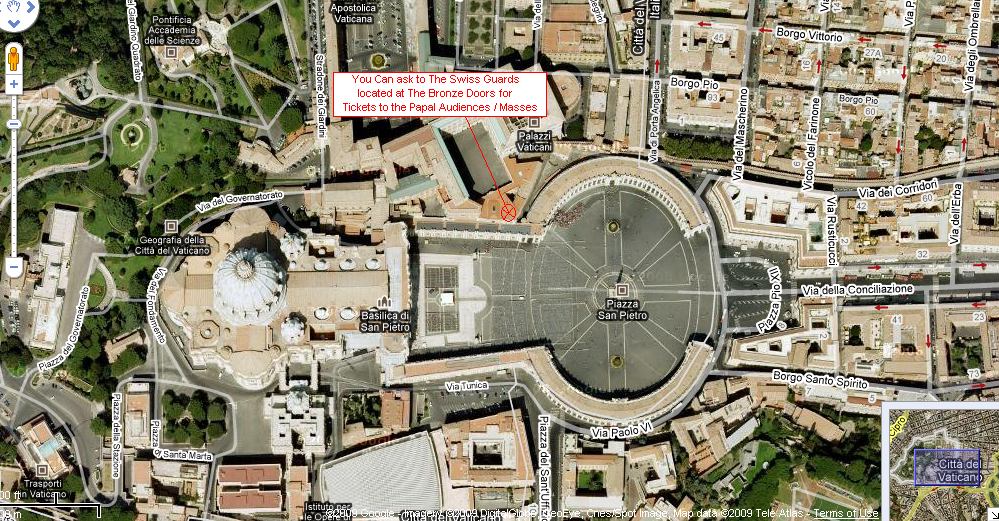
If you happen to be in Rome on a Wednesday, then you can be blessed by the Pope himself. He hands out blessings at 10:30am on Wednesdays. Check with your hotel or guesthouse to arrange tickets for the event. The Swiss guard also hands out tickets on Tuesdays from their post near the bronze door. Be sure to check the Pope’s schedule before getting too excited about being blessed. He is a busy man and routinely leaves his Vatican home.

The Vatican Museum is my favorite museum in the world. From entire rooms filled with the works of masters to hallways covered with brightly painted maps of an uncertain world, this place is an unbelievable experience. Budget plenty of time to take it in. The museum is laid out to move you through several gorgeous rooms and immaculate hallways before climaxing at the Sistine Chapel. The museum is free the last Sunday of each month, and is not open any other Sundays. The rest of the week is fair game.

Finish your day with a stroll down the Tiber river just as dusk blankets Rome.

Day 3 – Trastevere and personal interests

With so many options around Rome, pick something personally interesting to do on your last day. Take a cooking class, check out the art at Galleria Borghese, go to a wine tasting, explore catacombs and crypts, check out Florence (only an hour and a half away by fast train), go to a football game, or perhaps just take to some serious shopping.

On your third night in Rome, spend some time in Trastevere. Trastevere is a cool neighborhood on the west bank of the Tiber filled with locals, expats, artists, and college students. It is a great place to sample authentic Roman food, explore, and get inexpensive lodging. The area feels less like a museum than ancient Rome and is a great place to get in touch with the city’s less touristy side.

All photography by Justin Delaney