Photo of the Day (6.15.10)

Even when you think the world has been completely mapped and charted, this week’s news that Afghanistan is sitting upon $1 trillion worth of minerals proves otherwise. After decades of war and a crippled economy, this could be a very positive turning point for the country. In light of this, I decided to dig up this photo from uncorneredmarket that shows some of Afghanistan’s underestimated natural beauty.

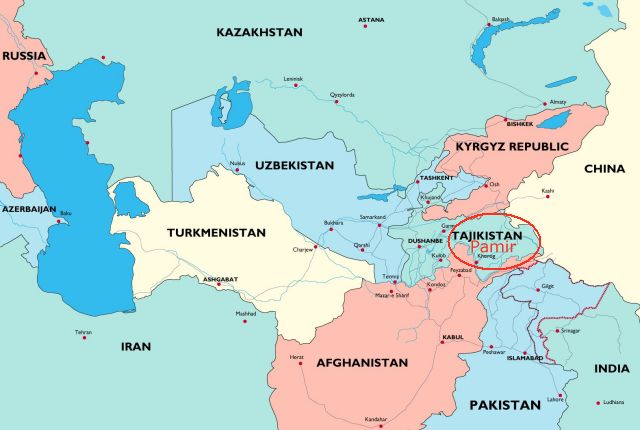
This picture was taken looking into Afghanistan from Tajikistan on the Pyanj River. The Pamir Mountains, which can be seen here, are formed by a junction in the Himalayas and are among the world’s highest mountains.


Do you have photos of a faraway place that few have seen & shared? Share them with us! Submit to our Flickr Pool and it could be the next Photo of the Day!

Mountainfilm Festival unveils 2010 line-up

Organizers for this year’s Mountainfilm Festival, scheduled to take place from May 28th through the 31st in Telluride, Colorado, have announced the line-up of films scheduled to be screened during the event. The list of films deal with some very diverse, and often provocative, subject matter, with topics ranging from the war in Afghanistan to the impact of plastic on our lives and the environment to the looming extinction crisis, and beyond. Whether you’re a budding climber, an active environmentalist, or just have a love of good cinema, you’re sure to find something in the line-up that well peak your interest.

The most well known film on the list is, without a doubt, The Cove, which made the rounds on the film festival circuit last year before going on to win the 2010 Academy Award for Best Documentary. The movie struck a chord with viewers and critics alike for its no nonsense, and often graphic, portrayal of the annual dolphin slaughter in Japan. The Cove returns for an encore showing at the Mountainfilm Festival this year after having a single, surprise screening last year.

Other intriguing films to make the cut include an intense and personal look at life on the front lines of the war in Afghanistan entitled Restrepo and a climbing film called Point of No Return that follows mountaineers Jonny Copp and Micah Dash on what would ultimately be their final climb. The festival will also mark the U.S. debut of The 10 Conditions of Love, a documentary about Rebiya Kadeer, an activist from the Chinese province of Xinjiang. Kadeer has been very vocal in her criticisms of the Chinese government, and as a result she was thrown in prison for more than six years. The film explores her activist lifestlyle and the toll it has taken on her family.

The films being screened at Mountainfilm are just one element of a very active weekend in Telluride. In addition to the movies, there is the Moving Mountains Symposium on the opening day of the festival. This year’s topic is the Extinction Crisis, and there will be a number of speakers on hand to discuss this very important subject. In fact, there will be great speakers attending the festival all weekend long, with the likes of Greg Mortenson, author of Three Cups of Tea and Ed Viesturs, America’s preeminent mountaineer, on hand to share tales of their adventures.

Passes are still available for the film festival in a variety of packages. Click here to check out the details. And for a complete list of the films that will be screened at Mountainfilm, click here.

One for the Road: Carl Hoffman’s “Lunatic Express”

Looking for escape and adventure, Carl Hoffman embarked on a journey to ride some of the world’s most dangerous transport, a trip that he recounts in his new book “Lunatic Express: Discovering the world… Via Its Most Dangerous Buses, Boat, Trains, and Planes” (Broadway Books). A bus through a mountain pass in South America, a crowded ship in South Asia, or an airplane in the Congo – if it had a high rate of fatal accidents, Hoffman sought it out and hopped on.

Though he uses the framework of “danger” as a hook, Hoffman’s story is less about safety and more about the human connections he makes as he chooses the type of transport almost no other traveler will. It’s no coincidence that the riskiest rides are also the cheapest, and he is pleased to discover that he connects to “a whole river of people on the move” – people for whom travel is a necessity instead of a holiday. Rather than danger, Hoffman encounters incredible discomfort; instead of being mugged, he finds he is protected by seatmates, shipmates, and new friends who are curious about his presence among them. In fact, his scariest situation is in Afghanistan, a war zone. There, it’s not simply transport that is dangerous, but his very presence in the country.

His exploration becomes, like so much travel, a search for authenticity and an examination of his own motivations. As a fan of second- (but not third-) class transport, I appreciate Hoffman’s experience off of the tourist trail (even when he’s technically on the tourist trail). He writes, “here, on these buses, I was anywhere but at the end of the earth; I felt right smack in its crowded heart.” This experience is where the value in his book lies.

His use of danger as the structure for his travels yields a fortunate, if not entirely unexpected result: the relationships he forms when crammed into the world’s lowest-class transport, which most travelers can afford to skip.

Travel often provides a clearer picture of the place we come from rather than the place we are visiting, and therefore it’s fitting that Hoffman’s most telling leg of the journey is the home stretch – a cross-country trip on a Greyhound bus from California to Washington DC. Dangerous? Hardly. Uncomfortable? Definitely. But the discomfort of a Greyhound bus, where seats are assigned, the roads are some of the best in the world, and there’s nary a chicken clucking from a box in the aisle, is an altogether different kind of discomfort than he experienced previously. In keeping with the “danger” theme, Hoffman dutifully mentions a recent beheading on a Greyhound bus in Manitoba, but true danger is absent in his trek. Instead, the sweaty, stinking, and seething mass of humanity in the developing world is replaced by the soulless, depressing experience of America’s penniless. Comparing the generosity and curiosity he witnessed in underdeveloped countries to his encounters with American counterparts, Hoffman writes, “we were a bus of lost souls in a country that itself seemed without a soul.” Gone is the fresh, bus station food, the kiosks replaced by “vending machines full of Snickers and Fritos and twenty-ounce blue energy drinks.” Everything, not just his traveling companions, feels empty back home.

Hoffman ends his journey as we all will at some point: alone. Though his words claim otherwise, Hoffman hints at the loneliness of the solo and long-term traveler, arriving to an empty apartment, unable to maintain his relationships, disoriented. He concludes tidily, happily even, though I wonder at his ability to ignore his travel addiction for long.
Shoot outstanding destination photos — with your iPhone

I used to think that the quality of a travel photograph was mostly hardware dependent, that a fancy Single Lens Reflex (SLR) or Four Thirds camera was critical towards capturing beautiful travel photos. Shots taken with my older, Canon SD300, for example, always seemed to be grainy, poorly lit and generally embarrassing to share among my friends and family. By contrast, my recent Canon Rebel XTi seems to take good photos irrespective of lighting, location or movement. Put enough monkeys in a room with a box full of SLRs, so they say, and the photos will turn out good eventually.

Application, I know now, is much of the battle. ISO speeds, megapixels, sensor quality and number of espressos consumed are all important variables in composing an ideal shot, and with enough training and tinkering, many cameras can produce a beautiful shot.

And then there’s the photographer’s eye, or simply put, skill. In a recent series for the Associated Press, photographer David Guttenfelder put together a stunning feature on the life of US armed forces in Afghanistan, shot solely behind the lens of his trusty iPhone. Yes, with 3 megapixels, no zoom, no flash and a tiny lens, Guttenfelder captured a series of photos better than all of the photos that I’ll ever shoot in my entire life. As it goes to show, talent, skill and composition are better than any hardware that money can buy.

Take a look at the series over at the AP website.

Want some more inspiration? Head over to our own Karen Walrond’s posterous blog for shots that she’s captured on her very own iPhone.

Afghanistan’s first skateboarding park, Skateistan


Two years ago, a couple of Australians started teaching kids in Kabul to skateboard. For free. The activity instills them with confidence and courage, and offers them what youths all over the world want: a way to escape. “Teenagers are trying to dissociate from old mentalities, and I’m their servant,” Oliver Percovich, one of the Australians, told the New York Times last January. “If they weren’t interested, I would’ve left a long time ago.”

Now, with the help of over $650,000 in private donations and land, water, power and security from the Afghan Olympic Committee (AOC), Afghanistan has opened its very first first skatepark, Skateistan. Skateistan is a 19,380 square foot indoor arena which contains a learning area at the back with classrooms for studying and computer use.

“We managed to bring together about 200 street children, this sport is not only entertainment for them, it is also giving them hope for their future,” said AOC head Mohammad Zahir Aghbar. Classes are still free, and the children of the rich and poor come together at Skateistan, many of them sponsored by the organization itself — Reuters reports that at least one child is able to skate and learn there instead of selling gum on the street because Skateistan pays her parents the $1 per day she used to earn.

Check out more information about the Afghan Stake School and how to get involved and/or visit at Skateistan.org.

[via Reuters]