Trans World Expedition: Driving around the globe

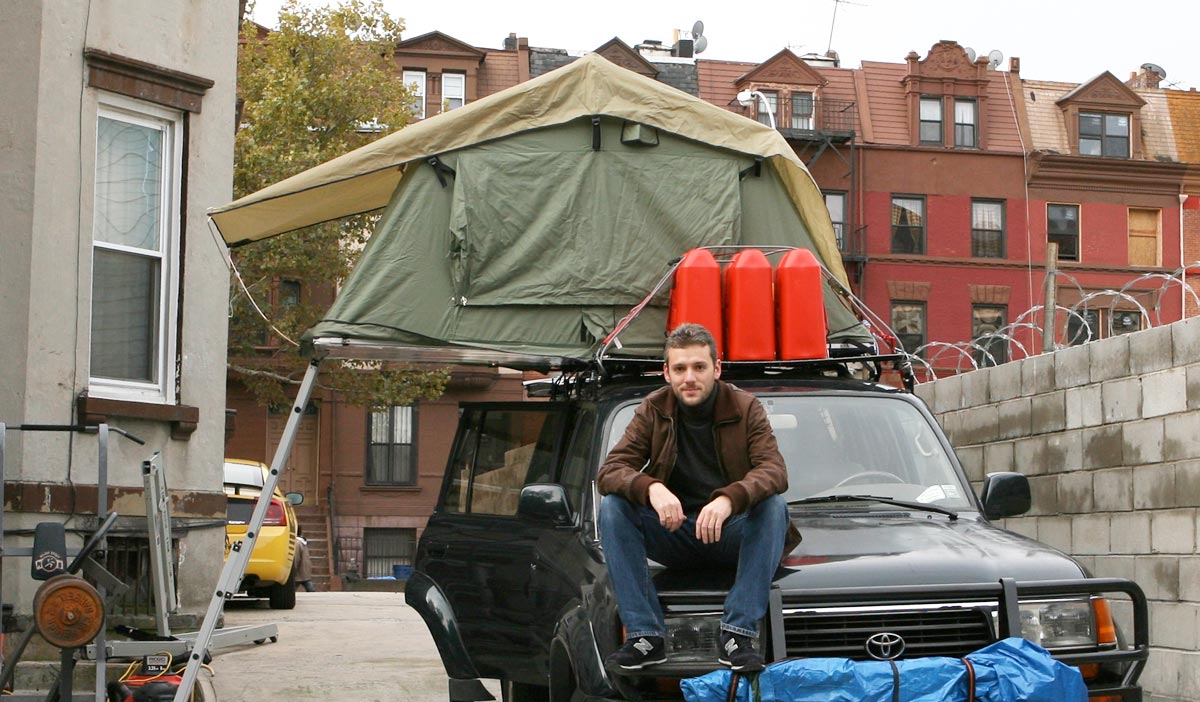
In a little over two weeks time, on November 15 to be exact, Nicolas Rapp will be setting out on an adventure of a lifetime. He’ll be quitting his comfortable job as an art director for the Associated Press, and setting out on a year long road trip, driving his way around the globe.
Nick’s route will begin and end in New York City. First, he’ll head south into Mexico, continuing down through Central and South America. Eventually he’ll ship his vehicle by boat to South Africa, where he’ll turn north and drive his way to Europe, before turning east across Asia. From there, he’ll once again ship his vehicle, this time across the Pacific, where he’ll then complete his expedition by driving across the U.S. back to New York City. You can review his entire route on his website by clicking here.

In order to complete this type of long distance driving journey, the intrepid traveler had to select the perfect vehicle. Nick elected to go with the Toyota Land Cruiser, which seems like the most logical choice. The rugged and powerful 4×4 is used all over the planet, which means finding parts for it should be easy, and it will perform well in nearly any type of terrain. In preparation for the journey, Nick upgraded the suspension, reinforced the bumpers, added a roof rack, and installed a storage system for all of his gear. He also added a rooftop tent to the vehicle which will give him a comfortable place to sleep each night, saving him money on accommodations as he goes.

Nick budgeted $46,000 for his year long adventure, which includes all of his supplies, costs for shipping the land cruiser, while flying himself, and a fund for emergency repairs. He’s also had to get a battery of vaccinations, as well as a number of travel visas, maps, and guide books as well. He admits that sticking to his budget will be one of the challenges along the way.

Fortunately for us, we all get to follow along with Nick on this journey. He’ll be posting updates and stories from the road at his website located at TransWorldExpedition.com. You can head over there now and read about his preparation for the trip and his final thoughts in the days leading up to the journey.

Good luck Nick! Enjoy the ride!

Cycling the Silk Road

Cycling tours have become increasingly popular in recent years, especially amongst adventure travelers who are looking to explore the world from the seat of their bikes. One of the leaders in organizing these kinds of adventure cycling trips has always been Tour d’Afrique Ltd, the creative minds behind such epic rides as their namesake Tour d’Afrique and the Vuelta Sudamericana. The company has even launched a website called DreamTours that allows us to design and plan our own cycling adventures, leaving all the logistics to their travel experts.

As if that wasn’t enough to keep us happily peddling our way around the globe, the Tour d’Afrique team is busily preparing for another long distance ride for 2010 that will cover the entire Silk Road, starting in Istanbul, Turkey and ending in Xi’an, China. The ride will cover more than 6650 miles over 16 weeks time, crossing through Iran, Turkmenistan, Uzbekistan, Kyrgyzstan, and Tajikistan, as riders follow one of the most famous and important trade routes of all time, a route that was also explored by such historical figures as Alexander the Great, Marco Polo, and Genghis Khan.

Some of the highlights of the journey will include passing through an amazing variety of landscapes, from including snow capped mountains and desolate open plains. Travelers will get the opportunity to camp below sea level in the arid deserts of the Xinjiang Province in western China, while also ascending to dizzying heights as they climb along the Pamir Highway in Tajikistan, which rises well above 15,000 feet, offering a challenge for both the heart and the legs. The ancient cities of Samarqand, Bukhara, and Merv will be stops along the way as well, offering refuge from the road and a chance to explore marketplaces that have been bustling with shoppers for centuries.


All told, this cycling tour will put riders in the saddle for a total of 92 days, covering an average of roughly 70 miles per day. There will also be 22 rest days, and one day of travel by ferry across the Caspian Sea, bringing the total number of days on the Silk Road to 114. That’s quite a commitment for any traveler, but fortunately the route is broken down into seven stages, so even if you can’t make the full ride, you can still have the opportunity to experience part of the adventure by riding one of those sections instead. The cost for the full trip is €8500, but the company is currently running an early-bird special that cuts €400 from the price when you book the trip before November 15th. Pricing for the individual stages can be found on this web page near the bottom.

The Silk Route Tour is an amazing cycling tour that combines culture, history, and adventure into one spectacular trip that is sure to be a life altering experience. The ride gets underway on May 22nd of next year, so get training now and prepare to join in on this once in a lifetime experience

Racing on foot through the Sahara

Last Sunday, an incredible endurance event got underway in Cairo Egypt, when the 2009 Sahara Race began. The 155 mile event pits 130 runners from more than 30 countries against one another in a six-stage race through the heart of the Western Desert, a part of the Sahara that covers more than 1.7 million square miles along Egypt’s borders with Libya and the Sudan.

Over the past few days, the runners have covered a variety of challenging stages ranging in length from 21 to 28 miles. In a sense, they are running a marathon each day, through the sand and heat of one of the hottest and driest environments on the planet. Along the way they passed through three or four mandatory checkpoints along the way, collecting water as they go. Upon completing the day’s stage, they camp in the desert for the night, resting up, and preparing for another run the following morning.

Today’s stage is the longest and most grueling however, with a 54 mile course dubbed the Black Desert March. The runners got underway at 4 AM this morning, and many will continue well into the night before they reach their next camp. If they complete the stage, they’ll finish up on Saturday, with a short run to the finish line at the Great Pyramids in Giza, capping the week’s events.

The Sahara Race is part of the 4 Deserts series of Ultramarathons, each of which take place on an annual basis. The other three events are held in the Atacama Desert of Chile, the Gobi in China, with the final race taking place in Antarctica, the largest desert on the planet. Each of the races offers its own unique challenges, pushing some of the world’s best endurance athletes to their limits in races against themselves and the environments around them.

New Hampshire museum dedicated to vintage camping

There once was a time when family vacations meant loading up the car and hitting the road for a camping trip that involved setting up a big canvas tent or parking a silver Airstream camper in a vaguely wooded area, and enjoying some time in the great outdoors. It was a simpler time, when mom packed sandwiches in a wicker picnic basket, or dad helped cook dinner by sliding a hot dog on to a stick that would be hovered over the fire for an indeterminate time.

Fortunately, that era isn’t completely lost to us thanks to the Museum of Family Camping located in Bear Brook State Park in Allenstown, New Hampshire. The museum was the brainchild of one Roy Heise, who first proposed such a site back in 1990. Heise spent years collecting all manner of camping gear starting with his years with the Boy Scouts and extending to his later life, when in 1955 he opened the first public campgrounds in New Hampshire. Heise’s collection became the launching point of the museum when it finally opened its doors back in 1993, and since that time, the number of items on display has risen to more than 1500.

This slice of camping Americana begins with the building itself. The museum is housed in a wooden bunkhouse that dates back to the 1930’s, with several 50’s era campers flanking it on either side. Moving inside, you’ll find all manner of vintage gear, including old lanterns, coolers, tents and sleeping bags. There is even a full campsite set up in a manner of the time period, that gives us an indication of just what “roughing it” meant in bygone years.

As if all that old gear wasn’t enough of a draw, the museum is also home to the Family Camping Hall of Fame, which includes such luminaries as Teddy Roosevelt, L.L. Bean, and Roy Heise himself. One wall inside the old log cabin is filled with plaques dedicated to memorializing those that made camping fun and adventurous for families everywhere.

The museum is a perfect walk down memory lane for those who have fond memories of camping with the entire family, but modern campers will get a kick out of it too, as they realize how much their gear has evolved and changed over the years. If you’re ever in Allenstown, stop by to see how camping in the U.S. has changed over the years and be glad that our tents now weigh a third of what they once did and our campfire dinners have improved immeasurably.

Classic Treks: The Continental Divide Trail

When it comes to long distance treks, the U.S. is blessed with not one great hike, but three. Most people already know about the Appalachian Trail in the eastern part of the country and the Pacific Crest Trail in the west, but the third jewel of the trekking Triple Crown is the Continental Divide Trail, which just might be the most scenic and challenging of all.

The CDT stretches for more than 3100 miles from the border of Canada at the northern end to the Mexican border in the south. In between, it runs through Montana, Idaho, Wyoming, Colorado, and New Mexico, as it winds its way through some of the most rugged and remote mountain regions in the United States, including the San Juans, the Sawatch Range, and the Tetons, amongst others.

The trail derives its name because it runs directly along the Continental Divide, which marks the barrier between the Pacific and Atlantic Ocean drainage basins. To one side, all the rivers run west to the Pacific, while on the other, they turn east toward the Atlantic. The Rocky Mountains, running from northern Canada, down through the U.S. create this effect, and serve as a dramatic backdrop to this long distance hike.Unlike the Appalachian Trail and the Pacific Crest, the CDT is not quite complete yet. Right now it is constructed of a number of smaller trails and roads that are interconnected, and while hiking those paths, the difficult can range from a moderate to strenuous hike, with altitude playing a role in the challenge. There are some areas however where the trails do not meet, forcing trekkers to bushwhack their way through rugged backcountry. The CDT also happens to be longer than those other two trails, stretching nearly a thousand miles further in length than the Appalachian, and more than 450 miles longer than the Pacific Crest. Add more elevation gain to the mix, and you’ll begin understand why this trail is held in such high regard.

Due to the very rugged, and remote nature of the CDT, there are fewer thru-hikers then there are on the other long distance trails in the U.S. It takes roughly six months to cover the entire distance, and various segments provide different, and very unique challenges. For example, in the south, along the leg that runs through New Mexico, there is little water to be found, forcing hikers to bring plenty of their own, although local hiking groups do supply water caches at strategic points along the way. In contrast, at the northern end, in Montana and Idaho, trekkers may find plenty to drink, but will instead be dodging grizzly bears and gray wolves.

While the Continental Divide Trail may be the forgotten leg of hiking’s Triple Crown, it is spectacular none the less. The trail is less crowded than its companions, offers more challenges, and is more rugged and remote too. For those that have already completed the AT and the PCT, the lure of the CDT is too much to pass up, and they find that it is worth the hike, and quite possibly surpasses those other two trails in nearly every way.