When Condé Nast comes out with a readers’ poll, cruise travelers worldwide take notice. To be mentioned near the top of their list is a sought-after award worth bragging about. In the February edition of Condé Nast Traveler, Disney Cruise Line found plenty to be proud of as three of their four ships ranked in the top three places in the large cruise ship category.
Beating out Celebrity Eclipse and Celebrity Equinox to round out the top five, classic Disney Cruise ships Disney Magic and Disney Wonder took the first and second spots, respectively, followed by 2011’s Disney Dream in third place.
“With four ships in our fleet, more families than ever before can set sail on a Disney Cruise Line vacation filled with imaginative fun for the kids and exciting family time for all,” said Karl Holz, president of Disney Cruise Line in a SILive report. “We’re thrilled that the experiences our cast and crew members deliver at sea continue to be recognized as outstanding by our guests.”
Interestingly, it was Disney Cruise Line’s two older ships, Disney Magic and Disney Wonder that took top honors followed closely by 2011’s Disney Dream with the latest, greatest version of what Disney does at sea, Disney Fantasy trailing in eighth place. Not that eight place is bad mind you – just not quite as magical.
Here are all top ten in the large ship category. Click on any of them for more information from Condé Nast.
Andrew Zimmern insists that yak penis “melts in your mouth.” The author, chef and host of the Travel Channel show “Bizarre Foods” also claims that delicacies like snake and deer penis, live frog heart, lizard sake, cow placenta, squirrel brain, sugar cane rat, wildebeast eyeballs and fried tarantulas are all perfectly edible, if not downright delicious. In Madagascar, Zimmern witnessed a circumcision ritual in which the foreskin was eaten, and, though he estimates he’s eaten 60-70 types of animal penis and testicles, he says he draws the line at eating human flesh (see videos below).
Zimmern, 51, is a native New Yorker and graduate of Vassar College who struggled with drug and alcohol addiction in the early ’90s. He was homeless for a year and fed his drug habit by snatching purses and selling the credit card numbers and passports he found. With the help of friends, he moved to Minnesota, got clean, and turned his life around as a chef.
Zimmern claims he’s never gotten sick from any of the bizarre foods he’s eaten and he’s on a mission to get Americans to expand their culinary horizons. In the new season of the show, which premiers on February 11, he’ll feast on baked muskrat, deep fried pig testicles and fermented fish eggs, among other treats. We caught up with Zimmern to ask him how he stomachs all the crap he puts down his gullet.
I’ve seen you eat some ridiculous things over the years but find it hard to believe that the one food you dislike is walnuts?
Don’t I get to not like something? I just think they’re soapy and gross. I just can’t stand them.
Are there other foods you won’t eat?
That’s it!
But, some of the things you eat just boggle my mind. In Goa, for example, you drank cow urine and ate a fish that hadn’t been refrigerated for more than a year (see video below). What were you thinking?
Terrible, I know.
Does your producer ever suggest something so vile that even you say, ‘No – I am not eating that!’
It’s extremely rare. There’s nothing that happens in the show that I don’t either create or vet or both. I’m usually the one who finds foods in the field and says, ‘We’ve got to include this.’ This show is driven by my curiosity and desire to interpret cultures through food. It’s not driven by a producer saying, ‘This sounds really gross, let’s use that.’ If there is no cultural relevance to something, if it’s just thrill seeking eating, it’s not in our show.
In this upcoming season, you’ll be sampling deep fried piglet testicles, among other things. How were those?
Testicles of animals are delicious. The larger the animal the faster they need to get from the clip into the frying pan. Smaller testicles – roosters, ducks, geese, vermin – are very, very delicate and creamy and are easier to keep fresh. Pig’s balls are great. An animal’s testicles are just another piece of meat that can be cooked the right way and taste very good or cooked the wrong way and they’re not.
You ate those pig balls at a fair in Iowa?
No, we were on a pig farm, Rustik Rooster, in Iowa. Certain breeds of pigs if you let them grow too big with their testicles attached, the meat will develop a gamey flavor as the animal matures. So when the piglets are young, they snip the testicles. We cleaned them, soaked them in a brine, and then breaded and deep-fried them. They were delicious.
You visited a restaurant in Beijing that specializes in animal penises (see video below). How was that?
We used to be able to eat everything because whole animals went into butcher shops but we’re returning to that in some parts of the country. Ten years ago, you couldn’t buy pig livers or lamb kidneys, for example, and now you can. There’s a renewed interest in snout to tail eating and people are understanding that if we are going to eat meat, we need to eat the whole animal to be environmentally sustainable, and people are seeing how delicious that can be as well.
Americans are pretty much the world’s wimpiest eaters aren’t we?
Extremely so. Not even close.
I wonder if your show has turned people on to some funky foods they otherwise wouldn’t have tried?
It’s hard to say ‘yes’ without sounding like a douchebag but yes, you’re right. The show has been on since 2007. I had been trying to sell this idea well before that. I am extremely proud of what we’ve been able to contribute to the national conversation about food. The show has had a positive impact on helping to remake taste here in America.
Your show is the only one my 5-year-old son and I can agree on.
You should buy him my book. My son is 8 and all the 5-year-old kids in our neighborhood just devour it. No one counted on “Bizarre Foods” being as popular with kids and families as it has been. There are very few shows that a mom, dad, 5-, 10- and 15-year-old can sit down and enjoy together. “Bizarre Foods” is one of them and I’m very proud of that.
My favorite moments on the show are those very rare occasions when you find something that even you can’t stomach. Durian is one of those really challenging foods, right?
There are a lot of foods I have a hard time with. Sometimes I speak in code on camera because I’d rather be a good guest, not this TV guy who is making fun of people who are trying to accommodate, entertain or inform us.
Tell us about a few of the things that have been very hard to swallow?
Lots of things, from fermented skate wing in Korea to fresh animal blood, even little things like eating fresh milk right from a cow, donkey, horse, a reindeer, or a camel. Warm, foamy milk out of an animal’s teat is not how people are used to drinking it. There is a mind over matter aspect to this that is always difficult to deal with. But the practice of tasting and acquiring knowledge allows you to say, ‘that’s not that bad’ and then you get pleasant surprises that I think make for a very interesting eating life. Because I’m most often pleasantly surprised, I’ve learned that you really need to try things.
I can’t recall ever seeing you spit something out. You swallow just about everything, right?
I always do. I can count maybe two or three items I spit out. One was a snack food on the streets of New Delhi that was made with putrid water that I knew would make me sick. Another occasion was in the Philippines when someone offered me a rotten chicken intestine that was raw. In the pilot, I spat out my first taste of durian, which was just horrific. And I learned a valuable lesson.
The orchard manager was so hurt because he was so proud of his country’s favorite fruit. It was quickly smoothed over, but I realized that I wanted to accomplish my goal of broadening peoples’ minds and open them up to the idea that we could share ideas about our differences and resolve them if we could talk about our love of food. And I couldn’t accomplish that goal if I was spitting things out.
I hear you, but there’s no way I could swallow some of the things you eat. Bat, for example. How do you eat a bat?
I ate grilled bat in Thailand and Samoa. I loved it! [In Samoa] there was a giant fruit bat; I shot it out of the sky while standing underneath a breadfruit tree.
You’ve traveled to more than 100 countries, many of them pretty tough places. Watching the Suriname episode, that looked like the hardest travel experience. Was it?
Not enough close – it was by far the most strenuous travel experience. The entire experience was absolutely brutal. We travel with a crew and they need a clean place to sleep and regular meals. I love eating a fried turtle stew or wild pig liver in the jungle, but the crew needs to be looked after in a different way and Suriname was extremely hot, hard living. We had a 52-kilometer hike over a 30-hour period through virgin rain forest. It was extremely brutal.
A little over 20 years ago, you were a homeless drug addict in New York. Could you have envisioned then that you’d be able to turn your life into a success story?
Never in a million years when I was a homeless addict and alcoholic living on the streets in 1990 and 1991 did I think that I would get sober or live to see my 31st birthday. I was scooped up off the streets by friends who did yet again another intervention on me. [They] put me into a treatment facility in Minnesota and I’ve been sober ever since. That is the greatest blessing of my life. That I’m alive is good enough but the fact that I’m in a position to have the type of life that I do is extraordinary and it’s why I place so much emphasis on giving back to the community because my gratitude is immense. I’m the luckiest person in the world.
Have you ever landed in a place to find out you arrived just after the town’s can’t-miss event of the year? Well, hopefully that won’t happen again this year. Gadling bloggers racked their brains to make sure our readers don’t overlook the best parties to be had throughout the world in 2013. Below are more than 60 music festivals, cultural events, pilgrimages and celebrations you should consider adding to your travel calendar this year – trust us, we’ve been there.
Above image: Throughout Asia, Lunar New Year is celebrated with lantern festivals, the most spectacular of which is possibly Pingxi. [Photo credit: Creative Commons]
Kumbh Mela, a 55-day festival in India, is expected to draw more than 100 million people in 2013. [Photo credit: Creative Commons]
Many Dutch people wear orange – the national color – and sell their secondhand items in a “free market” during Koninginnendag, a national holiday in the Netherlands. [Photo credit: Creative Commons]
Up to 50 men work together to carry their church’s patron saint around the main square in Cusco, Peru during Corpus Christi. [Photo credit: Blogger Libby Zay]
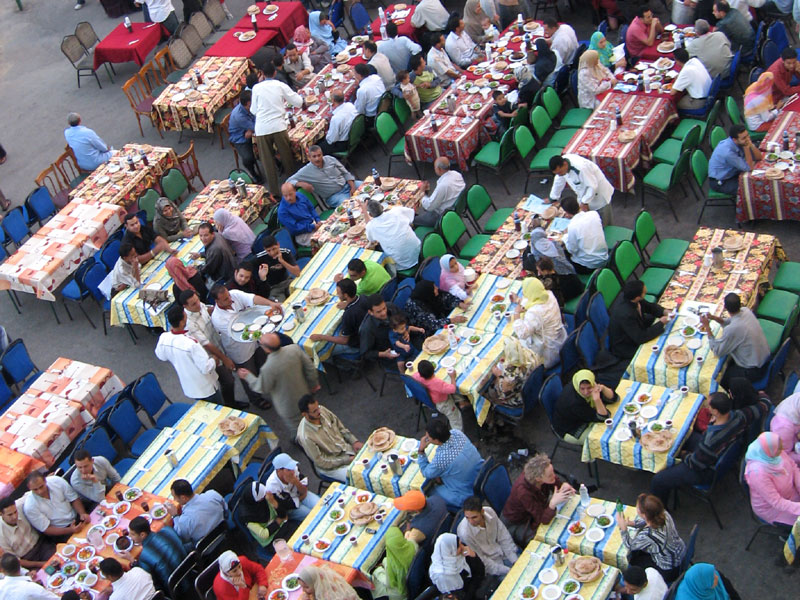
The annual observance of Ramadan is regarded as one of the Five Pillars of Islam. Visit Istanbul, Turkey, at this time and see a festival-like atmosphere when pious Muslims break their fasts with lively iftar feasts at night. [Photo credit: Creative Commons]
July 12–14: Pitchfork (Chicago, Illinois)
July 17: Gion Festival Parade (Kyoto, Japan)
July 18–21: International Comic Con (San Diego, California)
July 19–22: Artscape (Baltimore, Maryland)
Festival-goers get their picture taken at a photo booth during Foo Fest, an arts and culture festival held annually in Providence, Rhode Island. [Photo credit: Flickr user AS220]
August
August 2–4: Lollapalooza (Chicago, Illinois)
August 10: Foo Fest (Providence, Rhode Island)
August 26–September 2: Burning Man (Black Rock Desert, Nevada)
August 31–September 2: Bumbershoot (Seattle, Washington)
More than six million people head to Munich, Germany, for beer-related festivities during the 16-day Oktoberfest. [Photo credit: Creative Commons]
During Dia de los Muertos (Day of the Dead), family and friends get together to remember loved ones they have lost. Although practiced throughout Mexico, many festivals take place in the United States, such as this festival at La Villita in San Antonio, Texas. [Photo credit: Blogger Libby Zay]
A new year isn’t just the time to look ahead, it’s also the time to look back and commemorate. 2013 marks plenty of centennials, from the birth of civil rights activists to metro lines. Here is your chance to not only explore new destinations, but also learn a little bit about the past with a list of places that all have something worth celebrating this year.
If you’re looking to help celebrate a few centennials in 2013, look no further.
Glacier Park Lodge, Montana, USA
Opening to guests on June 15, 2013, the Glacier Park Lodge has become a focal point of the park. Built on the Blackfeet Reservation, the land was purchased from the Piegan, a tribe of the Blackfeet Nation, and at its opening, hundreds of Blackfeet Indians erected teepees around the lodge. Today it features 161 rooms and can accommodate up to 500 people.
National Museum of Fine Arts, Cuba
Located in Old Havane the National Museum of Fine Arts houses both a Cuban specific collection as well as a universal one, including ancient art from Egypt, Greece and Rome. The museum is a UNESCO World Heritage Site.
Tour de France, France
One hundred years of mountain stages, yellow jerseys and champagne finishes, Tour de France 2013 should be a momentous occasion. The centennial edition kicks off in Corsica on June 29, and in an attempt to celebrate the beauty of the country that is its namesake, the route is 100% in France, the first time in 10 years. Washington State Parks, USA
If there ever was a time to take advantage of the outdoors in the Pacific Northwest, it’s this year. For Centennial 2013, explore the state’s extensive network of beautiful spaces, complete with yurts, rustic cabins and the occasional mountain goat.
Metro Line 8, Paris, France
Serving some of the City of Light’s most iconic stops like Invalides, Opera and Bastille, Métro Line 8 was the last line of the original 1898 Paris Metro plan. Opened on July 13, 1913 (one day before French independence day), it is the only Paris underground line to cross the Seine and the Marne above ground, via a bridge.
Grand Central Terminal, New York, USA
An iconic hub of travel, Grand Central Terminal in New York City is known for its Beaux-Arts architecture, and the pure romanticism of adventure that it induces. After almost a decade of renovation, on opening day on February 2, 1913, it welcomed over 150,000 people from all over the city. It’s no surprise that Grand Central Terminal has a year of events planned, and maybe it’s time we all took a commemorative train ride.
Soccer fields, USA The U.S. Soccer Federation is celebrating its 100 years on the field with a variety of events throughout the year, but a special emphasis will be on the U.S. Women’s National Team’s matches, and the U.S. Men’s National Team’s campaign to qualify for the 2014 FIFA World Cup, which means for soccer fans, there are plenty of places around the country to celebrate.
Konzerthaus, Vienna, Austria
Home to the Vienna Symphony, the Konzerthaus is a hub of classical music. With a goal of emphasizing both traditional and innovative music styles, it hosts several music festivals a year. In a season it hosts over 750 events, resulting in around 2,500 compositions.
Rosa Parks Museum, Montgomery, Alabama, USA
Civil rights activist Rosa Parks would have turned 100 this year, and in her honor the Rosa Parks Museum is coordinating the Rosa Parks 100th Birthday Wishes Project. They have been collecting words and inspiration from visitors and 1,000 will be chosen from the Montgomery area and 1,000 from around the state and country. Take part in the celebration on February 4, Parks’ birthday.
Bangladesh National Museum, Bangladesh
One of the largest museums in Southeast Asia, the Bangladesh National Museum started out as Dhaka Museum in 1913. Besides the standard collections of archaeology, classical art and natural history pieces that national museums are traditionally known for, it also illustrates the freedom struggle that ended in the liberation of Bangladesh.
Museo Teatrale alla Scala, Milan, Italy
Attached to the famous Scala Theater in Milan, the Museo Teatrale alla Scala holds over 100,000 works that relate to history, opera and ballet. In the hallways you’ll find musical instruments and portraits of great singers to have graced the theater. A must for any classical music or opera lover.
Edinburgh Zoo, Edinburgh, Scotland
The 82-acre Edinburgh zoo, is home to the UK’s only Giant Pandas, which are a huge hit with locals. They also have a Squirrel Monkey cam for your viewing pleasure. With over 1,000 animals, the zoo has an extensive list of activities to celebrate its 100th year.
Karachi Race Club, Pakistan
You rarely hear of people traveling to Pakistan for the horses, but the Karachi Race Club has now been attracting racing fans for a full 100 years. The biggest racecourse of Pakistan, seven to ten races are held at Karachi Race Club every Sunday.
Konzerthaus, Vienna, Austria
Home to the Vienna Symphony, the Konzerthaus is a hub of classical music. With a goal of emphasizing both traditional and innovative music styles, it hosts several music festivals a year. In a season it hosts over 750 events, resulting in around 2,500 compositions.
Line A, Buenos Aires, Argentina
Opened to the public on December 1, 1913, Line A was the first line of the the first working subway system in the southern hemisphere. Today it is used by over 200,000 people a day. Until recently, some of the line’s original La Brugeoise trains were still in use, but are now slated to be replaced by more modern day cars, and the line itself is set for reconstruction in mid-January.
I was recently researching Little Corn Island, Nicaragua. I instantly became charmed by the island and obsessed with the idea of visiting it as soon as possible. But it’s difficult to find footage online featuring the tiny island. Situated 43 miles east of Nicaragua’s Caribbean coast, the island only encompasses 1.1 square miles. The island’s highest point is only 125 feet. Little Corn Island is a beautiful little dot on the map, populated largely by English-speaking Creole people. This video captures the island so far the best of any I’ve seen, and I have a feeling it still hardly does it justice.