Video: One Day In Yosemite National Park

On June 26 of last year, 30 filmmakers descended on Yosemite National Park to take part in a very interesting project. They spread out across the park’s 761,000 acres in an effort to capture the essence of a single day in that iconic place. They shot footage of the landscapes, wildlife, visitors and staff. They managed to record images from that day that were both sprawling in scope as well as intimate and personal. And at the end of the day, everything they captured on film was turned over to Steven Bumgardner, the park’s official videographer, who compiled everything into the stunning short film that you’ll find below.

Ever wondered what a day in Yosemite is like? Watch the video and find out. Enjoy!


The Best Of The West: Classic Ski Lodges

Despite deceptively balmy temperatures in parts of the U.S., there’s still plenty of ski season left. Why not spend it staying at a classic ski lodge or chalet out West? These regal or groovy remnants from the early-to-mid-20th century are a dying breed, although some have been refurbished to good effect, while still retaining their original style. They also tend to offer friendly, personalized service, so you feel like a welcome guest, not just a number.

Classic places are often more affordable, and just as stylish and comfortable than their boutique or generic high-end chain counterparts. Even when they’re pricey, they’re a bit of living history that can give your ski trip a fun retro feel. Think racy Piz Buin and Lange boots ads, fondue, tight, color-blocked sweaters, Bicentennial Ray-Bans, and all things Bavarian.

Below, some favorite vintage ski accommodations across the West. Don’t forget your Glockenspiel.

Tyrolean Lodge, Aspen, CO
It may come as a shock that Aspen has a classic ski lodge that’s remained little-changed in atmosphere or ski-town spirit since its opening in 1970, but the Tyrolean is just that place. Located several minutes’ walk from the slopes, this no-frills, family-owned chalet is one of the best deals in town, with rooms starting at $155/night; some with kitchenettes. The rooms have been upgraded to be more modern, but the decor and vibe is still vintage Tyrol ski culture. Love.

Tamarack Lodge
, Mammoth Mountain, CA
This small, mid-century property overlooking Twin Lakes is on the California Register of Historic Places, and caters to the cross-country crowd. It has both European guesthouse style rooms, historic, refurbished cabins (see photo above), and from December through April, ski-in/out access. If the town of Mammoth is too hectic and soulless for you, consider this a peaceful alternative to the mainstream.
Strawberry Lodge, Kyburz, CA
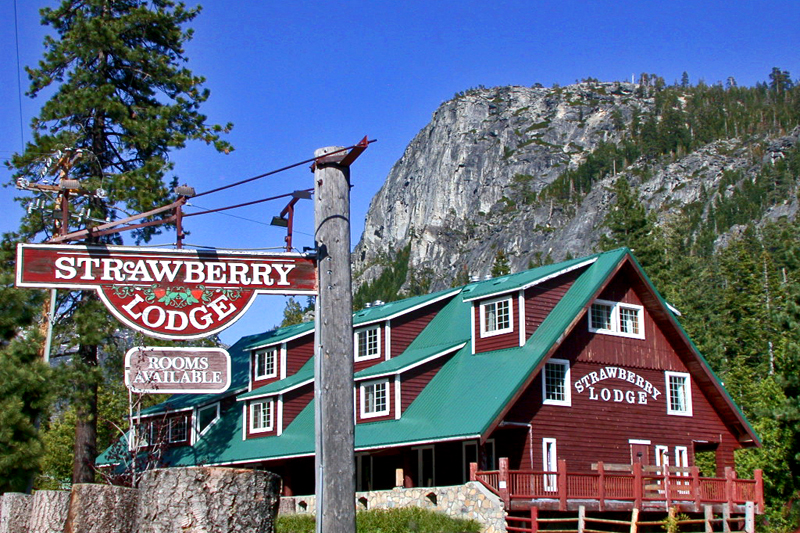
Highway 50 Tahoe road-trip regulars will be familiar with this former Pony Express stop (right). Located off the side of the road in the nano-community of Kyburz, Strawberry is 20 minutes from South Shore. It’s seriously old-school, in that musty, funky way, with bad taxidermy, historical oddities, and is a much-loved Lake Tahoe institution.

With 31 rooms starting at just $49 a night (some are European style, with a shared bath), it’s hard to pass up, especially when you consider the proximity to all manner of vices, ranging from drinking (please don’t attempt to drive back) and gambling, to outdoor recreation. I love it because it’s one of the last remnants of old Tahoe, in a pastoral mountain setting. Strawberry also offers cross-country skiing, and the restaurant and bar can get hopping, sometimes with live music.

Sun Valley Lodge, Idaho
Built in 1936 at America’s first destination ski resort (with the world’s first chairlifts), the SVL was considered cutting-edge. It offered “every amenity a skier could possibly imagine.” Today, the 148-room property has been completely refurbished into a luxury hotel, complete with glass-encased swimming pool, yet it retains its majestic timber-and-stone facade and stately atmosphere.
P.S. Hemingway slept here.

Timberline Lodge, Mt. Hood, OR
Celebrating its 76th year, this National Historic Landmark (lobby, right) was built at a time when American heritage and the spirit of adventure crashed head-on with the Great Depression. FDR heralded the lodge as a “testament to the workers on the rolls of the Works Progress Administration,” which funded most of the property’s construction. The lodge shut down twice, once during WWII, and again in 1955, as it had fallen into disrepair. Under a new lessee, it was restored to grandeur and reopened later that year.

Located less than 90 minutes from Portland, Mt. Hood is a favorite local’s ski area. Timberline is built in the classic Pacific Northwestern lodge style, constructed primarily by hand of native timber and rock. The bright rooms are upscale rustic, with wood paneling, thick comforters, and stone fireplaces: all the trappings for a cozy getaway.

Alta Peruvian Lodge
, UT
Located at one of Utah’s premier ski resorts, this three-story wooden lodge had an unlikely start as a pair of barracks buildings in Brigham. They were relocated to Alta in eight pieces, and reconstructed into a 50-room lodge that opened in 1948. In 1979, an architect was hired to gussy up the property, although by today’s standards, it retains a retro Alpine charm (the kelly-green shutters decorated with Edelweiss, for example).

Rooms are straightforward and more motel than mountain lodge, but a fantastic deal, starting at $129 for a dorm bed. Prices include all meals, served family style in the lodge dining room, and free shuttle service to Alta Mountain and Snowbird. There are also twin and queen rooms with a shared or private bath, as well as bedroom suites. As for why the property is called the Peruvian? No one knows, although possibly it’s for a nearby landmark, Peruvian Creek.

Nordic Inn, Crested Butte, CO
Reopened on December 15, 2012, under new ownership, this beloved, 28-room Alpine lodge (right) opened over 50 years ago. Located just 500 yards from the slopes, the Nordic has refurbished half of its spacious rooms, which are now kitted out with hardwood floors, down comforters and pillows, and gorgeous Colorado beetle kill pine woodwork. The remaining rooms (which are a colorful ode to the ’80s, and a screaming deal for ski-in lodging) will be redone by June 1.

P.S. Ski lodges aren’t just for winter! Many are open year-round, and summer is also peak season for outdoor recreation.

[Photo credits: Tamarack, Mammoth Mountain Ski Area; Strawberry, 50Cabins.COM; Sun Valley, Sun Valley Resorts; Nordic Inn, Ken Stone]
Gadling Gear Review: Brooks Range Mojave Waterproof Down Jacket

Anyone who enjoys cold weather adventures probably already knows that down is the best insulator for keeping us warm when the mercury begins to drop. Lightweight and comfortable, down can be used in a variety of products that help us enjoy the great outdoors, even in extreme conditions. But the material has a major flaw that has, at times, limited its usefulness in the past. When down gets wet, it tends to clump up and lose its loft. Worse yet, in cold conditions wet down will freeze solid and become practically useless. That has all changed with the introduction of a revolutionary new water repellant down called DownTek, which is just now making its way into a number or new products.

One of the first products to hit the market that uses DownTek is the new Mojave Jacket from Brooks Range Mountaineering, a company that specializes in creating gear for extreme environments and activities. The jacket features 800+ fill wrapped in durable, weather resistant fabrics and includes an attached hood and high-quality zippers designed for use in cold, wet conditions. In short, it is the perfect jacket for mountaineering, snowshoeing, cross country skiing or nearly any other cold weather activity.

The Mojave was built with active outdoor enthusiasts and travelers in mind and its design reflects this. Some down jackets can be overly bulky and hamper movement, which makes them less than ideal choices for some of our more active pursuits. But Brooks Range knows that its customers are looking for products that will allow them to hike, backpack and climb without restrictions so their products are built to support those activities. The result is a jacket that performs amazingly well while still providing nearly unrestricted motion while on the trail.Of course, all of this doesn’t mean very much if the jacket, and more importantly DownTek, doesn’t perform as advertised. Fortunately, that isn’t an issue here, as the Mojave provides everything you would expect out of a down jacket and so much more. The water resistant fill is simply a revolution in terms of cold weather gear, making this garment far more versatile and reliable than similar products that don’t use this new type of down. Better yet, the same process that makes the down fill water resistant also adds anti-microbial and anti-bacterial properties, ensuring that even after it gets wet, the jacket remains clean and odor-free, something that any traveler can appreciate.

Those aren’t the only qualities that will make this jacket popular with travelers heading to cold weather destinations. In addition to the Mojave being very warm and comfortable, it is also highly packable. Unlike similar products from competitors, Brooks Range has created a jacket that can be compressed down to a relatively small size so at to not take up much room in your luggage or backpack. That is much appreciated by those of us who like to travel as light as possible without compromising on the performance of our gear.

It isn’t often while testing a product that I realize it is a significant leap forward in terms of performance, but that is exactly what the Mojave represents. DownTek gives this jacket, and the other products that it is being used in, properties that standard down simply can’t compete with. It does add a bit to the price tag of course, but as far as I’m concerned, it is worth every penny. The Mojave costs $299, which isn’t dramatically more expensive compared to similar products without the water-resistant down, but it is more expensive nonetheless.

If you’re the kind of person who wants a down jacket for keeping you warm while you run errands around town or shovel the sidewalks in front of your home, then a standard down jacket may completely fulfill your needs and expectations. But if you happen to be an active outdoors enthusiast or traveler, you shouldn’t settle for a product that doesn’t perform as well as it could. With the Mojave you won’t have to make those compromises and you’ll have a jacket that will keep you plenty warm and dry no matter how bad the weather gets.

80-Year-Old Sets Sights On Everest Summit

Eighty-year-old Japanese skier and mountaineer Yuichiro Miura has announced his intentions to attempt a summit of Mt. Everest this spring, returning to a mountain that made him famous back in 1970. If successful, Miura would become the oldest person to ever climb the mountain and the first octogenarian to do so.

This won’t be Miura’s first visit to the world’s tallest mountain. He first climbed it back in 1970, stopping short of the summit because he had another goal in mind. As an accomplished high alpine skier, Miura had traveled to the Himalayan peak in an attempt to become the first person to ski down its slopes – something that had previously been unthinkable. But the Japanese man, who was 37 at the time, achieved his goal and inspired the Oscar-winning documentary “The Man Who Skied Down Everest.”

After completing his quest to ski the Seven Summits – the tallest peaks on each of the seven continents – in 1985, Miura then chose to lead a quieter life for some time. But as he grew older, the Himalaya called to him once more and in 2003 he declared that he would return to Everest, this time to climb all the way to the summit. He was 70 years old at the time and when he was successful in his attempt, he became the oldest person to accomplish that feat. He would return five years later to scale the mountain again at the age of 75 and staying on his five-year schedule he is returning this year as well.

At the summit of the 29,029-foot mountain, the air is so thin that it’s roughly one-third of what you find at sea level. That’s enough to make climbers half Miura’s age gasp for air while their legs scream out in exhaustion. The 80-year-old says that he’ll need to regain the strength and energy of a much younger man if he hopes to be successful. He describes his quest for a third summit of the mountain as the “best anti-aging” activity that he knows.

The spring climbing season on Everest begins in early April and will run into June. We’ll know then if it is possible for a man who has passed his 80th birthday to climb such a daunting peak.

[Photo Credit: KYODO]

Food And Wine Bike Tours Visit Italy’s Dolomite Mountain Range

Food and wine may already be an embedded focus of vacation plans for many travelers. It’s not something to put on a to-do list, pencil in on an itinerary or even think all that much about when traveling. But maybe it should be. Travel companies feature and package food and wine bike tours in sizes that fit just about anyone and in 2013, there are plenty of them.

Discovering and experiencing unique cuisine around the world can make for rich, vivid travel memories. Tasting a wine in the region it was created can make us fans of a label for life.

ItaliaOutdoors Food and Wine is a private guide service that creates biking, skiing and hiking adventures with world-class culinary programs. Last year, in Bike Tour Cycles Through Culture, Food In Italy, Gadling shared information about ItaliaOutdoors‘ Summer Chefs On Bikes Tour. That seven-day, June 2012 event took cyclists on one of the former trade routes that distributed spices and goods from the East throughout Western Europe.

This year, ItaliaOutdoors has several bike tours through the Dolomite mountain range in northeast Italy, starting this spring. Each tour is a challenging climb and riding exploration that gets up close and personal with Italy’s rich culinary heritage.

Train Like a Local – May 26 to June 1, 2013
As close to a beginner/intro bike tour as one might get, this one focuses on climbs ranging between 900 and 1700 meters in the foothills of the Dolomites. Train Like a Local prepares cyclists for more challenging climbs in the upper Dolomites and the Alps. Along the way, group members sample regional cuisine and discover local wines unknown beyond the area.
The tour repeats September 1-7, 2013.The Agony and the Ecstasy tour – June 9 to 15, 2013
For more experienced cyclists, this tour brings one of the hardest climbs in northeast Italy. Designed for cyclists who have trained hard and are ready for difficult climbs, this tour features the regions of Veneto, Trentino-Alto Adige and Friuli Venezia, with stops to sample and savor local delicacies such as prosciutto, homemade gnocchi and grappa.

The Classic Climb tour – July 7 to 13, 2013
Adventure travelers will like that this tour traces a path through the heart of the Dolomites, combining little-known passes with the rigorous bike climbs that have made the region a sought-after destination for cyclists. Experiencing the blend of Italian and Austrian/Germanic cultures that define the region, expert cyclist and mountain guide Vernon McClure and cooking instructor and chef Kathy Bechtel, also an avid biker, will be along for the ride. The tour repeats September 8-4, 2013.

Limiting groups of 12 people or less, ItaliaOutdoors makes daily customization and refinement changes to itineraries, based on participants’ interests, pacing and real-time finds along the way.

ItaliaOutdoors also features private bike tours where a custom trip is planned and your tour is personally led by their owner/expert guides, as we see in this video:


Other sources for cycling tours include the Bike Tour Network, BackRoads and Bike Tours Direct.

[Photo Credit-Flickr user will_cyclist]