Medieval monasteries on Lake Tana, Ethiopia

The Christian communities of Ethiopia have an eye for dramatic settings. From the sweeping views of Debre Libanos to the many monasteries perched atop sheer cliffs, the surroundings of a holy place are often as beautiful as the place itself.

It makes sense from a religious point of view. If you’re going to spend your life celebrating Creation, where better to do it than a place where Creation is at its most awesome or serene?

This is certainly true of the monasteries and nunneries on the islands of Lake Tana. These religious communities are set in a placid lake surrounded by green hills and fields. At 65 km (40 miles) in diameter it’s the largest lake in Ethiopia and has been a center of worship for more than 500 years.

Hiring a boat is pretty straightforward at the lakeside town of Bahir Dar, and our first stop is a peninsula a few miles along the coast where stands the 16th century church of Ura Kidane Mihret. The boat docks at a little pier and my wife and I take a narrow path through a dense forest. Coffee grows everywhere under the shade of the forest canopy. I’ve never seen coffee growing before. Splitting open one of the red berries I find the bean inside, a pale yellow, sticky thing that bears little resemblance to the roasted beans I’m used to. We drink Ethiopian coffee every morning at home so it’s nice to see where it comes from.

We climb a hill and pass though a simple stone gate. In the yard the monks are busy laying the foundation for a new building. All the monks have to work hard, either at farms on the mainland or helping out around the church and monastery. The church itself is deceptively simple on the outside–a large, round building topped by an elaborate cross–but when we pass through the tall wooden doors we’re stopped short by brilliantly colorful paintings reaching from floor to ceiling.

%Gallery-87469%

The outer wall of the church shelters an inner wall that encloses the worship area and holy of holies. Every inch of this wall is covered in paintings. Some scenes are familiar, like the Crucifixion and St. George defeating the dragon. Others are strange to us, coming from holy books that have been discarded by or lost to the Western tradition, like the Miracle of Mary and the Kebre Negast. The Ethiopian Orthodox Church includes many such books in their canon. The books of Enoch and Jubilees were translated into Ge’ez, the ancient Ethiopian language still used in church services, but were lost to the West and survive in the New Testament only in a few quotations. If it wasn’t for ancient Ethiopian translators, these books would be almost entirely unknown.

The paintings are vivid, showing scenes of miracles and worship. Mary is a popular figure and every phase of her flight to Egypt is shown in detail. There’s also a brilliant painting of all the souls in Hell being freed after the Crucifixion.

The paintings sometimes take interesting twists to familiar themes. For example, the common image of St. George killing the dragon has a unique legend attached to it in Ethiopia. There once was a village that worshiped the dragon and made human sacrifices to it every day. A maiden named Brutawit was going to be sacrificed and St. George told her that if she believed in God that she would be saved. She was, thanks to George’s skill with a lance, and she took the dead beast back to the village to show that God was more powerful than the dragon. The entire village then converted to Christianity.

A short boat ride away is the island monastery of Kibran Gabrael. Like many monasteries, it’s off-limits to women so my wife hung out in a shady grove while I went to see the monastery’s famous library of medieval manuscripts. The monastery is quiet, most of the monks being on the mainland tending crops, but the librarian is in and he leads me to a little building stuffed with books. As a dedicated bibliophile I’ve been to some of the great libraries of the world and looked through many rare illuminated manuscripts, but I was very impressed with what I saw on this peaceful little island. The level of artistry in the books is equal to any of the great works of medieval France or Italy, yet completely different in style. The librarian opens up book after book of sturdy goatskin, showing me richly colored paintings of Bible scenes. Each of the Gospels has its own book, and there’s a hefty New and Old Testament that weighs in at 17 kilos (38 pounds)! Also in the library are a selection of icons. When a monk goes off on his own to pray in solitude for a few days, the abbot gives him a book to read and an icon to meditate on. Thus the monks get some fine art to admire and think about while they are cut off from the rest of humanity.

Lake Tana has several other monasteries and churches other than the ones I mention here. Some take an entire day trip by boat to visit. Someone seriously interested in seeing them all would need about a week to do it properly. Hopefully some day I’ll go back and write about them all here.

Next stop: Gondar–Ethiopia’s Camelot!

You can read the rest of the Ethiopia series here.

Mountainfilm Festival announces special guests for 2010

The Moutainfilm Festival, held annually in Telluride, Colorado, is an amazing mix of art, culture, adventure and environmental responsibility. Now in its 32nd year, the festival has become one of the top spots for photographers, filmmakers, explorers, and adventurers of all types to congregate and share their latest creations, while discussing important issues of the day.

One of the centerpieces for Mountainfilm is its Moving Mountains Symposium, which focuses on a different environmental issue each year. For 2010, the topic of the symposium, which will kick off a full weekend of events on May 28th, is the Extinction Crisis. Speakers will include mountaineering legend Rick Ridgeway, philanthropist Greg Carr, and National Geographic photographer Joel Sartore, amongst others. These speakers will host lectures and discussions covering the alarming rate at which plants and animals are dying out on our planet. It has gotten so bad in fact, that some scientists are predicting that as many as 30-50% of all species on Earth could be gone by the middle of the 21st Century.

The festival has announced a host of other special guests who will be making their appearance in Telluride on that weekend as well. Those guests come from a wide variety of backgrounds ranging from environmental activists, social anthropologists, photographers, writers, and more. A few of the big names that will be on hand include Greg Mortensen, author of Three Cups of Tea, National Geographic Explorer in Residence Mike Fay, who once walked 2000 miles across Africa, and America’s top mountaineer, Ed Viesturs, who has summitted all fourteen 8000 meter peaks without the use of supplemental oxygen.

If you would like to attend the Mountainfilm Festival, which runs from May 28th-31st, there are a wide variety of options when it comes to buying passes, including excellent discounts for students and teachers. More information can be found by clicking here. The Mountainfim website also has good information for travelers who are planning to attend, with details on the best ways to travel to the town and where to stay when you get there. That information can be accessed by clicking here.

But if you’d really like to get involved in one of the best adventure film festivals anywhere on the planet, perhaps you’d consider volunteering. Volunteers have the opportunity to help make this one of the best events around, and earn themselves passes to attend any of the films being screened and take part in the other wonderful events that will be taking part that weekend.

And if you simply can’t make it to Telluride in May, then keep an eye on the Mountainfilm on Tour page, where they’ll announce dates for when the films will be arriving near you.

New York diary: six sweet scenes

One of the things I love about travel is the fact that no matter how well I may think I know a place, I always find some new surprises when I re-visit there. Take my trip to New York earlier this month. I’ve been to New York a couple of dozen times over the past few years, but on this last trip, I discovered new delights each day. Here are six that stood out. For those of you who know New York well, many of these will be boringly familiar – but for this out-of-towner, they were sweet slices of the city.

Restless Legs at the Lolita Bar
Early in my visit I was privileged to be one of the speakers at the mostly monthly Restless Legs reading series organized by the indefatigable David Farley. Restless Legs is a terrific idea that Farley launched in July 2008. It’s set in the Lolita Bar, which is a welcoming space with a long curving wooden bar and scattered tables, chairs and stools on the ground floor and a long, narrow meeting room, which Farley has dubbed the Restless Legs Arena, underneath. Before the reading, people congregated convivially at the bar over $3 well drinks and $5 margaritas and mojitos, then at 6:00, everyone filed downstairs and crammed into every square inch of sitting or standing space. There was a microphone at the front of the room and all in all, it was the perfect place for a reading.

The room reminded me of smoky, closet-sized jazz clubs I frequented many decades ago as a wide-eyed student making my first big-city forays (of course, in 21st century New York, the smoke was only in my mind). It also recalled descriptions I’d read of the beatnik poetry reading scene in San Francisco’s North Beach during the 1950s. The Arena is a wonderful space for people to share and celebrate a passion, in this case, a passion for travel and for writing that transports us to other places. After the reading, there was a break to go upstairs and crowd around the bar and down more libations, then we all filed back down, mojitos and Guinness in hand, for a question-and-answer session. It was a simple and magnificent evening shared with fellow travel addicts. Restless Legs at the Lolita Bar – check it out.


Central Park in winter

I arrived in New York on the day that the great blizzard of 2010 dumped two feet of snow and more on the city and surrounds. Two mornings later I went for a walk through Central Park with my daughter, who had taken the train in from grad school studies on Long Island for the Restless Legs reading. Being in the land of seeing-my-daughter-as-a-full-fledged-adult-for-the-first-time was a very new and wonderful place, but that’s not the place I want to write about here.

The other place that was new for me was Central Park in winter, snow-softened and -rounded, icy and white. One hill showed a scene straight out of Norman Rockwell: Kids in puffy oversized coats and big ear-flapped hats dragging sleds up the snow and then swooshing and whooping down, over and over again. The carriage-drawing horses snorted little white clouds and clop-clopped the pavement, a family fashioned a red-scarfed snowman in one corner and kids flung flaky snowballs in another. I have walked through Central Park in spring, summer and fall, but never surrounded by plump white boughs and snowdrifts, and it was a new place with a wintry magic all its own.

Soho House
You have to be a member of Soho House to enter its cushy confines. Or be invited by one. Luckily, a writer friend who happens to be a member invited me for lunch on a Monday, so I gained a new view of the Meatpacking District. On the noon of my visit, Soho House’s Sixth Floor, where the bar and restaurant are located, looked like a cross between an old English gentleman’s club – overstuffed leather sofas and chairs, chandeliers, the kind of place where you feel like pulling out a cigar and ordering a snifter of brandy – and a swanky cyber-café, with creative types bent intently over laptops everywhere, throughout the drawing room, around the bar and even in the dining room.

People were building websites, negotiating screenplays, dissecting books — the very molecules in the air seemed to be tapping laptops. And yet somehow a kind of Old World sheen and calm reigned in the high-ceilinged, converted warehouse setting, with light pouring in over 9th Avenue, chandeliers sparkling and crystal gleaming. The lunch was delicious – we both had what my friend called the “glam chicken sandwich,” a marinated chicken breast with avocado and a piquant mustard on some kind of artisanal bread – but it was the setting that really made the visit for me, so beautifully New York, in its energy and its exclusivity. The annual membership fee is $1,800, but you can always try to find a member to befriend.

The Breslin Bar and Dining Room
On my next to last day in the city, I met a veteran guidebook writer at a place she picked – the Breslin Bar and Dining Room in the Flatiron’s Ace Hotel. When I walked into the lobby, I thought I’d wandered into the NYU library or a computer convention by mistake. Literally every available sitting space was taken by someone with a laptop open; no one was talking, everyone was reading or typing. Digitally disoriented, it took me a while to locate the entrance to the Breslin on the left side of the lobby.

When I did find it and wandered in, I was benumbed and bar-wildered. The place was packed nose to tail with people bellying up to the bar and spilling over, onto and around countertops. My friend had managed to secure one counter and I ordered the $8 Brooklyn IPA East Indian Pale Ale and we yelled at each other for a while. The ale was tasty and everyone around us seemed to be having a frenetically good time. We didn’t try any of the restaurant’s famous meat-centric menu, but we did order chips — and were momentarily flummoxed when instead of the platter of still sizzling thin treats we’d envisioned, the waitress plopped down a plastic bag holding a dozen pre-packaged crisps. What was sweet about the Breslin was simply that it was such a scene. There was a raucous, rowdy, “It”-spot energy to the place – a perfect whiff of eau de courant for this visitor.

Basta Pasta
By a complicated suite of serendipities, I ended up meeting with a longtime friend and part-time New Yorker and his wife. I’d thought he was in India; they’d thought I was in California. And suddenly there we all were, on the sidewalk outside the Ace Hotel. To celebrate this unexpected reunion, they took me to their favorite Flatiron neighborhood restaurant, Basta Pasta. The moment we walked in, I loved the place. There was a joyous buzz and delicious scent in the air, the buzz emanating from the 50 or so satisfied diners at 18 tables, the scent from the open kitchen directly in front of us when we walked in.

My friends described Basta Pasta as an Italian-Japanese fusion restaurant, a concept that might seem strange until you take your first bite of spaghetti with tobiko fish roe and shiso and realize this is one of those intercultural marriages that make the world a better place. For openers, the fresh fish carpaccio was light and delicious and the cartoccio di funghi misti — three kinds of mushrooms baked inside sealed cooking paper with thyme, garlic and olive oil — was ambrosial. For dessert, I’d suggest the Vulcano, a luscious lava pool of melting chocolate inside warm cocoa sponge cake with vanilla gelato and fresh fruit. The service by our Japanese waitress was at once warm and efficient, and the atmosphere was infectiously exuberant, with anniversary and birthday celebrations and general goodwill all around. All in all, Basta Pasta was, in a word, oishissimo!

Idlewild Books
My very last stop before catching a taxi to JFK was, appropriately enough, Idlewild travel bookstore – whose name pays homage to the original New York International Airport (its name was changed from Idlewild to JFK in 1963). My favorite travel bookstore in the world is the incomparable Book Passage in Corte Madera, California, but Idlewild comes as close to that icon as any bookstore I’ve found. A pleasantly airy and expansive space, Idlewild has hundreds of intriguing travel lit titles, from the latest Jan Morris and Paul Theroux to classics like Lawrence Durrell’s The Alexandria Quartet and George Orwell’s Homage to Catalonia, and hard-to-find books like The Travels of Marco Polo and Miguel Covarrubias’s Island of Bali. It’s an exceedingly intelligent and stimulating collection, organized geographically, and a half-hour there will surely stoke your wanderlust. Since opening in 2008, the store has also become a favored spot for book events and classes, from travel writing and journaling to foreign languages. I wish I’d had more time to browse – but I’ll be back in June, and I’ll make sure to land at Idlewild then.

So, here’s a very personal serving of six sweet scenes. I’d love to hear your New York favorites too, so I can start a list of serendipities for my June return.

The Museum of the Funeral Service Institute of Vienna


The Funeral Service Institute of Vienna is responsible for most of the city’s undertaking. They will cremate you, find you your ideal coffin or even have you turned into a diamond. Whatever your needs after death may be, they can probably accommodate you.

They also happen to have a museum, which is open to the public but viewable by appointment only. I would highly recommend making an appointment, as you’ll get a €4.50 personal tour (€2.50 for larger groups) from the museum’s delightfully enthusiastic curator, Dr. Wittigo Keller. The exhibit is truly fascinating. From their funeral customs to their beliefs about death, the Viennese have an intriguing cultural perspective on the big sleep.

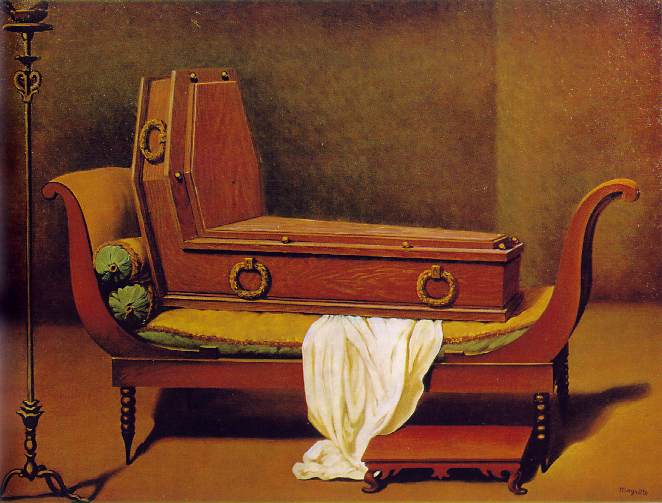
There is currently very little English-language information available about the Museum of the Funeral Service Institute of Vienna, so I’m delighted to be the first to take you on a virtual tour. Let’s start with the sitting-up coffin above.

%Gallery-88625%The Sitting-Up Coffin

Jacques-Louis David famously painted this portrait of Madame Récamier, then this coffin to go around her. Keller, the curator of The Museum of the Funeral Service Institute of Vienna (FSIV), created this coffin for a European funeral fair (which happens every three years). “It’s not practical,” he noted. Bodies must legally be buried six feet underground (below the freezing line), so one would have to dig several feet deeper to bury this coffin. Still, for the right price, he could says they could make it work.

The sitting-up coffin was one of the first things we saw at the museum, and it set the stage for an intellectual and curious look into death, rather than one filled with dread. The initial willies were shaken off, and we began discussing the new trend of creating diamonds out of the deceased’s ashes.

Diamonds Made of Dead People

You may have heard of LifeGem or another company which does this. People have been making diamonds synthetically for years (all you need is carbon, heat and pressure), and making a diamond from someone’s ashes, to some, is a beautiful way to give them metaphorical “eternal life.” Most diamonds created from human ashes are light blue, due to the chemicals in our bodies, but in the cases of people who’ve been through extensive medical treatments, the color can be different. Some companies will add chemicals post-mortum and allow you to make the diamond any color you like, but the FSIV doesn’t do that. Keller reports that it takes about 8 months to turn human ashes into a diamond, and the price for a quarter carat is about €4,680 (€14,440 for a full carat). It’s something to think about, because unless you put your desire to become a diamond in your will, your loved ones probably won’t come up with the idea.

Wearing Grandma’s ashes in a diamond necklace isn’t really any stranger than keeping her on the mantle.

Funeral Fashion

Next, we headed into a room filled with black outfits for all the various officiants in historical Viennese funerals. In addition to black, funerals in Vienna could feature red paraphernalia for military men, and for children, youths and anyone unmarried, much of the black regalia would be light blue. Keller joked that a light blue funeral meant that you were “a complete loser in this life and the next,” and added that if you’re not married, you’d best not die in Vienna.

From about 1850 to about 1930, what mourning women wore to funerals in Vienna was an extremely important matter. Every October, newspapers would publish what the proper style for funerals would be that year, and if women were spotted in last year’s style, it reflected very poorly on them and their families. Naturally, it became possible to rent the appropriate dress to wear to a funeral — in fact, this is still practiced in Vienna. Just as you might rent a gown for a ball, you can rent a mourning dress for an important funeral. Jewelry was also regulated by the annual October announcement, and Keller says that this was actually the origin of costume jewelry.

After Death Certification

Next, we headed into a room of what Keller called “rescue alarm clocks.” Production of these began around 1854 when there was mass hype about the possibility that you could seem dead and be buried, and then suddenly wake up — buried alive. There were many, many different contraptions you could purchase to prevent this horrifying fate. For example: the double-sided knife, which specially licensed doctors would stab into your heart to ensure that you were dead (you can still request this, and he says old ladies in particular sometimes do, €300), known as “after death certification.” Another rescue alarm clock was quite literally an alarm, which he demonstrated for us:

That rope would have led from a coffin directly into the dining room of the cemetery-keeper. That’s a dinner party foul.

Cultural Differences

Next, we looked at some antique children’s funeral toys, which really confused me at first. Basically, Keller explained, a funeral is viewed like a wedding, or any other important passage, and children must be taught how to behave before they can attend. So, from a very young age, children would be given funeral toys to play with so that they could learn the proper procedures and not be afraid.

On the whole, death in Vienna is regarded as a far less scary affair. Perhaps it’s because of the toys, or perhaps it’s because Austrians save money — some their whole lives — for their funerals. Farmers would buy their coffins during a good year when they had the cash and paint it to match their furniture, then use it as a bookshelf or wardrobe until they, you know, needed it. Having a savings account for your funeral or a coffin in your living room probably helps you get used to the idea of dying. “Old Viennese folk songs are all about wine and death,” said Keller. “Death goes with you to the wine tavern and follows you home at night; it’s your best friend.”

The funeral is regarded as a festival, a goodbye party. People save their whole lives to throw a good one, so that they will be remembered for that last great party they gave. “You should tell people they can learn to die in Vienna,” said Keller with a cheeky smile.

Final Details

As I mentioned, you can only visit the Museum of the FSIV by appointment, so to make one, call 501-95-4227 (country code 43) or ask your concierge. If your German’s pretty good, you can get more information here on the website. Alternatively, if you should happen to be in Vienna on the Long Night of the Museums (the first Saturday in October, when museums stay open late), you can test out the coffins. Literally. They’ll put you in a coffin, close it, and leave you there until you knock. According to Keller, last year, 1,500 people did just that. The oldest was an 88-year-old woman. “The girls are much braver than the boys,” he noted cheerfully.

My visit to Vienna was sponsored by the Vienna Tourist Board and Cool Capitals, but the opinions expressed in the article are 100% my own.

First impressions of Ethiopia

They say first impressions are lasting impressions, and while that’s a cliché, strong first impressions of a country can tell you a lot.

I’ve been in Addis Ababa, the capital of Ethiopia, for four days now. My wife has just joined me and I’m treating her to a two-week road trip around the historic northern part of the country to celebrate our tenth anniversary. Memories make the best presents, after all.

This is our first time in sub-Saharan Africa and we’ve both been taken by surprise, summed up by my wife’s assessment of the Ethiopians: “They’re like us.”

(She’s Spanish, so when she says “us” she means Mediterranean people.)

To a great extent they are–in attitudes, priorities, even many mannerisms. With 1500 years of Christianity and an even longer period of nationhood, along with several centuries of Islamic learning and contact with the Mediterranean, Middle East, and South Asia, they’ve developed a culture similar enough to Southern Europe to be recognizable while different enough to be intriguing.

Take social life, for instance. Ethiopians have a great cafe culture and love to while away the hours sipping coffee, chatting with friends, and reading the paper at their favorite cafe. Addis Ababa has a wealth of cafes, both traditional and modern, to suit every mood. The Ethiopians discovered coffee, and it’s equally excellent everywhere, so you pick your place by location and decor.

Their attitude to education is similar to ours too. Private schools abound, the capital has plenty of good bookshops, and every city of any size has at least one university. I’ll be taking a closer look at the schools in a later post in the series.

There’s a relaxed relationship between the sexes here that’s much like our own. While many people frown on premarital sex, that doesn’t stop them from having dating. This has a beneficial effect for female Western travelers in that they won’t be constantly harassed by chronically lonely men like often happens in northern India and parts of the Middle East. Both male and female travelers will receive a fair amount of innocent flirting, though. Considering how good looking the Ethiopians are, this isn’t a bad thing.

%Gallery-85449%I’m ashamed to admit that I thought Addis Ababa was going to be dirty. While it’s a poor city, a small army of street sweepers keeps it pretty tidy. They can’t stop the dust that blows everywhere, though, and the pollution is as bad as a Western city during rush hour. One stark difference is the poverty. There are countless beggars. Many of them are farmers whose crops have failed and they’ve been forced to come to the city to find food. Others are handicapped or have suffered injuries that keep them from working. More prosperous Ethiopians readily give to beggars and don’t judge them simply because they’re poor. This is a pleasant difference from our own culture.

So in the first four days we haven’t had any real culture shock. Expats living in Addis Ababa say it’s easy to slip into daily life here. The Ethiopians we know in Madrid say the same thing about Spain!

Of course we’ve only seen the capital city so far and talked to members of only three of Ethiopia’s many ethnic groups, so as we travel around Ethiopia for the next two months I suspect we’ll discover many differences.

But I bet we’ll find some more similarities too.