Taking a look at McSweeney’s

For the uninitiated, Timothy McSweeney’s Internet Tendency (just called “McSweeney’s” on the street) is a literature and humor website started several years ago by author Dave Eggers. The site never fails to be entertaining, in its own quirky, ultra-hip way, and it succeeds in its mission to be different from just about everything else out there. (check out a New York Times assessment of the McSweeney’s quarterly here.)

There are dozens of different categories of content, many of interest to the traveler. There are dispatches from a writer who lives in Lisbon, Portugal, travel narratives-slash-recommendations from Kevin Dolgin, who takes a look at everywhere from A to Zagreb, and dispatches from one of the dirtiest rivers in the United States.

The Lists are, in my opinion, the most amusing part of the site. Here are some samples:

Common Illnesses at the Vatican (Hymnorrhoids; Ave Malaria; Exorcysts)

Vacation Slogans for Lower-Tier Towns (A Reasonable Place to Visit; Town in Mirror is Smaller than it Appears; A Place to Gas Up)

Actual Examples of Model Conversational Phrases that the Travel Guide Les Etats-Unis Dans Votre Poche: Edition Bilingue Felt Were So Central to the Experiences Likely to be Undergone by French Visitors to America that it Included Them on its Companion Study Cassette Tape (Yeah! I’ll bet if you laid those burgers end-to-end they would reach to the moon. Let’s go try one, shall we?; Where’s the fine democratic American melting pot?; I’m never lucky at these kinds of luck things.)

Forsake your family this Christmas day and spend a few hours browsing around the site. When they get mad, don’t mention my name.

Christmas Eve in The Gambia: One holy night

Christmas Eve in N’Jowara, The Gambia years ago was one night where it felt like world peace has a chance. Instead of heading down to spend Christmas near the capital, Banjul where a group of us rented an apartment year round, I decided to have my Peace Corps friends come to my village for a village Christmas.

Having eight people show up on Christmas Eve day for two nights of comfort and joy in a place that doesn’t have running water or electricity takes a bit of planning. One of my Gambian friends took me on his motorcycle from village to small village a couple days earlier in search of chickens to buy for Christmas dinner. (Chicken and dumplings was about as close to a traditional meal as I could think of considering my gas stove oven was not much bigger than a bread box.

Chickens are hard to come by since they are considered special occasion food. The eggs are also valuable so people want to hold onto their egg-laying birds. Without electricity there’s no way to refrigerate meat, therefore all animals for parties are bought alive and kept until it’s time to cook them. We did buy four chickens and bought them back to my village with their feet tied together and slipped over the handlebars. Yep, it’s rough being a chicken in The Gambia.

Water for bathing and cooking also became a task where guests had to help out. Luckily, water in my village was not a problem even though there were only wells. (Now, there is one stand-pipe.) We were able to keep buckets coming. As soon as we boiled a kettle of water for drinking and it was cool, we started another one.

When the villagers heard I was having a slew of guests for Christmas, they were as excited as I was. Although, The Gambia is predominately Muslim, for the people living in my village, my decision to celebrate one of the most prominent holidays from my culture was exciting. Seeing what the village toubob (non-African) was going to do next was always a treat the other days of the year. Seeing what I did for Christmas was a bonanza. There was great interest in my small artificial tree that I festooned with ornaments–some handmade, some sent by my mother, and the Christmas cards I had scotch taped to my white washed walls. I tied a piece of red ribbon around each of the white candles I bought for the occassion and placed one in each of my five windows. As my friends arrived in whatever way they managed to get to my village (there wasn’t a regular taxi service,) shaking off red dust from their backpacks, thrilled that some of the homesickness of being away for the holidays would be chased away, the feeling of good will grew.

Christmas Eve night was when goodwill spilled out past our own gathering. As night fell, the village looked more like Bethlehem than any Christmas card picture I’d ever seen. The trees that rustled gently in the shadows and the men with their long caftans that were illuminated by the kerosene lamps set in shop doorways cast a certain holy night glow. The cattle were lowing, the goats were bleating, and if a woman on a donkey, a man with a staff, and some wise men rounded the corner, it would have been like a live nativity for sure.

I can’t remember whose idea it was that we should go Christmas caroling. Since one of us had a guitar to help us stay on key, why not? We bought candy to give out while we went from compound to compound sharing one of our almost extinct holiday traditions. Who carols anymore?

My favorite stop was at the compound of one of the village elder women, Mama Badja. Mama Badja was one of my most favorite people who always made me feel good, even on my lowest days. This particular night she was so tickled with the whole scene of us gathered in her yard that she grabbed my hand, chortling out, “Amie M’Bye” my African name) and danced to whatever carol we were singing.

That was a moment of transformation when it didn’t matter which religion was being celebrated. The point was feeling as if the world’s people were one. If it would have been possible to bottle up the air that surrounded us that night, there would be world peace for sure.

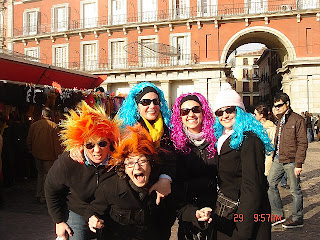
Christmas in Madrid, where’s your wig?

One of the strangest things people do in Madrid for Christmas is wear crazy wigs around the city. What’s stranger is that nobody really knows why!

For the last 30 years or more, Plaza Mayor has been home to a Christmas market with over a 100 stalls that sell all sorts of things: miniature statues of Jesus and the Virgin Mary; novelty gift-wrapping material; carnival accessories like tinsel wigs, rainbow wigs, Afro wigs, assorted head-boppers, mad glasses with flashing lights or with eyes springing out — the list is endless. I think the carnival stuff, although sold pre-Christmas and worn throughout the festival, is mainly for New Year’s Eve.

Go there after 6pm pre or post Christmas and Plaza Mayor is a jolly circus of people of all sexualities and walks of life frolicking around the area being merry, encompassing and radiating the joy of Christmas in the capital. There is a great video that captures this spirit, you can check it out here.

Needless to say, there is Christmas activity all over the city, but Paseo Castellana, which is the business high-street of Madrid is one of special interest. It’s decorated with lights and huge sparkling Christmas trees, all so magnificent that there is a special bus that takes you along the route just to see them all. Also this year, 60 international artists have sculpted structures from ice that represent Madrid like the Puerta de Alcala, or the Santiago Bernabeu football stadium.

It’s cold here but not excruciating so everyone’s on the streets in holiday mode — it’s a great time to be in Madrid.

Merry Christmas!

Christmas Eve in Denmark: Bask in the glow

In elementary school in the U.S., and I’m sure in elementary schools pretty much everwhere, there are the chapters of social studies books that present a sampling of holiday traditions in other countries. One of my favorite things about traveling is finding out which things hold true outside the pages of a book–and which are sometimes true, but not always the way that is pictured.

My Christmas spent in Denmark was my first Christmas away from home–it could have not been more perfect. It was social studies book perfection. One thing I found out is that Danes really do hold hands while they sing carols and dance around a live Christmas tree that has real candles lit all aglow. The candles are only lit on Christmas Eve.

My Danish family (I still call them that years later) had a pitcher of water close to the tree in case it caught on fire. Besides dancing around the tree, we also wound our way through the house. It was wonderful. I remember feeling safe and loved. This YouTube video is not of my family, but of a family who lives in Svendborg. Still, the look and feel is the same. Notice the garland of the Danish flags. My family’s tree had these as well as paper hearts like the one in the picture. Click on it and it will take you to the Web site with instructions. This video is less than a minute long, but you’ll get the idea.

Infiltrating North Korea Part 19: A Final Word


Infiltrating North Korea is a 19-part series exploring the world’s most reclusive nation and its bizarre, anachronistic way of life. To start reading at the beginning of the series, be sure to click here.

Although it was a short trip of only five days, my time in North Korea proved to be one of the most fascinating journeys I’ve ever taken.

This brief glimpse into the world’s most reclusive nation was a rare opportunity to go back in time and witness what the Soviet Union was like fifty years ago. Everything I’ve ever read about the former USSR was alive and well in the streets of Pyongyang; red banners hanging everywhere, blanket censorship, ubiquitous propaganda, very few automobiles, fantastic and accessible cultural arts, barely any crime, and a tightly controlled populace afraid to even fold a newspaper with an image of Kim Il Sung on the front for fear of doing something sacrilegious to the Great Leader’s image.

The North Koreans, however, have taken this concept of totalitarianism even further than the Soviets ever did. The Korean cult of personality, for example, requires that people not only wear a pin of Kim Il Sung or Kim Jong Il on their lapel every day, but also that they bow to any statue of the leaders they come across–and there are a lot of statues in North Korea. Not even Stalin nor Lenin were worshipped to such a degree.The North Koreans are also more paranoid about tourists than their Soviet predecessors; we weren’t allowed to speak to anyone during our time in North Korea, we were routinely prohibited from taking photographs, and we couldn’t wander about on our own. We saw only what the government wanted us to see and spoke only to those thoroughly vetted and officially approved to deal with tourists.

Knowing that my journey to North Korea was carefully regulated to reveal only the positive sides of this “socialist paradise” was extraordinarily frustrating. History is full of naïve international observers who were similarly distracted by smoke and mirror tactics, and then reported back to the civilized world about the excellent conditions they witnessed at various prisons, camps, and hellholes.


Totalitarian governments are very effective with their Potemkin villages and deceitful webs and I wanted to make sure I did not fall victim as well. I therefore read everything I could get my hands on before visiting the country. If you plan on going yourself, I highly recommend that you do the same, otherwise you will be won over by singing children, clean streets, well dressed citizens, and a fanatical devotion to socialism.

In fact, I will go so far as to say that it’s criminal to visit North Korea without educating yourself first. Mandatory reading starts with The Aquariums of Pyongyang by Kang Chol-Hwan–the son of a privileged Pyongyang family who spent ten years of his life, starting at the age of nine, in a North Korean labor camp. Chol-Hwan is coincidently my age and it was therefore particularly poignant knowing that at the same time I was going to high school homecoming dances and football games in the 1980s, Chol-Hwan was being beaten, brainwashed, and forced to cut trees and dig holes in freezing temperatures without adequate clothing. And, he ate rats to survive.

This certainly raises a moral conundrum; should tourists pay exorbitant prices to visit this totalitarian nation knowing that their hard currency helps support the regime?

I scoffed at this originally because my experience in traveling has taught me that human interaction with supposed “enemies” is the very best diplomacy in the world. In addition, bringing an outside perspective to an imprisoned people can also be extraordinarily powerful. The whole reason East Germany was the first communist country to fall was because they had more access to the outside world than any other communist country–they saw what life was like on the other side of the Wall and they rebelled.


The problem with North Korea, however, is that the people remain isolated even in the presence of foreigners. We were never given a chance to speak or interact with a single person. My initial belief that I could make some type of impact, perhaps by simply giving a child a candy bar, turned out to be an absurd impossibility.

And, as a result, my presence did nothing more than slightly boost the government coffers and help Kim Jong Il purchase more of his beloved premium cognac while the rest of the country starves.

And so, I leave it up to you to decide on whether such a trip is appropriate or not (and if you’d like contact information for my travel agent, please email me). Despite my frustrations, however, I feel fortunate that I was able to go and I can only hope that my injection of hard currency into the Kim Jong Il regime has been negated by this fair and balanced account of my time spent in the Hermit Kingdom.

Yesterday: A Tale of Two Cities