From a Czech forest castle reported to house the gates of hell to a gargantuan castle right here in the United States, the world’s most haunted castles boast histories rich with frightening details. Specters haunt the halls of these old castles and travelers visit to experience brushes with the paranormal. Some of these castles possess secrets darker than a moonless night, and when darkness comes, the spirits stir.
These are the ten places to go and meet ghosts. Covering nine countries, each of these castles has a past that may just try and make a ghostly impression on your present.
%Gallery-155791%
Edinburgh Castle
Country: Scotland
Built: 12th century
Haunting: Do you believe in ghosts? Edinburgh is one of those places where skeptics cross the threshold and start saying yes. A few years ago, Time Magazine set out to name the ten most haunted places in the world and included Edinburgh Castle on that list. For starters, a headless drummer has been seen and heard in the castle halls beginning around 1650. Lady Glamis, accused of witchcraft in 1537 and burned at the stake while her young son watched, is also known to prowl the dark halls. A ghost dog has even been seen delicately prancing through the misty graveyard.
There have been so many hauntings for so long that Edinburgh Castle attracted one of the most thorough paranormal investigations ever. In 2001, an English doctor enlisted roughly 240 volunteers to spend 10 days in and around the castle. The volunteers were all screened to insure that none of them knew anything about the castle. The findings? The place is a paranormal hot spot. Many of the volunteer experiences were consistent with past sightings at the castle. There were burning sensations, phantom gropes, shadowy figures and a specter in a leather apron seen in the same spot he was seen by unrelated individuals before the study. Its ancient dungeons and cobbled corridors are home to some serious creepiness.
Visiting: Fly to Edinburgh from London for under $100 round trip. Buy tickets to visit the castle here.
Chillingham Castle
Country: England
Built: 12th century
Haunting: The appropriately named Chillingham Castle is located in the northern corner of England and has been haunting guests for a very long time. The castle served as a fortress to repel attacks from the Scots in the north and has thus seen a great deal of bloodshed. Chillingham has been featured on at least six ghost-related shows, and the webs are rife with strange pictures of its ghosts and orby videos.
So what haunts this medieval castle that appears to be plucked from Westeros? Most notably a childlike ghost, called the blue boy. The blue boy is seen regularly in the pink room as a flash of blue light and also above guests’ beds as a blue halo following a loud cry. Perhaps most creepy is one of the castle’s ghostly apparitions who wanders the dank halls late at night – John Sage. John Sage has a terrifyingly ridiculous backstory and was hung by Longshanks during the war with the Scots. He can be heard dragging bodies here and there.
Visiting: The Chillingham homepage states, “Tours last about 2 hours, depending on psychic activity.” The castle also accepts brave overnight guests. To get there, fly into Newcastle or Edinburgh and travel 70 miles to reach the castle.
Houska Castle
Country: Czech Republic
Built: 13th century
Haunting: Located in the forests north of Prague, Houska castle was never a strategic battle location. It also appears to have no function of outside fortification. It was not built to repel attacks or to keep things out. It was built to hold something in. It was built to close the gateway to hell.
The castle is built upon a fabled bottomless pit from which winged creatures and half-man-half-beasts allegedly exited. Demonic activity persisted at this site and eventually, Bohemian rulers decided to seal up the gateway with a castle. Before sealing off Hell’s realm, it is said that nearby prisoners were granted pardons if they would agree to be lowered by a rope into the hole. The story goes that the first lowered prisoner let out a yell after entering the hole. When he was raised up, he appeared to have aged over 30 years. He died of unknown causes just days later.
Wait, it gets stranger. During the 1930s, the Nazis took over the castle to conduct occult experiments with dimensional portals. Hitler, a paranormal enthusiast, was known to dabble in the occult, and it is uncertain what the scientists learned from Housksa Castle. Years later, during renovations, several Nazi officer skeletons were found, and it appeared they were killed execution style.
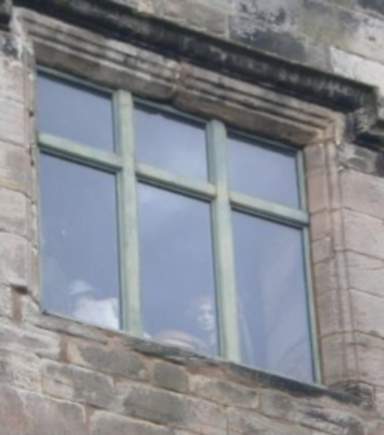
The recurring ghosts at Houska are plentiful, and include a giant bulldog/frog/human, a headless black horse and a woman in an old dress who is frequently seen peaking out of the top floor windows. Beneath the cellar there is said to be some nonhuman remains of the beasts that emerged from the hole.
Visiting: Houska Castle is just north of Prague and day trips to this spot are easy.
Belcourt Castle
Country: United States
Built: 1894
Haunting: In adjusted today dollars, Belcourt Castle cost its owner over $100 million back in the 19th century. Oliver Belmont, namesake of the Belmont stakes, heir to the Belmont family empire and poster child for turn of the century trustfund champions, built this behemoth. On its completion, Oliver chose to instead travel the world, collecting artifacts for the castle, which sounds like a pretty cool thing to do after building a gigantic home. The years were not kind to the castle and disrepair plagued it for much of the 20th century. In 1956, the mansion was sold to the Tinney family for $25,000 ($200,000 in today dollars), or about a fifth of a penny on the dollar (adjusted for inflation).
The Tinneys got a beat-up fading mansion with massive infrastructural needs – and a few ghosts. The strangest thing about Belcourt is that the hauntings allegedly come from the vast assortment of artifacts rather than the actual house. There is a haunted 15th century set of armor that lets out a blood-curdling scream every March, said to be the time that its medieval owner took a spear through the eye. In the Gothic ballroom there are haunted chairs that many claim to have been pushed out of while sitting by unknown forces.
Visiting: The owner of Belcourt Castle gives ghost tours and this May, he will be giving them on Friday and Saturday evenings. It is also open for weddings and other events. Belcourt Mansion is roughly an hour-and-a-half drive from Boston down 95 South.
Brissac Castle
Country: France
Built: 11th century
Haunting: The stylish French château is over seven-stories tall with around 200 rooms and is considered the tallest château in all of the Loire Valley. After a rich history, beginning with the Counts of Anjou in the 11th century, the domain was purchased by a noble husband and wife named Jacques and Charlotte. Charlotte enjoyed tormenting her husband by having noisy sex with randoms. She would keep her husband up all night with her lovers and eventually her husband snapped.
The affair ended when both the lover and Charlotte the wife disappeared. Jacques was likely behind it, but after their death, the lovers’ moans did not stop – they grew louder. The moans persisted and Jacques was forced to sell the castle, tormented by the ghosts of his past. Today, it is said that in the early morning the lovers’ moans persist.
Visiting: Château de Brissac is open to tours and even has two suites and two rooms to stay in overnight. The price for the overnight stay is not cheap, starting at 390 Euros with availability from May through September. Reach Brissac from Paris by high-speed train, taking just an hour and a half to reach nearby Angers.
Eltz Castle
Country: Germany
Built: 1157
Haunting: A picturesque castle with one of the richest interiors in all of Deutschland, Eltz rises up out of the surrounding Mosel forest as if boasting its longevity to the surrounding environs. A testament to its strength as a stronghold, Eltz Castle is one of few castles in the region that has never been destroyed. It is also one of just a few German castles that is said to be haunted. Allegedly, the ghosts of medieval knights still patrol the castle, which, 33 generations later, is still owned by the same original family. Imagine living in the same house as your Great X 30 grandmother.
Visiting: Reach Eltz Castle by flying into Frankfurt Hahn airport and traveling by bus or taxi for the final 15 miles to the city of Cochem.
Castle of Bardi (or Landi Castle)
Country: Italy
Built: 900, ish
Haunting: Built on a spur of red jasper, Bardi towers over the Emilia-Romagna valley. Bardi’s etymological impetus began with Hannibal and his cavalry of war elephants. The last elephant, named Bardus, allegedly died here during the march to Rome. Unfortunately, the castle is not haunted by a menacing ghost elephant.
A sad old story explains the real ghosts of this incredible fortress. Instead of Romeo and Juliet, we have a tale of Moroello and Soleste. Soleste was the daughter of the castle’s lord, and she was in love with Moroello, the captain of the knights. During a long battle, Soleste waited for Moroello to return, perched on the edge of her family fortress, eyes locked on the distant horizon. Eventually, she saw riders galloping back from the battlefront. When the soldiers reached her eyesight, she noticed they were riding with enemy colors. She was overcome with grief at the possibility of Moroello’s death and threw herself off of the castle’s edge. In a sad twist of irony, the riders were in fact Moroello and his soldiers, and they were just wearing the enemy colors to boast. Moroello found his love dead on the ground and immediately realized what he had done and killed himself. The ghost of Moroello haunts the castle to his day, wandering the grounds searching for his lost love.
Visiting: Bardi is located in Emilia-Romagna in northern Italy. The easiest way to reach the region is by plane to Parma or by train from nearby Bologna or Milan.
Dragsholm Castle
Country: Denmark
Built: 1215
Haunting: Some places are simply haunted by a ghost or two, but Dragsholm, located on an islet in Denmark, is allegedly home to 100 ghosts. How anyone came to take inventory on the ghosts and find such a round number was likely done with some relation to Dragsholm tourism development, but the place is wicked haunted, having functioned as both a prison and a battle fortification. Some consider it the most haunted castle in the world.
Of the many stories about Dragsholm’s ghosts, perhaps the most terrifying origin ghost tale involves the White Lady. Before she wandered the castle halls as a ghost, the White Lady was just a girl – a girl who was in love with one of the castle laborers. As a member of nobility, her father, and owner of the castle, condemned the relationship, but the affair persisted. Eventually, the father grew so angry about the ongoing affair that he imprisoned his daughter in the walls of the castle. She was not seen again until hundreds of years later. In the 20th century, during some routine castle remodeling, workers found a skeleton in one of the walls. The skeleton was wearing a white gown.
Visiting: Dragsholm Castle is open to overnight visitors, so if you want to stay in a really creepy castle this is probably the one. To get there, take a train from Copenhagen through Hillerød to Odsherred. The castle also has a restaurant.
Moosham Castle
Country: Austria
Built: 1208
Haunting: Built by the Prince-Bishops of Salzburg, Moosham Castle has a strange and sinister past. Hundreds of witches were beheaded within the walls of Moosham, and many still haunt the Austrian castle. Due to these hauntings, the castle is known colloquially as the Witches Castle.
In addition to being home to a coven of creepy witch ghosts, Moosham is also allegedly the lair of the werewolf. During the 1800’s, Moosham saw a sudden preponderance of mutilated cattle and deer corpses. As a consequence of this, several Moosham residents were tried and imprisoned as werewolves.
Visiting: Take bus #270 from the Salzburg bus station to reach Moosham. The trip takes about two hours.
Warwick Castle
Country: England
Built: 1068
Haunting: First built in the 11th century by none other than William the Conqueror, Warwick has seen more battles than perhaps any other castle in Europe. It has found peace in recent years, but the spirits still linger. Its eroded walls and faded battlements tell the tale of a long hard life for the spirits that now walk its halls.
The ghost tower is said to be one of the castle’s most haunted areas, as Sir Fulke Greville still wanders its interior. Murdered by his manservant in 1628, he is said to materialize from his portrait late on cold evenings. The castle dungeon, home to all sorts of past torment, also seems to be quite haunted. Many visitors complain of vertigo and nausea upon touching the dungeon apparatuses.
Visiting: Warwick Castle is very tourist accessible and is open every day except Christmas. Warwick Castle is located just 40 minutes from Birmingham airport.
Honorable mention:
Castle Bran or Dracula’s Castle
Country: Romania
Built: 1212
Haunting: In the heart of old Transylvania, deep in the Carpathian wilderness, is a castle named for a ruler from the 15th century – Vlad III Dracul. After Vlad’s father was assassinated and his brother was buried alive, he set out to become more ruthless than anyone in fiction could believably create. He makes pint-sized tyrants like Joffrey Baratheon look like equitable play dates.
It all began at an Easter feast when Vlad asked his nobles how many princes they had survived, insinuating that they conspired against past rulers. The story goes that he arrested all of them. He impaled the older ones and their families and made the younger nobles into slaves for a wave of ambitious improvements to the castle. All told, Vlad impaled tens of thousands of people, earning the nickname Vlad the Impaler, and the tales get so ridiculous that it is difficult to sift the myths from the truth. In fact, Vlad never actually lived in Castle Bran, though the castle has come to be associated with the “Son of the Dragon.”
Visiting: The easiest way to reach the castle is by traveling by train from Bucharest, Romania to Brasov, Romania. Many tour companies in Bucharest can arrange a day trip for well under 100 Euros.
[Top image of Brissac Castle via flickr image user @lain G]