Scientists Confirm Remains Of King Richard III Have Been Found

Archaeologists from the University of Leicester have confirmed that they have found the remains of King Richard III beneath a parking lot in Leicester, England.

Richard III was the last of the Plantagenet kings and fought an epic struggle with the Tudors during the War of the Roses for control of England. He was killed at the Battle of Bosworth in 1485. Support for the Plantagenet line crumbled and soon Henry Tudor was crowned King Henry VII.

After the battle, Richard III’s body was buried in the church choir of the Franciscan friary of the Grey Friars. Dr. Richard Buckley, lead archaeologist for the project, explained that the church’s location has always been generally known although the friary was dissolved in 1538 and soon all trace of the building above ground had disappeared.

Two trenches were dug at the site last August and human remains were found almost immediately. One male skeleton had suffered from scoliosis that led to curvature of the spine. It was also unusually slender and aged in its early thirties. All characteristics agree with contemporary descriptions of Richard III.

There are ten trauma wounds on the body. Eight are on the skull. One was from a bladed weapon that cut off a section from the base of the skull. A second injury, also on the base of the skull, cut through the bone as well. Both of these wounds would have been fatal. Several other blows shaved off pieces of bone or left pockmarks in the skull. It appears that Richard wasn’t wearing a helmet by this point in the battle.Two cut marks on the rib and pelvis also appear to have been inflicted after his armor was removed. The archaeologists theorize that Richard III was stripped and given “humiliation injuries,” a common practice with dead or dying victims in the Middle Ages. Historical sources state that Richard’s naked body was slung over a horse and brought to town after the Battle of Bosworth. It may have been at this time that the extra injuries occurred.

Richard III almost suffered another humiliation centuries later when the foundation for a 19th-century brick outhouse nearly cut into his grave.

Initially the archaeologists thought they’d found a barb, perhaps from an arrow, in the body but it turns out that this was probably a Roman nail disturbed from an earlier site. No other artifacts were found in the burial.

The next step was to radiocarbon date the bone. Results showed that they dated to the late 15th early 16th century. This was all interesting but still only circumstantial evidence. There was still no proof that they had found the lost king. There was also the troubling popular legend that an angry mob threw his remains into the River Soar after the dissolution of the friary. There’s even a historic plaque at the location where this was supposed to have taken place.

The university tracked down some descendants of Richard III who agreed to give DNA samples to compare with DNA extracted from the skeleton. This was the clincher. Project geneticist Dr. Turi King confirmed at a press conference today that, “The DNA evidence points to these being the remains of Richard III.”

Dr. Richard Buckley added that they could now confirm that the body is that of Richard III “beyond a reasonable doubt.”

Back in December, some of this information was leaked to the press, but today’s news conference is the first official confirmation that archaeologists have, indeed found a lost medieval king.

Richard III’s remains will be reinterred in Leicester Cathedral early next year. A permanent exhibition about Richard III and the excavation will open in town at about the same time. The university has also launched a new Richard III website.

[Top photo courtesy University of Leicester. Bottom image of the Battle of Bosworth courtesy Wikimedia Commons]


Share on Tumblr

Israel Restores Ancient City


The government of Israel has just completed a $2 million restoration of the ancient Nabatean city of Avdat, The Jewish Press reports.

Avdat is in the Negev Desert and was one of the westernmost points on an extensive incense trade network the Nabateans built stretching as far as the southern Saudi peninsula that flourished from the 3rd century B.C. to the 2nd century A.D. Incense was important in rituals for many civilizations, especially for Roman funerals. The trade network began to wither when Romans converted to Christianity and stopped needing incense to cover up the stink of their cremations.

The extensive ruins include houses and an acropolis with a Nabatean temple. Avdat later became part of the Roman and then Byzantine Empire. Remains of a Roman military camp and a Byzantine church can be seen there. The church has a floor made up of marble tombstones with still legible epitaphs. Like in the more famous Nabatean city of Petra, a sophisticated irrigation system allowed for agriculture and even vineyards in the harsh desert region. The residents even had enough water to make themselves a bathhouse.

The city was destroyed by an earthquake in the 5th century and was rebuilt. Another earthquake in the 7th century finished it off.

The site, which is a UNESCO World Heritage Site, suffered vandalism in 2009. The vandals pulled down columns, smashed stones and wrote graffiti over parts of the site. They were never caught. Now Avdat has been completely restored and the local archaeologists boast that it’s better than it was before.

Avdat hit the news last year when it was discussed in historian Tom Holland’s book “In the Shadow of the Sword,” in which he suggests that Muhammad was from Avdat and not Mecca. He also calls into question much of the Muslim tradition for its own origins. The book was criticized by scholars and Holland even received death threats, presumably not from scholars.

The site is in Avdat National Park, so a visit to the ruins can also include hiking and wildlife photography. Check out the gallery for some images of this amazing site. If it looks a familiar, that’s because it was the site for the filming of “Jesus Christ Superstar.”

[Photo courtesy Urij]

%Gallery-177802%

Damage To Timbuktu’s Antiquities Not As Bad As Originally Thought


Earlier this week we reported on the possible destruction of Timbuktu’s collection of medieval manuscripts. Now it turns out those initial reports were exaggerated.

Timbuktu in Mali is a UNESCO World Heritage Site thanks to its many shrines to Muslim saints and its collection of some 300,000 manuscripts dating as far back as the beginning of the 13th century. They’re in several languages and cover everything from the history of the Songhai Empire to medical texts. They’re the biggest collection of texts from west Africa and are immeasurably important in our understanding of the continent’s past.

Sadly, the city got captured by the Islamist group Ansar Dine (Defenders of Faith) last April as part of a war against the government. The Islamists enforced a harsh version of Sharia law and destroyed many of the shrines. It was also feared that they had destroyed all the manuscripts.

Now that Timbuktu has been liberated by French and Malian forces, it turns out the damage isn’t as bad as previously reported. Reuters reports that most of the manuscripts were hidden in private homes and secret caches. The people of Timbuktu have had to do this many times in the face of invaders, and so they got together to protect their heritage.

The two libraries that housed tens of thousands of the manuscripts were not significantly damaged. About 2,000 manuscripts are missing. Some were burned and others may have been stolen to be sold on the international antiquities market. Also, it appears that only “dozens” of the more than 300 shrines were destroyed or significantly damaged.

An Agence France-Presse report today states that some manuscripts were smuggled all the way to the capital Bamako in the south, where they were out of reach of the rebels. The furniture in one of the main libraries was looted and there’s a pile of ash on the floor from where the Islamists burnt some of the manuscripts, but the library and collection as a whole are fine.

So it looks like the ancient heritage of Timbuktu has survived another war. Hopefully soon the situation will stabilize and the famous city will once again become a destination for scholars and adventure travelers.

[Photo courtesy Gina Gleeson]

Ancient ‘Toilet Paper’ Discovered In Fishbourne Roman Palace


An examination of some strange ceramic disks found at the Fishbourne Roman Palace is changing how we look at some of the most private aspects of Roman life.

Excavations at the palace in the past 50 years have uncovered dozens of pieces of broken pottery that had been deliberately shaped into flat disks. Archaeologists tentatively called them gaming pieces but were never convinced that was correct. Now a new study published in the British Medical Journal suggests they were used to wipe Roman ass crack.

Palace curator Dr. Rob Symmons said in a press release, “Obviously, we will have to think about re-classifying these objects on our catalogue and then we will look into a scientific analysis to identify any tell-tale residues that prove that these objects were used for anal cleaning. Which should be fun.”

Perhaps dip them in water and sniff?

It was already known that the Romans used sponges soaked in vinegar on the end of a stick to wash their rear ends. Ceramic disks wouldn’t have been as hygienic (or comfortable) but could have worked.

Fishbourne in West Sussex is the largest Roman villa in Britain. Built in the first century A.D., its floors were decorated with elaborate mosaics that are in a remarkable state of preservation. It’s unclear who lived there. Archaeologists have suggested either a Roman governor or a local British chieftain who threw in his lot with the conquerors. The palace burnt down around the year 270.

[Photo courtesy Fishbourne Roman Palace]

%Gallery-177595%

The Best Of The West: Classic Ski Lodges

Despite deceptively balmy temperatures in parts of the U.S., there’s still plenty of ski season left. Why not spend it staying at a classic ski lodge or chalet out West? These regal or groovy remnants from the early-to-mid-20th century are a dying breed, although some have been refurbished to good effect, while still retaining their original style. They also tend to offer friendly, personalized service, so you feel like a welcome guest, not just a number.

Classic places are often more affordable, and just as stylish and comfortable than their boutique or generic high-end chain counterparts. Even when they’re pricey, they’re a bit of living history that can give your ski trip a fun retro feel. Think racy Piz Buin and Lange boots ads, fondue, tight, color-blocked sweaters, Bicentennial Ray-Bans, and all things Bavarian.

Below, some favorite vintage ski accommodations across the West. Don’t forget your Glockenspiel.

Tyrolean Lodge, Aspen, CO
It may come as a shock that Aspen has a classic ski lodge that’s remained little-changed in atmosphere or ski-town spirit since its opening in 1970, but the Tyrolean is just that place. Located several minutes’ walk from the slopes, this no-frills, family-owned chalet is one of the best deals in town, with rooms starting at $155/night; some with kitchenettes. The rooms have been upgraded to be more modern, but the decor and vibe is still vintage Tyrol ski culture. Love.

Tamarack Lodge
, Mammoth Mountain, CA
This small, mid-century property overlooking Twin Lakes is on the California Register of Historic Places, and caters to the cross-country crowd. It has both European guesthouse style rooms, historic, refurbished cabins (see photo above), and from December through April, ski-in/out access. If the town of Mammoth is too hectic and soulless for you, consider this a peaceful alternative to the mainstream.
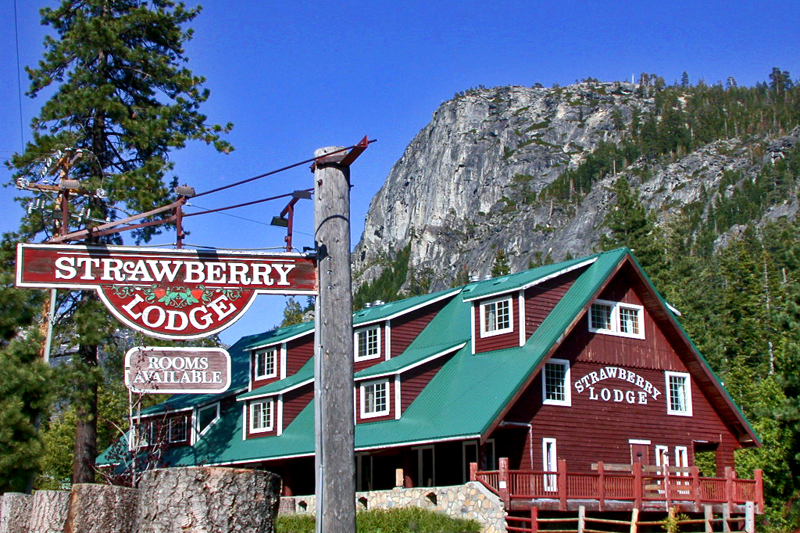
Strawberry Lodge, Kyburz, CA
Highway 50 Tahoe road-trip regulars will be familiar with this former Pony Express stop (right). Located off the side of the road in the nano-community of Kyburz, Strawberry is 20 minutes from South Shore. It’s seriously old-school, in that musty, funky way, with bad taxidermy, historical oddities, and is a much-loved Lake Tahoe institution.

With 31 rooms starting at just $49 a night (some are European style, with a shared bath), it’s hard to pass up, especially when you consider the proximity to all manner of vices, ranging from drinking (please don’t attempt to drive back) and gambling, to outdoor recreation. I love it because it’s one of the last remnants of old Tahoe, in a pastoral mountain setting. Strawberry also offers cross-country skiing, and the restaurant and bar can get hopping, sometimes with live music.

Sun Valley Lodge, Idaho
Built in 1936 at America’s first destination ski resort (with the world’s first chairlifts), the SVL was considered cutting-edge. It offered “every amenity a skier could possibly imagine.” Today, the 148-room property has been completely refurbished into a luxury hotel, complete with glass-encased swimming pool, yet it retains its majestic timber-and-stone facade and stately atmosphere.
P.S. Hemingway slept here.

Timberline Lodge, Mt. Hood, OR
Celebrating its 76th year, this National Historic Landmark (lobby, right) was built at a time when American heritage and the spirit of adventure crashed head-on with the Great Depression. FDR heralded the lodge as a “testament to the workers on the rolls of the Works Progress Administration,” which funded most of the property’s construction. The lodge shut down twice, once during WWII, and again in 1955, as it had fallen into disrepair. Under a new lessee, it was restored to grandeur and reopened later that year.

Located less than 90 minutes from Portland, Mt. Hood is a favorite local’s ski area. Timberline is built in the classic Pacific Northwestern lodge style, constructed primarily by hand of native timber and rock. The bright rooms are upscale rustic, with wood paneling, thick comforters, and stone fireplaces: all the trappings for a cozy getaway.

Alta Peruvian Lodge
, UT
Located at one of Utah’s premier ski resorts, this three-story wooden lodge had an unlikely start as a pair of barracks buildings in Brigham. They were relocated to Alta in eight pieces, and reconstructed into a 50-room lodge that opened in 1948. In 1979, an architect was hired to gussy up the property, although by today’s standards, it retains a retro Alpine charm (the kelly-green shutters decorated with Edelweiss, for example).

Rooms are straightforward and more motel than mountain lodge, but a fantastic deal, starting at $129 for a dorm bed. Prices include all meals, served family style in the lodge dining room, and free shuttle service to Alta Mountain and Snowbird. There are also twin and queen rooms with a shared or private bath, as well as bedroom suites. As for why the property is called the Peruvian? No one knows, although possibly it’s for a nearby landmark, Peruvian Creek.

Nordic Inn, Crested Butte, CO
Reopened on December 15, 2012, under new ownership, this beloved, 28-room Alpine lodge (right) opened over 50 years ago. Located just 500 yards from the slopes, the Nordic has refurbished half of its spacious rooms, which are now kitted out with hardwood floors, down comforters and pillows, and gorgeous Colorado beetle kill pine woodwork. The remaining rooms (which are a colorful ode to the ’80s, and a screaming deal for ski-in lodging) will be redone by June 1.

P.S. Ski lodges aren’t just for winter! Many are open year-round, and summer is also peak season for outdoor recreation.

[Photo credits: Tamarack, Mammoth Mountain Ski Area; Strawberry, 50Cabins.COM; Sun Valley, Sun Valley Resorts; Nordic Inn, Ken Stone]