Last week’s arrest of diaper-wearing cocaine smugglersat JFK proved more laughable than horrifying to those not directly involved. Drug busts are in the media so often, we rarely pay attention to them. They’re certainly not something I care about.
Yet, I’ve recently become obsessed with a National Geographic show called “Locked Up Abroad.” I don’t recall hearing about this harrowing documentary series when it first aired in 2007, but it caught my eye about a month ago, during a late-night Netflix bender. It’s now in its sixth season on the National Geographic Channel.
Each episode profiles one or two subjects, most of whom have been imprisoned in developing nations. While a few episodes detail hostage and other kidnapping situations (Warning: if you’re at all easily disturbed, please don’t watch … nightmares are almost guaranteed), most involve drug smuggling gone awry.
As a die-hard adventure traveler, I find “Locked Up Abroad” absorbing (that’s not an intentional diaper pun) because it’s a real-life dramatization of my worst fears. As a solo female wanderer, I can’t help but worry sometimes about kidnapping or becoming an inadvertent drug mule, no matter how self-aware I try to be. Many of the episodes on “Locked Up Abroad,” however, involve people with the intellect of dead hamsters, and it’s hard to feel much in the way of empathy, given their greed and gullibility.Still, it’s hard to resist a good prison story, especially when it involves South America or Bangladesh, and pasty, bespectacled English blokes or naive teenage girls from small-town Texas. The psychology behind why these people take such enormous risks, and how they manage to survive in inhospitable and downright inhumane conditions is fascinating.
Perhaps I’ve just watched “Midnight Express,” “Brokedown Palace,” and “Return to Paradise” one too many times, but I’ve often wondered how I’d fare in such a situation, and I hope I never have to find out. But documentaries like “Locked Up Abroad” are more than just sensationalism. They’re a window into our desperate, greedy, grubby little souls, as well as testimony to the will to survive.
For some reason, YouTube and National Geographic Channel video links are disabled or broken, so if you want to check out some footage, click here.
The government of Israel has just completed a $2 million restoration of the ancient Nabatean city of Avdat, The Jewish Press reports.
Avdat is in the Negev Desert and was one of the westernmost points on an extensive incense trade network the Nabateans built stretching as far as the southern Saudi peninsula that flourished from the 3rd century B.C. to the 2nd century A.D. Incense was important in rituals for many civilizations, especially for Roman funerals. The trade network began to wither when Romans converted to Christianity and stopped needing incense to cover up the stink of their cremations.
The extensive ruins include houses and an acropolis with a Nabatean temple. Avdat later became part of the Roman and then Byzantine Empire. Remains of a Roman military camp and a Byzantine church can be seen there. The church has a floor made up of marble tombstones with still legible epitaphs. Like in the more famous Nabatean city of Petra, a sophisticated irrigation system allowed for agriculture and even vineyards in the harsh desert region. The residents even had enough water to make themselves a bathhouse.
The city was destroyed by an earthquake in the 5th century and was rebuilt. Another earthquake in the 7th century finished it off.
The site, which is a UNESCO World Heritage Site, suffered vandalism in 2009. The vandals pulled down columns, smashed stones and wrote graffiti over parts of the site. They were never caught. Now Avdat has been completely restored and the local archaeologists boast that it’s better than it was before.
Avdat hit the news last year when it was discussed in historian Tom Holland’s book “In the Shadow of the Sword,” in which he suggests that Muhammad was from Avdat and not Mecca. He also calls into question much of the Muslim tradition for its own origins. The book was criticized by scholars and Holland even received death threats, presumably not from scholars.
The site is in Avdat National Park, so a visit to the ruins can also include hiking and wildlife photography. Check out the gallery for some images of this amazing site. If it looks a familiar, that’s because it was the site for the filming of “Jesus Christ Superstar.”
Andrew Zimmern insists that yak penis “melts in your mouth.” The author, chef and host of the Travel Channel show “Bizarre Foods” also claims that delicacies like snake and deer penis, live frog heart, lizard sake, cow placenta, squirrel brain, sugar cane rat, wildebeast eyeballs and fried tarantulas are all perfectly edible, if not downright delicious. In Madagascar, Zimmern witnessed a circumcision ritual in which the foreskin was eaten, and, though he estimates he’s eaten 60-70 types of animal penis and testicles, he says he draws the line at eating human flesh (see videos below).
Zimmern, 51, is a native New Yorker and graduate of Vassar College who struggled with drug and alcohol addiction in the early ’90s. He was homeless for a year and fed his drug habit by snatching purses and selling the credit card numbers and passports he found. With the help of friends, he moved to Minnesota, got clean, and turned his life around as a chef.
Zimmern claims he’s never gotten sick from any of the bizarre foods he’s eaten and he’s on a mission to get Americans to expand their culinary horizons. In the new season of the show, which premiers on February 11, he’ll feast on baked muskrat, deep fried pig testicles and fermented fish eggs, among other treats. We caught up with Zimmern to ask him how he stomachs all the crap he puts down his gullet.
I’ve seen you eat some ridiculous things over the years but find it hard to believe that the one food you dislike is walnuts?
Don’t I get to not like something? I just think they’re soapy and gross. I just can’t stand them.
Are there other foods you won’t eat?
That’s it!
But, some of the things you eat just boggle my mind. In Goa, for example, you drank cow urine and ate a fish that hadn’t been refrigerated for more than a year (see video below). What were you thinking?
Terrible, I know.
Does your producer ever suggest something so vile that even you say, ‘No – I am not eating that!’
It’s extremely rare. There’s nothing that happens in the show that I don’t either create or vet or both. I’m usually the one who finds foods in the field and says, ‘We’ve got to include this.’ This show is driven by my curiosity and desire to interpret cultures through food. It’s not driven by a producer saying, ‘This sounds really gross, let’s use that.’ If there is no cultural relevance to something, if it’s just thrill seeking eating, it’s not in our show.
In this upcoming season, you’ll be sampling deep fried piglet testicles, among other things. How were those?
Testicles of animals are delicious. The larger the animal the faster they need to get from the clip into the frying pan. Smaller testicles – roosters, ducks, geese, vermin – are very, very delicate and creamy and are easier to keep fresh. Pig’s balls are great. An animal’s testicles are just another piece of meat that can be cooked the right way and taste very good or cooked the wrong way and they’re not.
You ate those pig balls at a fair in Iowa?
No, we were on a pig farm, Rustik Rooster, in Iowa. Certain breeds of pigs if you let them grow too big with their testicles attached, the meat will develop a gamey flavor as the animal matures. So when the piglets are young, they snip the testicles. We cleaned them, soaked them in a brine, and then breaded and deep-fried them. They were delicious.
You visited a restaurant in Beijing that specializes in animal penises (see video below). How was that?
We used to be able to eat everything because whole animals went into butcher shops but we’re returning to that in some parts of the country. Ten years ago, you couldn’t buy pig livers or lamb kidneys, for example, and now you can. There’s a renewed interest in snout to tail eating and people are understanding that if we are going to eat meat, we need to eat the whole animal to be environmentally sustainable, and people are seeing how delicious that can be as well.
Americans are pretty much the world’s wimpiest eaters aren’t we?
Extremely so. Not even close.
I wonder if your show has turned people on to some funky foods they otherwise wouldn’t have tried?
It’s hard to say ‘yes’ without sounding like a douchebag but yes, you’re right. The show has been on since 2007. I had been trying to sell this idea well before that. I am extremely proud of what we’ve been able to contribute to the national conversation about food. The show has had a positive impact on helping to remake taste here in America.
Your show is the only one my 5-year-old son and I can agree on.
You should buy him my book. My son is 8 and all the 5-year-old kids in our neighborhood just devour it. No one counted on “Bizarre Foods” being as popular with kids and families as it has been. There are very few shows that a mom, dad, 5-, 10- and 15-year-old can sit down and enjoy together. “Bizarre Foods” is one of them and I’m very proud of that.
My favorite moments on the show are those very rare occasions when you find something that even you can’t stomach. Durian is one of those really challenging foods, right?
There are a lot of foods I have a hard time with. Sometimes I speak in code on camera because I’d rather be a good guest, not this TV guy who is making fun of people who are trying to accommodate, entertain or inform us.
Tell us about a few of the things that have been very hard to swallow?
Lots of things, from fermented skate wing in Korea to fresh animal blood, even little things like eating fresh milk right from a cow, donkey, horse, a reindeer, or a camel. Warm, foamy milk out of an animal’s teat is not how people are used to drinking it. There is a mind over matter aspect to this that is always difficult to deal with. But the practice of tasting and acquiring knowledge allows you to say, ‘that’s not that bad’ and then you get pleasant surprises that I think make for a very interesting eating life. Because I’m most often pleasantly surprised, I’ve learned that you really need to try things.
I can’t recall ever seeing you spit something out. You swallow just about everything, right?
I always do. I can count maybe two or three items I spit out. One was a snack food on the streets of New Delhi that was made with putrid water that I knew would make me sick. Another occasion was in the Philippines when someone offered me a rotten chicken intestine that was raw. In the pilot, I spat out my first taste of durian, which was just horrific. And I learned a valuable lesson.
The orchard manager was so hurt because he was so proud of his country’s favorite fruit. It was quickly smoothed over, but I realized that I wanted to accomplish my goal of broadening peoples’ minds and open them up to the idea that we could share ideas about our differences and resolve them if we could talk about our love of food. And I couldn’t accomplish that goal if I was spitting things out.
I hear you, but there’s no way I could swallow some of the things you eat. Bat, for example. How do you eat a bat?
I ate grilled bat in Thailand and Samoa. I loved it! [In Samoa] there was a giant fruit bat; I shot it out of the sky while standing underneath a breadfruit tree.
You’ve traveled to more than 100 countries, many of them pretty tough places. Watching the Suriname episode, that looked like the hardest travel experience. Was it?
Not enough close – it was by far the most strenuous travel experience. The entire experience was absolutely brutal. We travel with a crew and they need a clean place to sleep and regular meals. I love eating a fried turtle stew or wild pig liver in the jungle, but the crew needs to be looked after in a different way and Suriname was extremely hot, hard living. We had a 52-kilometer hike over a 30-hour period through virgin rain forest. It was extremely brutal.
A little over 20 years ago, you were a homeless drug addict in New York. Could you have envisioned then that you’d be able to turn your life into a success story?
Never in a million years when I was a homeless addict and alcoholic living on the streets in 1990 and 1991 did I think that I would get sober or live to see my 31st birthday. I was scooped up off the streets by friends who did yet again another intervention on me. [They] put me into a treatment facility in Minnesota and I’ve been sober ever since. That is the greatest blessing of my life. That I’m alive is good enough but the fact that I’m in a position to have the type of life that I do is extraordinary and it’s why I place so much emphasis on giving back to the community because my gratitude is immense. I’m the luckiest person in the world.
ARTSPACE London is one of London’s lesser-known art venues for out-of-town visitors. It opened in May of 2012 and focuses on Modern and Contemporary Arab, Iranian and Turkish art. The original ARTSPACE is in Dubai, and the owners decided to open a London branch to expose these Eastern artists to a Western audience.
The latest London exhibition is of Iraqi photographer Halim Al Karim, opening this year to mark the tenth anniversary of the invasion that led to the downfall of Saddam Hussein’s Baathist government.
Al Karim felt the oppression of that regime as much as any Iraqi. He was an opponent of the dictatorship and refused to serve his compulsory military service. To avoid being imprisoned and tortured by Saddam’s goons, he hid out in the desert for three years, where he lived in a hole in the ground and was fed by local Bedouin.
How that experience morphed into the surreal yet delicate image shown here is for the viewer to resolve. His show, “Witness from Baghdad,” displays a range of works from throughout his career. Many confront the issues of war and oppression head on, yet always in a creative and distinct way.
“Halim Al Karim: Witness from Baghdad 2013“ runs until February 23. If you won’t be in London in time to catch it, show up at ARTSPACE London anyway. It’s fast becoming a landmark on the London art scene.
Have you ever landed in a place to find out you arrived just after the town’s can’t-miss event of the year? Well, hopefully that won’t happen again this year. Gadling bloggers racked their brains to make sure our readers don’t overlook the best parties to be had throughout the world in 2013. Below are more than 60 music festivals, cultural events, pilgrimages and celebrations you should consider adding to your travel calendar this year – trust us, we’ve been there.
Above image: Throughout Asia, Lunar New Year is celebrated with lantern festivals, the most spectacular of which is possibly Pingxi. [Photo credit: Creative Commons]
Kumbh Mela, a 55-day festival in India, is expected to draw more than 100 million people in 2013. [Photo credit: Creative Commons]
Many Dutch people wear orange – the national color – and sell their secondhand items in a “free market” during Koninginnendag, a national holiday in the Netherlands. [Photo credit: Creative Commons]
Up to 50 men work together to carry their church’s patron saint around the main square in Cusco, Peru during Corpus Christi. [Photo credit: Blogger Libby Zay]
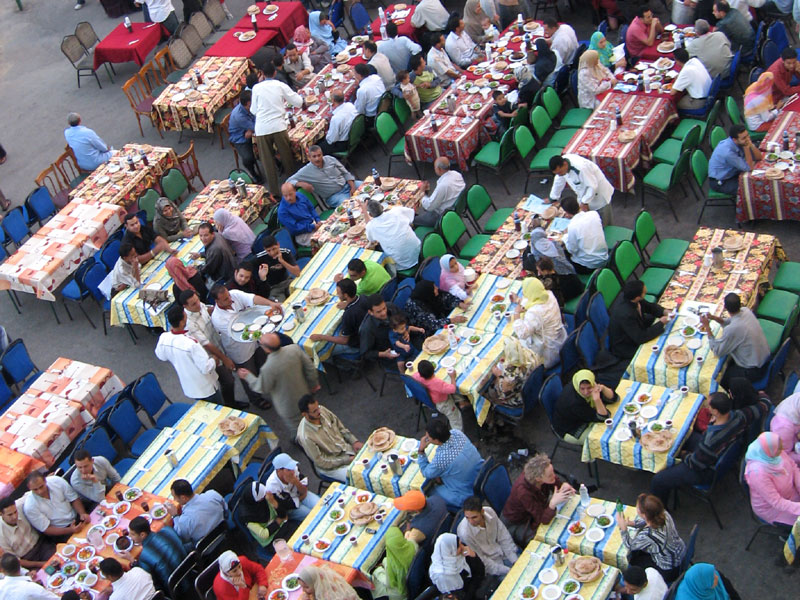
The annual observance of Ramadan is regarded as one of the Five Pillars of Islam. Visit Istanbul, Turkey, at this time and see a festival-like atmosphere when pious Muslims break their fasts with lively iftar feasts at night. [Photo credit: Creative Commons]
July 12–14: Pitchfork (Chicago, Illinois)
July 17: Gion Festival Parade (Kyoto, Japan)
July 18–21: International Comic Con (San Diego, California)
July 19–22: Artscape (Baltimore, Maryland)
Festival-goers get their picture taken at a photo booth during Foo Fest, an arts and culture festival held annually in Providence, Rhode Island. [Photo credit: Flickr user AS220]
August
August 2–4: Lollapalooza (Chicago, Illinois)
August 10: Foo Fest (Providence, Rhode Island)
August 26–September 2: Burning Man (Black Rock Desert, Nevada)
August 31–September 2: Bumbershoot (Seattle, Washington)
More than six million people head to Munich, Germany, for beer-related festivities during the 16-day Oktoberfest. [Photo credit: Creative Commons]
During Dia de los Muertos (Day of the Dead), family and friends get together to remember loved ones they have lost. Although practiced throughout Mexico, many festivals take place in the United States, such as this festival at La Villita in San Antonio, Texas. [Photo credit: Blogger Libby Zay]