Book review: Quiet Corners of Rome

Travel guidebooks conceive of the world as a series of obvious, important monuments. This is particularly true of a brash and magnificent city like Rome. Your typical traveler could be forgiven for simplifying this complex historic capital down to a giant marble stadium, a series of famous steps and giant chapel mural. But writer David Downie reminds us there’s a lot more to Rome than its monuments. In fact, Downie argues, Rome is a city best savored through its secret places: the sensual and contemplative spaces unknown to the average visitor.

In his new book, Quiet Corners of Rome, Downie (a Gadling contributor) treats us to an insider’s tour of over 60 of Rome’s hidden spaces based on years of exploration. What he reveals is a city that is not about grand monuments, but instead the spaces in between: quiet courtyards punctuated by burbling fountains and the fresh scent of pine, the distant vibration of church bells in a shady courtyard and ancient stone plazas bedecked with intricate architectural details. Each sight is accompanied by a serene photo taken by photographer Alison Harris. It’s less a tourist guide than a dictionary of intimate discoveries and pleasant surprises – a sprawling, overwhelming city made personable, particular and specific.

Looking for a guide to Rome’s greatest and grandest sights? This is not that book. What Quiet Corners of Rome accomplishes however, is something altogether more authentic. It’s a highly personal, approachable and enjoyable way experience one of our favorite places as it was meant to be experienced: by cherishing every hidden nook and secret city view.

Crucifixion nails found in Israel? Probably not.

There’s been a shocking archaeological discovery in Israel. Nails from the Crucifixion of Jesus Christ have been found!

Well, no, probably not.

The claim comes from Israeli Canadian documentary filmmaker Simcha Jacobovici, the Washington Post reports. Jacobovici has done several documentaries on Christian subjects and came across an archaeological report from 1990 mentioning the discovery of nails in the tomb of a man named Caiaphas. For those who know their Bible, this is the same name as the Jewish high priest who plotted to arrest Jesus and then gave him to the Romans. The name is right, the date of the tomb is right, so the nails must be those from the Crucifixion, right?

The Post quotes Jacobovici as saying, “There’s a general scholarly consensus that the tomb where the nails were found likely belonged to Caiaphas. Nails at that time were a dime a dozen, but finding one in a tomb is exceedingly rare.”

Actually neither of these statements is true. The Post quotes an Israeli archaeologist as saying that the inscriptions in the tomb aren’t clear as to the occupant’s identity, and I myself have seen Roman nails turn up in tombs. They were pretty common objects, after all.

The timing of this announcement just before Easter and just before Jacobovici’s next documentary comes out (titled “Nails of the Cross” to air Wednesday on the History Channel), adds to the suspicion that Jacobovici is fooling either himself or us.

There’s also the question of why a Jewish high priest would take the nails of someone who he thought was a false prophet to the grave with him, or even how he got them in the first place since it was Jesus’ family and followers who removed Jesus from the Cross.

In the view of this former archaeologist, this story is more of the usual sensationalism masking as science that fills so much of the media. A bit like the spurious discovery of Caligula’s tomb.

Never fear. There are plenty are saints’ relics in Rome, including enough nails for a dozen Crucifixions. Gadling’s own David Farley has even written a book about the Holy Foreskin, which you can also visit in Italy. Actually there’s more than one relic claiming to be the Holy Foreskin, but that’s another story. . .

[Image of Roman nails courtesy user Takkk via Wikimedia Commons. These are not the same nails that came from the tomb mentioned in this article.]

Where are all the travel guide apps for Android?

Nearly two years ago, I bought my first smartphone: the T-Mobile Android MyTouch*. I’m only occasionally jealous of my iPhone-carrying friends, as I find few travel guide apps for Android. Even after a move to Istanbul, I still use and rely upon it daily; Android‘s interface is fast and easy-to-use, and seamless use of Google applications like Gmail and Google Maps is part of the reason I bought it in the first place. Living in a foreign country means English-language books and magazines are expensive and hard-to-find, and like many travelers, I don’t want to carry bulky books around when I’m on the road. This leaves a perfect opportunity for mobile developers to provide real travel guide content and not just travel-booking apps, especially apps produced by reliable media sources with professional editorial. These days, every guidebook and travel magazine publisher is coming out with apps for the iPhone and now iPad, supplying users with content and directions on the go, but there are hardly any for Android.

So what’s available for mobile travelers from the top travel book and print sources? Better hope you’re running Apple OS…Guidebooks:

  • Fodor’s: Happy 75th Birthday Mr. Fodor, but we wish you had more than just five city guides for purchase (in London, New York, Paris, Rome, and San Francisco) and only for Apple.
  • Frommer’s: iPhone guides are available for ten major cities in the US, Europe and Asia, but nada for Android.
  • Lonely Planet: iPhone users are spoiled for choice: dozens of city guides, language phrasebooks, audio walking tours, and eBooks optimized for the iPad. Android users in 32 countries including the US are in luck: there’s a free Trippy app to organize itinerary items, as well as 25 “augmented reality” Compass city guides and 14 phrasebooks. NOTE: This article originally mentioned that the Compass guides were unavailable in the Android Market store, but they should work for most US users. I happen to be in a country where paid apps are not available and not shown in the Market.
  • LUXE City Guides: 20 cheeky city guides work for a variety of mobile phones, including iPhone and Blackberry, but none are compatible with my Android. Bonus: the apps come with free regular updates and maps that the paper guides don’t have.
  • Rick Steves: If you are headed to Europe, you can get audio guides for many big attractions and historic walks for iPhone, plus maps for the iPad. You can also download the audio files free for your computer, and props to Rick for mentioning that Android apps are at least in development.
  • Rough Guides: Here’s a new one: the Rough Guides app works for many phones but NOT the iPhone OR Android! It’s not as slick as some of the other guides (it’s a Java app) and you will use data to use it on the road, but it provides lots of info for many cities in Europe. You can also find a Rough Guides photo app on iTunes to view pictures from around the world with Google Maps and captions from Rough Guides.
  • Time Out: City travelers and residents might want to look at the apps from Time Out for 5 European cities and Buenos Aires, with Manchester and New York on the way. More cities are available for free on iTunes, search for Time Out on iTunes to see what’s available. iPhone only.
  • Wallpaper* City Guides: 10 of the design mag’s 80 city guides are for sale for iPhone for Europe, Tokyo, New York and Los Angeles.

Print media:

  • Conde Nast Traveler: It makes sense for magazines to embrace the iPad, and CNT has free Apple apps specifically for Italy, cruises, and their annual Gold List of hotels and resorts. Blackberry users can download an etiquette guide, but Android users are snubbed.
  • National Geographic: As befitting any explorer, Nat Geo has a world atlas, national parks maps, and games featuring their amazing photography, all for iPhone. A special interactive edition of National Geographic Traveler is for sale on the iPad; you can also read it on your computer. Androids can download a quiz game and various wallpapers; and all mobile users can access a mobile-friendly version of their website at natgeomobile.com.
  • Outside: Adventure travelers can purchase and read full issues on the iPad, but no subscription option yet.
  • Travel + Leisure: The other big travel glossy also has an iPad app for special issues. Four issues have been released so far with one available now on iTunes (romantic getaways) but future editions will follow to be read on the app. Just in time for spring break and summer, they’ve also released a Travel + Leisure Family app with advice and articles specifically geared towards travel and families. The apps are both free but you’ll need an iPad – these are designed for tablets, not phones. You can also read full issues of T+L and their foodie cousin Food & Wine on Barnes & Noble’s NOOK Color ereader; you can save per issue if you subscribe to the e-reader version.
  • USA Today Travel: Most major newspapers have mobile readers for all types of phones, but USA Today is the only one with their own travel-specific app. AutoPilot combines an array of cool travel booking capabilities and information with articles and blog post from the newspaper. Only iPhone users can enjoy free.

Two of our favorite magazines, Budget Travel and Afar, have no mobile apps yet but great online communities to tap into their extensive knowledge.

All in all, other than Lonely Planet’s Compass guides, a pretty weak showing for Android travelers. While iPhone has been around longer as a mobile platform that Android, they’ve lost the market share of users to the little green robot. As Android is available on a variety of phone manufacturers and providers, expect that number to continue to grow, along with the variety and depth of content for mobile and tablet users. Will the developers ever catch up or will travelers have to choose?

*Android has not endorsed this or paid me anything to write about them. But to show I’m not biased – Apple, feel free to send me a sample phone and I’ll test out the apps!

Photo courtesy Flickr user closari. Special thanks to Sean O’Neill, who blogs on Budget Travel and the new BBC Travel blog.

Celebrate Italy’s 150th birthday in Torino

150 years ago, Italy became a country. Well, sort of. Venice and Rome didn’t join for another 9 years, so many Italians will be waiting until 2020 for the big celebration of the Risorgimento, as the unification is called in Italian. Nevertheless, as Italy’s first capital city in 1861, Torino (aka Turin, home of the famed Shroud) is celebrating all year, including the reopening today of the Risorgimento Museum, with free admission for the rest of March. This weekend also marks the reopening of the Automobile Museum, with a huge expansion and total concept overhaul, fitting for a country that gave birth to the Ferrari, the Lamborghini, the Alfa Romeo, and Torino’s own Fiat.

Beginning this summer, the history and evolution of Italian fashion will be celebrated just outside Turin at La Venaria Reale. La Venaria Reale will also host a Leonardo da Vinci exhibition starting in October 2011. Not to leave out food, visitors can attend “royal dinners” all spring through fall, sample traditional regional dishes, and learn about their history as part of the unification. Buon compleanno, Italia!

Learn more about Italy’s birthday events at eng.italia150.it and

www.dreamofitaly.com

Rome – 3 days in Italy

With the bustle of a large European metropolis and the detritus of a monumental past, Rome delights with a frenetic pace and antiquities lurking innocuously around each bend in the road. Here, history has been built on top of history for thousands of years. Seeing bankers in candy red Alfa Romeos zipping by millenia old ruins frames the endurance of this old city. Each sediment in time is visible and speaks to the ancient tale of decaying empire and modern function. The past is everywhere. You may be taking a stroll to sample some Trippa for a late lunch and accidentally stumble upon the Pantheon. There is a certain beauty to this unplanned chaos, and the overlapping of ages is historical mayhem at its most charming.

Rome is estimated to have been settled over ten thousand years ago. It has been a destination for a very long time. It is said that all roads once lead to this settlement on the Tiber. Thankfully, getting to Rome is inexpensive care of European budget air lines. Easyjet flies to Rome from several European cities such as Paris, London, Berlin, and Amsterdam for under $200 round-trip. Three days is plenty of time to see the highlights of Rome, but budget more time to truly understand this storied destination.

%Gallery-119063%

Day 1 – Roam the streets of Old Rome

One of the most amazing qualities of Rome is the integration of the ancient city into the modern metropolis. Most ancient sites beautifully disturb the modern order of things. On an old square, a McDonald’s faces the Pantheon in a worthy example of the strange compromises the present has made with the past. Due to this integration of the historical and the proximity of many Roman landmarks to each other, Rome is a great city for wanderers.

Start at the Colosseum, and take in the crumbling feat of ancient engineering. The queue at the Colosseum can be rather daunting, but booking tickets in advance or purchasing a Roma pass bypasses the line. Here is a great online resource for line skippers. Around the Colosseum, also seek out the Arch of Constantine. It is hard to miss.

From the Colosseum, start heading northwest towards Foro Romano, or the Roman Forum – the ancient seat of Roman government. It is a ruined old structure, and its considerate ambitions can be ascertained by the remnants. The Foro Romano is just east of Palatine Hill – one of the seven hills of Rome. The Circus Maximus, or old chariot racing ground, is just on the other side of the hill.

Continue northwest along Fori Imperiali road and slowly make your way to the heart of Rome. You will pass Foro Traiano, Piazza Campidoglio, and several other breathtaking landmarks. Eventually, if you stay the course, you will arrive at the doorstep of the Pantheon. The Pantheon is such a feat of engineering that it is still the world’s largest unreinforced concrete dome. During the renaissance, master architects such as Brunelleschi studied the Pantheon’s construction to reverse engineer advancements in the architectural field. This was 1300 years after the Pantheon’s construction. To call the Pantheon a marvel would be an insult. It stands as a testament to conquering impossibility.

Next the Pantheon, duck into Tazza D’Oro for some caffeine rejuvenation. Tazza is accused of making the best cappuccino in Rome. The place is busy and confusing. Follow someone who looks like they know the lay of the land.

Head north and east to the Trevi fountain, where well wishers toss away an estimated 3000 Euros per day. It is said that if you toss a coin into the Trevi fountain, then you will be guaranteed a return trip to Rome. North of the Trevi fountain is the Spanish Steps – the longest and widest staircase in Europe. Climb from the Piazza di Spagna to the top and cherish the view out over Rome.

For dinner, find a busy restaurant and order a lot of food. Rome is a mecca for food and has multitudes of delicious options. It is difficult to find a bad meal in Rome, so be adventurous. Hostaria Antica Roma on Appian Way is highly recommended.

Day 2 – Vatican City and Sistine Glory

Vatican City is a sovereign city state ruled by the Pope. With a population of less than a thousand, and only 110 acres in total size, the Vatican is considered the smallest country in the world, edging out the micro-state of Monaco. This center of the Catholic world boasts immaculate gardens, a heavenly basilica, and one of the top museums in the world.

The best way to reach the Vatican is on foot by crossing Ponte Sant’Angelo over the Tiber River. Castel Sant’Angelo is framed gloriously between winged angels on both sides of the bridge. The castle is a great first stop of the day, and houses a museum and Hadrian’s tomb. Castel Sant’Angelo has been a tomb, a castle for the popes, a prison, and also figures prominently int the novel Angels and Demons by Dan Brown.

West of Sant’Angelo is Vatican City. Entering on Via della Conciliazione is probably the most dramatic way to approach the holy place. Once in Vatican City, take in the breathtakingly large Piazza di San Pietro (St. Peter’s square) before entering the basilica. The square boasts an obelisk that was relocated from Egypt almost two-thousand years ago.

The height of the Michelangelo designed dome in St. Peter’s Basilica is so lofty that you could fit the entire statue of liberty within the dome with room to spare. The interior of St. Peter’s is a heavenly place, festooned with gold finery and artistic masterpieces. You can climb to the top of the dome for a stunning view out across Rome, or take to the crypts beneath the marbled interior to check on some papal tombs.

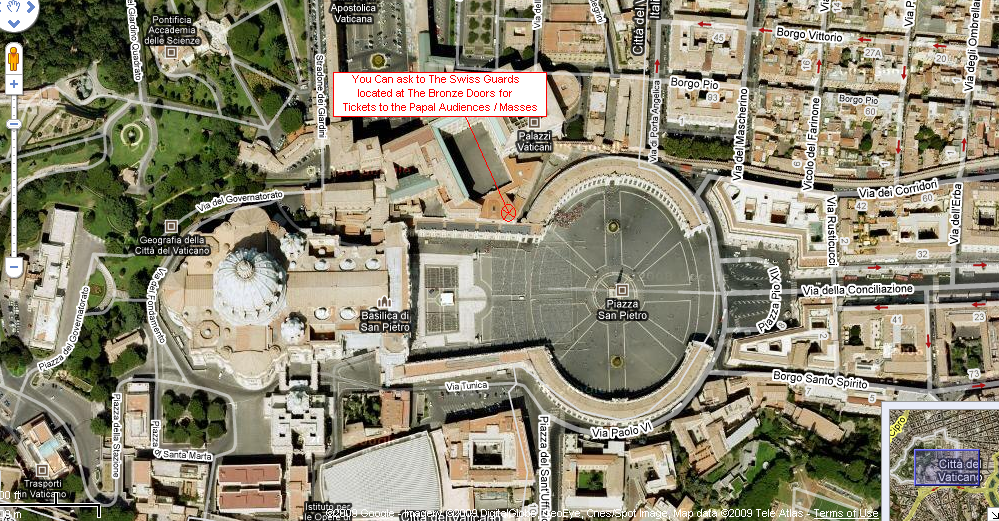
If you happen to be in Rome on a Wednesday, then you can be blessed by the Pope himself. He hands out blessings at 10:30am on Wednesdays. Check with your hotel or guesthouse to arrange tickets for the event. The Swiss guard also hands out tickets on Tuesdays from their post near the bronze door. Be sure to check the Pope’s schedule before getting too excited about being blessed. He is a busy man and routinely leaves his Vatican home.

The Vatican Museum is my favorite museum in the world. From entire rooms filled with the works of masters to hallways covered with brightly painted maps of an uncertain world, this place is an unbelievable experience. Budget plenty of time to take it in. The museum is laid out to move you through several gorgeous rooms and immaculate hallways before climaxing at the Sistine Chapel. The museum is free the last Sunday of each month, and is not open any other Sundays. The rest of the week is fair game.

Finish your day with a stroll down the Tiber river just as dusk blankets Rome.

Day 3 – Trastevere and personal interests

With so many options around Rome, pick something personally interesting to do on your last day. Take a cooking class, check out the art at Galleria Borghese, go to a wine tasting, explore catacombs and crypts, check out Florence (only an hour and a half away by fast train), go to a football game, or perhaps just take to some serious shopping.

On your third night in Rome, spend some time in Trastevere. Trastevere is a cool neighborhood on the west bank of the Tiber filled with locals, expats, artists, and college students. It is a great place to sample authentic Roman food, explore, and get inexpensive lodging. The area feels less like a museum than ancient Rome and is a great place to get in touch with the city’s less touristy side.

All photography by Justin Delaney