Articles tagged “adventure travel”

Filter the Adventure Travel category by popular activities:

Biking, Camping, Climbing, Hiking, Paddling, Scuba diving, Skiing, Surfing


Lost And Found: How Uncertainty Makes Travel Memorable

As the bus begins to pull away from the bus stop in Chania, I catch the old man’s eye again, giving him a thumbs-up through the window. He stares back blankly – then leaps to his feet, waving his arms, pointing, shouting. I raise my hands in an uncomprehending shrug, keeping the palms turned inward to avoid flipping him a mountza, the traditional Greek insult. He shouts louder, as if volume alone could break through the language barrier that had us miming to each other a few minutes ago. Then his body slumps into a pose recognizable the world over – “Oh, you bloody fool” – and that’s when it hits me in the stomach.

I’m on the wrong bus.

I have an hour before my ferry leaves the port of Souda, taking me away from Crete and back to mainland Greece. If I don’t hit that ferry, my carefully engineered schedule slithers through my fingers and I’m left untethered, without local knowledge, a decent enough grasp of spoken Greek or the money for new tickets. Without that ferry, I’m lost.

I sit down, by order of my knees, and stare out at the dusty, baked scenery as we rattle God-knows-where-wards. And then something strange happens. Panic ebbs away. I start to appreciate how lovely the light is, the rose-fingered sunset fading through the spectrum into that special glowing blue that enlivens domed roofs and door-frames right across Greece. I’m warm, I’m well fed, and I have no idea what is going to happen next – and it’s this last feeling that is so intoxicating right now.

Perhaps this is the wrong question. Perhaps it’s really this: why do I want travel to be easy?

When most people travel, they seek the unknown – either in a familiar, packaged, piecemeal form with the help of guides and tour operators, or the raw, improvised version that’s so popular with people young enough for their nervous systems to take it. I go off the beaten track using a third approach, which I like to call “Oh You Bloody Fool.” Somewhat appropriately, it’s a way of travel I accidentally fell into. I go places, things go wrong, and I fall through space, screaming. This is usually, but not always, a metaphor.

There’s a perverse joy in having your travel plans collapse around you. I’ve missed many flights and will doubtless miss many more. Once I get over the initial shock, once I’ve leaned against the nearest wall and cursed everyone up to and including the Wright Brothers, a calmness steals over me. I change. Lacking any alternative, I’m forced to become the person who can deal with this mess. My senses fly open, taking great gulps of the world around me, collecting data for my suddenly hyperactive brain to sift through in search of Life Or Death Answers. My heart thumps. My jaw sets. No time to waste – and off I go.

In “A Field Guide To Getting Lost” (2006), Rebecca Solnit says:

“The thing the nature of which is totally unknown to you is usually what you need to find, and finding it is a matter of getting lost.”

I’ve spent a lot of the last decade getting lost. I’ve been lost on England’s North York Moors in the middle of a rainstorm with the light fading – one of the few times I’ve genuinely hated not knowing my location. I’ve blundered across Berlin at 4 a.m. in search of my hotel, clutching a rain-dissolved paper map. I’ve suffered a thousand deaths of embarrassment in front of strangers, and I’ve eyed other travelers – so competent, so self-assured – with a mixture of envy and hatred. Why can’t I land on my feet instead of my face? Why does it all have to be so hard?

Perhaps this is the wrong question. Perhaps it’s really this: why do I want travel to be easy? When it’s easy, it’s a non-experience that our memories can’t get a grip on. Thanks to the miracle of GPS, we need never be lost. We can get from A to B knowing exactly what B looks like and having a machine dictate the entire route to us. Our technological support networks are vast and all-powerful, and our guides, physical and virtual, know more about the places we’re going than we ever will. We are mired in certainty and we need never put a foot wrong. But what if that’s not what we need – or why we travel at all?

I’m not pondering any of this as my bus takes me away from Chania. I’m fully in the moment, hunting for clues to where this bus is going, scanning the horizon for landmarks that tally with the map in my “Rough Guide.” There are 11 people on that bus. One lady is wearing a brown hat; one man has spectacularly hairy ears. These details are unforgettably burned into me by an elevated level of awareness …

I’m having the kind of travel experience I left home in search of.

Ten minutes later, the port of Souda hovers into view, and I realize, with curious disappointment, that I’m saved. I’m on the right bus after all. I unwittingly compensate by getting off the bus far too early, forcing me to sprint the final mile with a fully-laden backpack, and then I spend the first hour of my ferry ride lying semi-naked on the cool metal floor of my cabin, trying to bring my temperature down. The rest of the journey is a self-recriminating haze.

These days, being lost is at the heart of the kind of travel I love, filled with stories I don’t know in advance, positioned along the uncomfortable line between serendipity and disaster. Occasionally wild uncertainty is thrust upon me, as when I was robbed of my passport in Düsseldorf, seven hours before my flight home to England. (Ever wondered how long a UK emergency passport takes to put together? About six hours.) I’ve learned to appreciate these experiences for what they are – a living hell at the time, a treasure-trove of travel memories afterwards. All that said, I give myself lots of leeway nowadays, spacing out connections and over-budgeting where I can. I may be a bloody fool, but I’m not stupid.

[Photo Credit: Flickr user Jenny Downing]
The Best Of The West: Classic Ski Lodges

Despite deceptively balmy temperatures in parts of the U.S., there’s still plenty of ski season left. Why not spend it staying at a classic ski lodge or chalet out West? These regal or groovy remnants from the early-to-mid-20th century are a dying breed, although some have been refurbished to good effect, while still retaining their original style. They also tend to offer friendly, personalized service, so you feel like a welcome guest, not just a number.

Classic places are often more affordable, and just as stylish and comfortable than their boutique or generic high-end chain counterparts. Even when they’re pricey, they’re a bit of living history that can give your ski trip a fun retro feel. Think racy Piz Buin and Lange boots ads, fondue, tight, color-blocked sweaters, Bicentennial Ray-Bans, and all things Bavarian.

Below, some favorite vintage ski accommodations across the West. Don’t forget your Glockenspiel.

Tyrolean Lodge, Aspen, CO
It may come as a shock that Aspen has a classic ski lodge that’s remained little-changed in atmosphere or ski-town spirit since its opening in 1970, but the Tyrolean is just that place. Located several minutes’ walk from the slopes, this no-frills, family-owned chalet is one of the best deals in town, with rooms starting at $155/night; some with kitchenettes. The rooms have been upgraded to be more modern, but the decor and vibe is still vintage Tyrol ski culture. Love.

Tamarack Lodge
, Mammoth Mountain, CA
This small, mid-century property overlooking Twin Lakes is on the California Register of Historic Places, and caters to the cross-country crowd. It has both European guesthouse style rooms, historic, refurbished cabins (see photo above), and from December through April, ski-in/out access. If the town of Mammoth is too hectic and soulless for you, consider this a peaceful alternative to the mainstream.
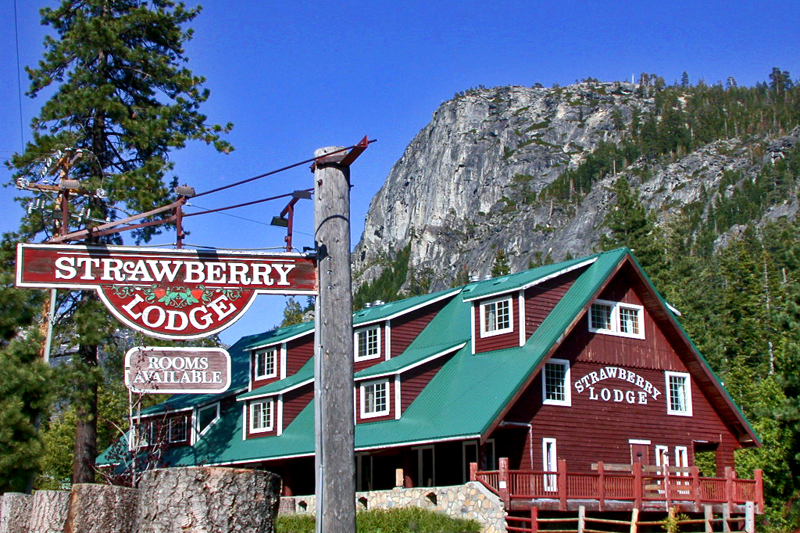
Strawberry Lodge, Kyburz, CA
Highway 50 Tahoe road-trip regulars will be familiar with this former Pony Express stop (right). Located off the side of the road in the nano-community of Kyburz, Strawberry is 20 minutes from South Shore. It’s seriously old-school, in that musty, funky way, with bad taxidermy, historical oddities, and is a much-loved Lake Tahoe institution.

With 31 rooms starting at just $49 a night (some are European style, with a shared bath), it’s hard to pass up, especially when you consider the proximity to all manner of vices, ranging from drinking (please don’t attempt to drive back) and gambling, to outdoor recreation. I love it because it’s one of the last remnants of old Tahoe, in a pastoral mountain setting. Strawberry also offers cross-country skiing, and the restaurant and bar can get hopping, sometimes with live music.

Sun Valley Lodge, Idaho
Built in 1936 at America’s first destination ski resort (with the world’s first chairlifts), the SVL was considered cutting-edge. It offered “every amenity a skier could possibly imagine.” Today, the 148-room property has been completely refurbished into a luxury hotel, complete with glass-encased swimming pool, yet it retains its majestic timber-and-stone facade and stately atmosphere.
P.S. Hemingway slept here.

Timberline Lodge, Mt. Hood, OR
Celebrating its 76th year, this National Historic Landmark (lobby, right) was built at a time when American heritage and the spirit of adventure crashed head-on with the Great Depression. FDR heralded the lodge as a “testament to the workers on the rolls of the Works Progress Administration,” which funded most of the property’s construction. The lodge shut down twice, once during WWII, and again in 1955, as it had fallen into disrepair. Under a new lessee, it was restored to grandeur and reopened later that year.

Located less than 90 minutes from Portland, Mt. Hood is a favorite local’s ski area. Timberline is built in the classic Pacific Northwestern lodge style, constructed primarily by hand of native timber and rock. The bright rooms are upscale rustic, with wood paneling, thick comforters, and stone fireplaces: all the trappings for a cozy getaway.

Alta Peruvian Lodge
, UT
Located at one of Utah’s premier ski resorts, this three-story wooden lodge had an unlikely start as a pair of barracks buildings in Brigham. They were relocated to Alta in eight pieces, and reconstructed into a 50-room lodge that opened in 1948. In 1979, an architect was hired to gussy up the property, although by today’s standards, it retains a retro Alpine charm (the kelly-green shutters decorated with Edelweiss, for example).

Rooms are straightforward and more motel than mountain lodge, but a fantastic deal, starting at $129 for a dorm bed. Prices include all meals, served family style in the lodge dining room, and free shuttle service to Alta Mountain and Snowbird. There are also twin and queen rooms with a shared or private bath, as well as bedroom suites. As for why the property is called the Peruvian? No one knows, although possibly it’s for a nearby landmark, Peruvian Creek.

Nordic Inn, Crested Butte, CO
Reopened on December 15, 2012, under new ownership, this beloved, 28-room Alpine lodge (right) opened over 50 years ago. Located just 500 yards from the slopes, the Nordic has refurbished half of its spacious rooms, which are now kitted out with hardwood floors, down comforters and pillows, and gorgeous Colorado beetle kill pine woodwork. The remaining rooms (which are a colorful ode to the ’80s, and a screaming deal for ski-in lodging) will be redone by June 1.

P.S. Ski lodges aren’t just for winter! Many are open year-round, and summer is also peak season for outdoor recreation.

[Photo credits: Tamarack, Mammoth Mountain Ski Area; Strawberry, 50Cabins.COM; Sun Valley, Sun Valley Resorts; Nordic Inn, Ken Stone]

­­Waiting In The Pythion Of Time

­­

One of my prime New Year’s resolutions for this year is to put together an anthology of selected pieces from my own writing career. With 30 years of narrative stories and reflective essays to sift through, I figure there must be enough material for at least a very slim volume.

As part of this process – or perhaps just as a very clever way of procrastinating the hard work of getting started on this process – I’ve been reading through old journals and letters recently. This can be a dangerously detouring pastime, of course, but sometimes it turns up one of those little seeds that blossom into a whole world I had forgotten.

So it is with a letter I have just come across, written in the winter of 1976 to my parents from a Greek border town called Pythion, where I was waiting for a train to Istanbul. Sometimes it is just such global synapses – way stations – that unencumber and inspire us.

Here is part of what I wrote:

*****

I took the 10 p.m. train on Tuesday from Athens and arrived in Thessaloniki around 11 a.m. the next morning. In Thessaloniki I was informed that the Istanbul train had left earlier that morning, but that I was in luck – there was another, special Wednesday-only train leaving for Istanbul at 13:10. When that one arrived, I learned that it traveled only as far as the border.

Still, that seemed better than nothing, so I had a very pleasant ride through Thrace with a compartment all to myself, and arrived at the border – poetic Pythion – at 2:30 a.m. Pythion being off-limits to foreigners, I was invited by the sole stirring being to sleep in the station’s waiting room, which I did rather comfortably until 8:30, when I was awakened simultaneously by a policeman demanding who I was and someone shouting in German that the train for Istanbul was leaving in 5 minutes.

I scrambled down the platform to the train, the policeman chasing after me, only to discover that the train had come from Istanbul and was bound for Athens.

And so I sit in the Railroad Buffet at Pythion, eyed by a suspicious policeman who can’t imagine what a foreigner would be doing here if not trying to uncover state secrets, and contemplating 10 hours of warming my toes and fingers by an old pot-belly stove in one of the more obscure of the obscure corners of the world.

Situations like this make me question the nature of reality. I am sitting on a hard wooden bench at the end of a long, stained table in a dirty, cold, deserted Greek border town, scratching out letters under a layering of turtleneck, work shirt, sweater, raincoat and scarf, and eating peanuts and figs to keep warm.

This is certainly one kind of reality, but is it any more real than that envisioned for me by my friends in Athens, who imagine me right now walking under minarets through crowded streets from Hagia Sophia to the Blue Mosque, or than the picture you may have of me right now (discussing me halfway across the globe even as I write these words) walking through sunny Athenian streets to the gleaming pillars of the Acropolis: Is my here any more real than that there?

I am here, but in a few weeks I will be at the Acropolis, and in 24 hours I will be wandering Istanbul’s alleys. Maybe all three are concurrent realities?

At any rate, last night, when I was sleeping happily somewhere in northeastern Greece, I had a dream that all my traveling was just a dream, and that I was actually still living in Connecticut, and in my dream I woke up from my dream (of traveling) and felt this tremendous relief and joy to be home and still so young as not to have to worry about being out and alone in the world.

Then, a split second later, I woke up from that dream – and found myself sweaty and disheveled in a humid train compartment speeding somewhere through the Grecian night.

And so I wonder about this pithy waiting room in Pythion – is this too a dream from which I am about to awake? And who/what/where will I be then?

*****

Now, three and a half decades later, I read these words, and life’s border towns and way stations come back to me: the raggedy, muddy-streets-and-strung-light-bulbs place where I spent an itchy night between India and Nepal; the misty, barbed-wire swamp where I once longingly looked out from Hong Kong toward then-forbidden China; the snow-locked sentry post between Pakistan and China; the dusty honky-tonk of Tijuana and Nogales.

I think of a one-cafe town in the middle of Malaysia where I was stranded between buses, and a patch-of-grass “taxi stand'” in Indonesia where cicadas serenaded me for hours while I waited for a ride; I think of a slumbering French railroad station where I passed an afternoon reading Proust and pondering the tall grasses that waved dreamily in a drowsy breeze, and a high Swiss village where I ran out of gas and francs, pitched a tent in a frosty field and watched the moon dance to the music of Van Morrison.

As I think back on all these places, one truth becomes clear: They were all way stations to adventure. They were the gathering of breath and coiling of muscle before the great leap into the unknown. They were the portals to wonders unimaginable and unforgettable.

And so, at the beginning of this new year, I find myself in the Pythion of time again. Just now the station master has come and checked my ticket, stamped my passport, waved me toward the platform. And here comes the train – I can see it now, all steam and gleam!

Already the pulse quickens, the mind races ahead once more: What lessons lie ahead, I think; what wonders are in store?

[Photo Credit: Grant Martin]

Video: New World Record Likely Set For Surfing Biggest Wave

Hawaiian pro big-wave surfer Garrett McNamara may have just broken his own world record for surfing the world’s largest wave. Via Skype with Anderson Cooper on CNN, McNamara described the “endless drop” of the estimated 100-foot wave he surfed on January 28 off the fishing village of Nazaré, Portugal.

Nazaré is also where McNamara set the world’s record in 2011, for conquering an estimated 78-foot wave. When asked by Cooper if he got an adrenaline rush from his latest feat, McNamara responded, “No rush, so it’s probably not at 100 feet! I’m not kidding you, Anderson. I don’t know what’s wrong with me. There’s definitely something wrong.”

Whatever the problem is, shredding monster waves isn’t it.


Score Big Savings On Lift Tickets For Super Bowl Weekend

We all know that America’s biggest unofficial holiday is coming up this weekend in the form of Super Bowl Sunday. But before the Ravens and 49ers take the field to determine who will go home with the Lombardi trophy, the rest of us will be looking to kill some time prior to kickoff. If you’re a skier or snowboarder who is thinking about hitting the slopes before the gridiron action commences, then Liftopia is here to help. The website that offers the best online marketplace for nabbing discounted lift tickets just got better thanks to its annual Game Day Sale.

During this once-a-year event Liftopia is offering as much as 85% off lift tickets to more than 200 ski areas across North America. For instance, skiers in Colorado can enjoy 51% off passes to Loveland and a 48% discount to Copper Mountain. In Utah, Park City VIP lift tickets are 35% off while those visiting Solitude can score a pass for as little as $50. Idaho’s Sun Valley is providing a 47% discount to those visiting their epic slopes, while in the eastern U.S. skiers and riders can get in on the fun with 70% off passes at Plattekill Mountain in New York and 85% off Bolton Valley in Virginia. Even the Canadians are celebrating the event with 34% off a two-day pass at Mont Tremblant and lift tickets as low as $22.98 at Holiday Mountain. For a complete list of discounts, click here.

The big game doesn’t officially get underway until 7:25 Eastern time, which means we’ll have most of the day to hit the slopes and enjoy some fresh powder. So, gather up some friends, grab some cheap lift tickets and enjoy the day. When you’ve had enough winter fun, head home to top off the day with what will hopefully be a great game. Sounds like a perfect Super Bowl Sunday to me.

[Photo Credit: Liftopia]