10 countries Americans need advance visas to visit

We live in an increasingly borderless world and we have access to many countries that were closed (or non-existent) 20 years ago. As reported earlier this week, Americans are especially lucky with access to 169 countries visa free. Still, there are still many countries that Americans need advance visas to visit. Visa applications and processing services can cost several hundreds of dollars and take a lot of time and energy to obtain, so figure in that into your travel planning but don’t let it discourage you from visiting.

Nearly all countries in Africa, the Caribbean, Central America, Western Europe, and the Middle East will give you a visa free or for a fee on arrival. See below for our guide to countries you will need to apply for advance visas, along with fees, useful information and links to consular websites.
Asia

  • China: US citizens pay $130 for tourist visas, single- or multiple-entry up to 24 months from date of application. Keep in mind a trip to Hong Kong or Macau counts as an exit from China, so plan on a multiple-entry visa if you’ll be in and out. You’ll need to send your actual passport in for processing and ideally plan 1-2 months in advance of travel.
  • India: Fees from visa contractor Travisa start at $50 and visas can be valid for up to 10 years, but note that you must have a gap of at least 2 months between entries.
  • Vietnam: Single-entry visas start at $70 and multiple-entry visas are valid for up to one year. Another option for Americans is a single-entry visa on arrival, apply online and pay another stamping fee at the airport.
  • North Korea: Not an easy one for Americans as there are no consular relations between the two countries, but it is possible if you go through a specialist travel agency such as New Korea Tours and realize you’ll be visiting only on a highly-restricted and guided group tour. Note that you’ll have to go through China, requiring another visa of course!
  • See also: Afghanistan, Bhutan, Pakistan

Eurasia

  • Russia: Russian visa rules are quite strict and complicated, so you’ll need to have a solid itinerary set up before you apply as visas are valid for specific dates and not extendable. You’ll need a sponsorship for your visa, typically provided by your hotel or tour operator for a small fee, and you’ll register your visas once in the country. Fees start at $140 and applications should now be filled out online. Tourist visas are generally only valid for two weeks and even if you are just traveling through Russia, you’ll need a transit visa.
  • Belarus: Similar to Russian rules, a letter of invitation must be provided from an official travel agency in order to get a visa. You also have to show proof of medical insurance and financial means (about $15 USD/day, can be demonstrated with credit cards or paid travel arrangements). Tourist visas start at $140 and $100 for transit visas. Gadling writer Alex Robertson Textor is currently planning a trip, stay tuned for his report next month.
  • Azerbaijan: The country changed its visa policy last year, and now Americans must obtain an advance visa. You’ll need an invitation from an Azerbaijan travel agency, then a tourist visa costs $20 and takes 10 business days to process. Transit visas don’t require an invitation letter but should still be obtained in advance of travel.
  • See also: Turkmenistan

Other

  • Australia: Getting a tourist visa is simple and cheap ($20). Apply online at any point in advance and you’ll be verified at the airport. Valid for as many entries as needed for 12 months from date of application.
  • Brazil: Tourist visas are $140 plus $20 if you apply by mail or through an agency. If you are self-employed or jobless, you’ll need to provide a bank account balance, and all applications should include a copy of your round trip tickets or other travel itinerary.
  • Iran: There’s a current travel warning from the US state department, but Rick Steves is a fan of the country and several reputable travel agencies provide tours for Americans. The US consulate notes that some Americans with visas have been turned away, so your best bet is to visit with a group.
  • See also: Nigeria, Paraguay, Saudi Arabia, Suriname

The good news for expats, students studying abroad, and other foreigners with residency is that many countries will allow you to apply in a country other than your home country for a visa. For example, I traveled to Russia from Turkey, getting my visa from a travel agency in Istanbul without sending my passport back to the US. Always check the US state department website for the latest visa information and entry requirements.

Photo courtesy Flickr user Thomas Claveirole.

Buzkashi – goats and gladiators

In central Asia, men play a strange game on horseback. Instead of a ball, they use a goat carcass. Instead of goals, they must ride until free of challengers. Instead of minutes, the game can be measured in days. This is Buzkashi – goat grabbing.

Long established as the national sport of Afghanistan, Buzkashi is polo’s drunken uncle. The sport is also played in Uzbekistan, Tajikistan, Kyrgyzstan, Pakistan, and Kazakhstan. It is a sport of the Stans – where the masters have ridden for centuries, gloriously along the steppes they call home. The game starts with the placement of a goat carcass in the center of a horse circle, and from there, the riders stare each other down while gripping tightly wound whips in their gleaming teeth.

%Gallery-116382%

During the Taliban reign in Afghanistan, the sport was outlawed, but today it has seen a resurgence as the national pastime. Two variations are played, Tudabarai and Qarajai. In both versions, the field is separated into two teams. Tudabarai is the simpler more traditional form of the game. To win, a lone rider must carry the goat until free and clear of all other riders. The riders use their boots and whips to discourage any sort of advance, though horse tripping is strictly forbidden. Qarajai is the more complex version of the game, and requires players to take the goat around a marker and then place it in the team’s designated scoring circle.

The winning team receives a bevy of prizes, from televisions to fine turbans to camels. Games have been known to last for days, and it is a rough demanding sport. It is said that only the masters of the sport, called “Chapandaz,” are truly adept at retrieving the carcass and absconding with it to glory. Unlike a running-back in the NFL, these masters do not hit their peak until much later in life. Most are well over 40. They have spent a lifetime training, and their horses are equally prepared. A good Buzkashi horse must train for five to ten years and can fetch over ten-thousand dollars. This amount is 25 times the average laborer’s yearly wage in Afghanistan and would be comparable to paying $1,000,000 in relative terms in the United States.

Since Afghanistan is a war zone, it is best to catch a game of Buzkashi in Uzbekistan or Kyrgyzstan. In Bishkek, Kyrgyzstan, it is possible to catch games during the late August Independence celebrations. Community Based Tourism arranges a number of tours in the region.

flickr images via U.S Embassy Kabul Afghanistan

The burqa and niqab: can travelers get used to anything? Should they?


Travel broadens the mind, at least for most people. As we explore different cultures and beliefs we see that for the most part they’re OK. While there are always local customs we just can’t follow, in general the more we travel, the more accepting we become.

But how accepting should we get? I’ve traveled extensively in the Muslim world and I’ve yet to figure out exactly how I feel about the burqa and niqab, two types of female Islamic clothing that cover the face. For the vast majority of the world’s population, the face is a key to identity. We look at the face to tell what a person is thinking and feeling. It’s how we spot friends and enemies at a distance. To see a covered face makes many people suspicious. In most cultures, it means the person has something to hide.

Here in Europe a debate is raging over whether the face veil should be banned. Some politicians say it’s oppressive and against Western values, while others defend it as part of a cultural heritage that needs to be tolerated in a free society. One thing these pundits have in common is that they talk about women who cover their faces, but very few actually talk with them. Regarding the burqa ban in France, one female friend quipped, “It’s just another case of men telling women what to wear.” Here’s a video from the BBC program Newsnight that interviews Muslim women both for and against veils.

This video makes two important points: that opinion is divided in the Muslim community over face covering, and that there are thinking, educated people under those veils.As a Western man I haven’t had many opportunities to talk with covered women, but when traveling in Somaliland I got to talk to a few niqabis. While talking with them I discovered that their personalities began to emerge. I also kept a lot of eye contact since there was nothing else to look at. The eyes are always expressive. Among niqabis they’re even more so.

Fellow travel writer Lara Dunston taught in Abu Dhabi for many years and noticed the same thing. The veil didn’t stop her from getting to know people as individuals. She even became able to recognize people just from their eyes. She says the vast majority of her students cover by choice. In the book From My Sisters’ Lips, Muslim convert Na’ima bint Robert talks about why she chose to cover her face, and interviews others who made the same choice. Central to their decision was the desire to be known for what they think, not how they look. They see the veil as accentuating a person’s identity rather than hiding it.

If only it were that straightforward. In many places it’s not individual choice but social pressure or even force of law that makes women cover their faces. Saudi Arabia, which is our ally because we need their oil and they need our weapons, has been instrumental in the global spread of radical Islam. For example, they’re building beautiful mosques and madrasas in the Muslim regions of Ethiopia in order to change what has been a bastion of liberal Islam. I’ll never forget passing through one village where the only stone building, and the only one that had more than one storey, was a Saudi-built mosque. Walking along the road in the noonday sun was a woman in a niqab with a huge bundle of firewood over her back. I was hot just standing there. I can’t imagine how she must have felt.

Take this woman: uneducated, almost certainly illiterate, who’s probably never been outside her own region, and introduce her to a Saudi cleric with his nice car and clothes and education, and he tells her she needs to cover her face or Allah will be angry and her neighbors will think she’s a slut. What’s she going to do? That’s not a choice; that’s oppression pure and simple.

In a response to the controversial “Just Say No To Burqas” mural in Australia, a Muslim activist friend of mine Asra Nomani said, “‘Say No To Burqas,’ says ‘no’ to not only burqas but the interpretation of Islam that says that women are too sexy for their faces and have to cover up to be ‘good Muslims.’ It’s important that we reject the interpretation of Islam that sanctions burqas. One girl who had to wear a burqa in my village in India asked me, ‘What’s it like to feel the sun shine on your face?'”

Asra makes a good point that the burqa is only one interpretation of Islam. The Koran and Hadith say that both men and women should dress modestly. They say nothing about women bundling themselves up from head to toe in yards of cloth.

An educated debate about this issue is becoming increasingly important as Western society becomes more multicultural. It’s becoming more important to me personally. I spend every summer in Oxford. Among the many Muslims there, most women wear headscarves, something that I barely notice anymore. A small minority of women wear the niqab, including a local pharmacist. Last year we were in the park and my son, then four years old, saw one of the mothers wearing a niqab.

“Why is she hiding her face?” he asked.

“Because she wants to for her religion,” I said.

“SHE SHOULD TAKE IT OFF!” he said in that typical child voice that carries for miles.

“Only if she wants to,” I replied rather lamely.

I couldn’t think of a better answer. I still can’t.

Photo of the Day (6.15.10)

Even when you think the world has been completely mapped and charted, this week’s news that Afghanistan is sitting upon $1 trillion worth of minerals proves otherwise. After decades of war and a crippled economy, this could be a very positive turning point for the country. In light of this, I decided to dig up this photo from uncorneredmarket that shows some of Afghanistan’s underestimated natural beauty.

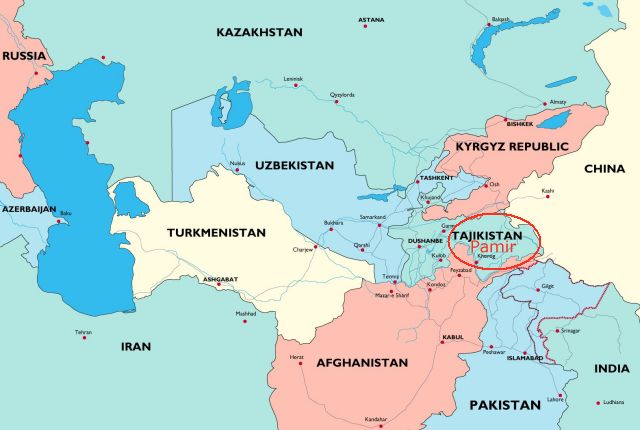
This picture was taken looking into Afghanistan from Tajikistan on the Pyanj River. The Pamir Mountains, which can be seen here, are formed by a junction in the Himalayas and are among the world’s highest mountains.


Do you have photos of a faraway place that few have seen & shared? Share them with us! Submit to our Flickr Pool and it could be the next Photo of the Day!

Afghanistan’s first skateboarding park, Skateistan


Two years ago, a couple of Australians started teaching kids in Kabul to skateboard. For free. The activity instills them with confidence and courage, and offers them what youths all over the world want: a way to escape. “Teenagers are trying to dissociate from old mentalities, and I’m their servant,” Oliver Percovich, one of the Australians, told the New York Times last January. “If they weren’t interested, I would’ve left a long time ago.”

Now, with the help of over $650,000 in private donations and land, water, power and security from the Afghan Olympic Committee (AOC), Afghanistan has opened its very first first skatepark, Skateistan. Skateistan is a 19,380 square foot indoor arena which contains a learning area at the back with classrooms for studying and computer use.

“We managed to bring together about 200 street children, this sport is not only entertainment for them, it is also giving them hope for their future,” said AOC head Mohammad Zahir Aghbar. Classes are still free, and the children of the rich and poor come together at Skateistan, many of them sponsored by the organization itself — Reuters reports that at least one child is able to skate and learn there instead of selling gum on the street because Skateistan pays her parents the $1 per day she used to earn.

Check out more information about the Afghan Stake School and how to get involved and/or visit at Skateistan.org.

[via Reuters]