Next feature for the A380? Showers!

Dubai’s Emirates airline just started revealing some plans for its A380 configurations. They’re the second customer for Airbus’s giant airship with delivery slated for later this year. And it looks like they’re going to try to beat Singapore Air, the first customer, in sheer ridiculousness of their first class product.

With showers. Yes, first class travelers on the new, highly-coveted Emirates A380 routes will soon be able to take a shower while they’re flying in the world’s skies. The service is slated to unroll on the new New YorkDubai A380 route scheduled for October 1, but eventually will be augmented into all of their super jumbo jets.

I’m curious as to whether this is going to be a high-water pressure, multi-head luxury shower or a tiny RV-style drizzle of water from the ceiling.

To support this service, Emirates plans to haul an extra TON of water on the aircraft, thus as the Times Online reports, increasing the carbon output by an extra 25 tons. Baffling. But as many airlines are wagering these days, the real money lies in the business class product. We cattle will pay anywhere around $1,000 for a flight between New York and Dubai, but each business class ticket should run around $18,000.

So much for being eco-friendly.
As the A380 creeps closer to the USA, Brits wonder “why are there ash trays”?

I’m sure that you’ve heard of the A380 by now, Airbus‘s super mega jumbo modern noah’s-ark behemoth of an aircraft, capable of carrying ten thousand passengers, flying around the world twelve times and curing myopia. It’s pretty sweet. And I mean that, it’s a magnificent creature.

I’ll bet you that many of you haven’t seen it in real life though, save for a few insiders in the industry and travelers in the South East Asian sector. Fact of the matter is, Singapore Airlines is the only customer with the aircraft right now and they aren’t flying the bird anywhere near our shores.

But they’re edging their way around the world. With delightful fanfare and general British hobknobbery the A380 made it’s first appearance in London last week and the redcoats are tickled pink. Swooning reviews are popping up left and right serenading the aircraft and telling us wild stories of how in business class they have two hooks for your coat on the seat in front of you. Two hooks! I could do anything with two hooks! They do go on to raise and answer an interesting question about ash trays though and why the heck modern airlines are still required to have them.

And honestly, I am looking forward to my first A380 flight, although unlike most reviewers I’ll probably be rolling like everyone else in cattle class. If you’d like to check out a review without the pleasure of the writer drooling all over himself though, check out The Cranky Flier’s experience.

Why the fuss about the EADS Boeing tanker order?

If you’ve been following the news over the past few days, you may have learned that congress and Americans alike are up in arms about the Air Force’s recent contract with the European Aeronautic Defense and Space Company (EADS), parent company to Airbus, to manufacture the next generation of their airborne tankers.

EADS recently outdesigned and outbid local favorite Boeing on the contract to win the 40 billion deal. The job is purported to create over twenty thousand jobs in Alabama and Kansas, while over forty thousand jobs would have been created (or retained, rather) at Boeing.

This is what has got so many Americans angry. But don’t be so quick to jump on the bandwagon. Here are a few points to consider before you start burning your stockpile of french fries, crepes and berets:

  • The US Airforce chose the aircraft that would work best for the armed forces. The two competing aircraft were compared based on five criteria, and in each of those categories, the EADS aircraft was superior to the Boeing. All of them.
  • The armed forces are required by law to not consider jobs created or lost in their selection process. A law called the Buy America Act also stipulates that they must hold several EU nations in the same manufacturing regard as the US. So even if they wanted to discriminate against workers in Europe or America, they couldn’t.
  • EADS, and thus Airbus, is not a French company. It’s a European conglomerate with multiple countries sharing ownership.
  • Competition is good! If we didn’t have two large airframe designers in the market, the resulting monopoly could result in poorly made, expensive machinery.

From an engineer’s standpoint, it’s simple to me: pick the product with the best price to performance ratio. In this case, it was the EADS aircraft. That’s it. I know our trade deficit will broaden, but this is not an area in which we want to pick a fight.

What irritates me is how politicians, bureaucrats and line workers paint the picture of the Air Force hating America and our troops because of this contract. As one union worker on NPR complained:
“It’s not the best. Boeing makes the best aircraft in the world. Not Airbus. Airbus makes cheap crap.”

We’re still creating jobs in the United States with this contract. We’re also finding the best, most cost-effective way to update our aging tanker fleet. Boeing, and our economy will survive.

Check out the NPR Morning edition article for more info.

The biggest plane ever built

I just saw The Aviator, director Martin Scorsese’s 2004 blockbuster with Leonardo DiCaprio as aviation tycoon Howard Hughes.

It’s a pretty entertaining movie that really gives you a glimpse into the airline industry’s early days–when Pan-American was pretty much the only business in town. The story does feel a little dragged out and pretty early on, you already get the picture that Hughes is a bit of a nut.

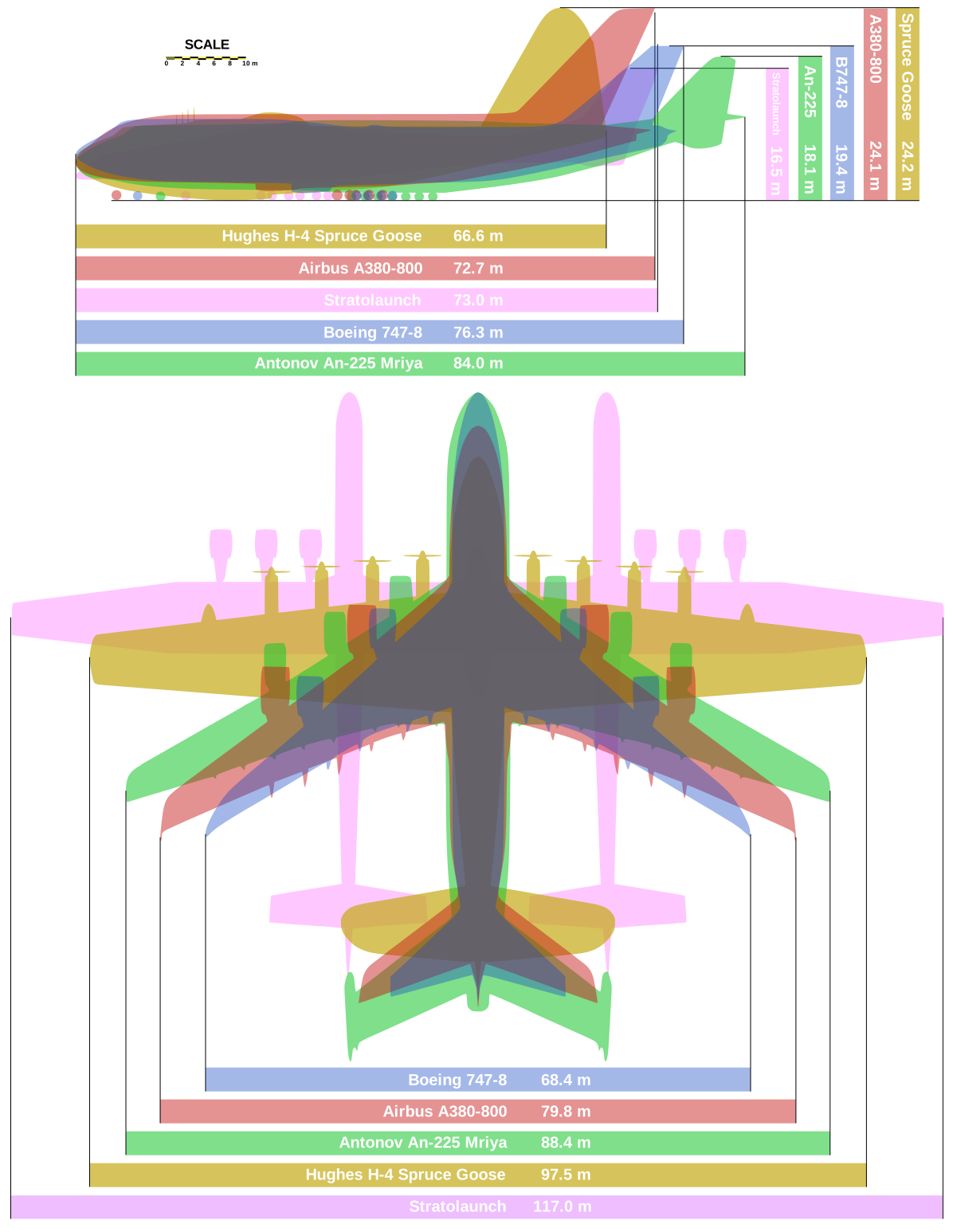
One of the more relevant part is his development of the “Spruce Goose”, or more properly, “The Hercule”, quite frankly the world’s largest airplane ever built. At five stories and more than a football field in wingspan, this wooden plane (that’s right, it was made from wood because aluminum was too scarce during WWII) still beats out the Airbus A380 in size.

So the next time you’re on an Airbus, or even a Boeing 747, imagine if that whole thing was made out of wood–and made fifty years earlier.

Here’s a great graphical comparison.

Airbus A380 moves towards flying green

Airplanes are not the world’s most eco-friendly commodity. To make amends with their carbon emissions, some airlines offer CO2 offsets for passengers. On Friday, Airbus took an even bigger step with its much talked about A380; it became the first commercial airline to fly with alternative fuel on a test flight from Filton, UK to Toulouse, France.

The fancy-schmancy A380 needs no modifications in order to use gas-to-liquid (GTL) fuel which is mixed with 60% regular jet fuel. Although the GTL used is no cleaner in terms of CO2 emissions, it produces no sulfur, providing for better air quality. Using alternative fuel in a commercial airliner, even at a small percentage, is also symbolically important; GTL is the first step in moving towards biomass-to-fuel (BTL), which could be concocted with anything from wood chips to industrial hemp. Maybe one day we will see airplanes running on 100% renewable resources, until then Airbus is calling its alternative fuel friendly A380 the “gentle green giant.”

The first commercial use of GTL might be by Qatar Airways in 2009. Until then it might be better to consider other options for green travel.