Budget Guide 2013: Downtown Manhattan

There’s always something new to discover in New York City, and if you’ve always stuck to the landmarks, skyscrapers and overpriced restaurants of midtown, now might be the time to venture south to the wilds of up-and-coming neighborhoods like Chinatown.

Here, the buildings are shorter, the streets are narrower and the Starbucks are less ubiquitous. Chinatown is a gritty neighborhood, with its congested streets, mysterious foreign smells and aggressive fake Rolex vendors. It is also one of the city’s most vibrant ethnic enclaves, with bright fruit stands, bargain foot massage parlors and scores of dingy but delicious eateries.

But the times, they are a-changing. In the past few years, farm-to-table fusion restaurants have started replacing the neighborhood’s traditional Chinese noodle shops. Some trace Chinatown’s renaissance to the opening of Apotheke, a trendy artisanal cocktail bar on Doyers Street. But it was Parisian club Le Baron that sealed the neighborhood’s fate when it selected lower Mulberry Street as the site for its much-hyped New York outpost last year. Real estate developers have descended on the neighborhood, branding the easternmost part of it “Chumbo” – a mash-up of “Chinatown” and “DUMBO,” its trendy Brooklyn counterpart. Costs, in turn, are rising.

However, deals can still be had for the budget traveler. Lower-end hotel chains fill the neighborhood, and cheap eats abound. Plus, Chinatown is a landmark in and of itself – just stepping out the door can yield dozens of classic New York experiences. Catch it while you still can.


Hotels

Wyndham Garden Chinatown: Opened in late 2012, the Wyndham Garden Chinatown is a bright new addition to Chinatown’s budget hotel scene. The contemporary 106-room property is located right in the heart of the Bowery, one of lower Manhattan’s main thoroughfares. Floor-to-ceiling windows look out on the hubbub of the neighborhood, while double-paned glass keeps the street noise muffled. All in all, it’s a clean and comfortable option. From $116. http://www.wyndham.com/hotels/new-york/new-york/wyndham-garden-chinatown 93 Bowery

Howard Johnson Manhattan SoHo: Forgive us, that’s “HoJo,” according to Howard Johnson’s youthful new branding campaign. The roadside motor inn has spiffed itself up for its brand new downtown Manhattan location, with pop art on the walls and neon purple track lighting in the lobby. Rooms are small but feature amenities like free Wi-Fi and flat-screen TVs. Early reviews are positive, with raves about comfort and value. From $169. http://www.hojo.com/hotels/new-york/new-york/howard-johnson-manhattan-soho 5 Allen Street

The Nolitan: Splurge on a room at the area’s first luxury boutique hotel, located just above the Chinatown border in trendy Nolita. The 55-room hotel opened in early 2012 and offers modern industrial design from Grzywinski+Pons, the same team behind the Lower East Side’s popular Hotel on Rivington. While prices may hover slightly above the typical budget range, guests can save on the affordable mini bar, free access to nearby 24-Hour Fitness and free bike, skateboard, laptop, iPad and video game system rentals. From $285. http://nolitanhotel.com 30 Kenmare Street

Eat and Drink

Nom Wah Tea Parlor: New York’s oldest dim sum teahouse reopened in 2011 under the energetic Wilson Tang, a former banker and nephew of former owner Wally Tang. Wilson redid the restaurant’s interior but kept vintage touches like the original tea booth, 1920s-style leather seating and newspaper clippings celebrating the teahouse’s 93-year history. Prices for small plates are in the $3-$7 range, while traditional teapots are around $1. Don’t miss the shrimp siu mai and house special pan-fried dumplings; they are superb. http://nomwah.com 13 Doyers Street

Nice Green Bo: Tourists regularly queue up for soup dumplings at Joe’s Shanghai, but locals in the know tend to prefer nearby Nice Green Bo. The dingy hole-in-the-wall restaurant offers a full menu of Shanghainese specialties, but its main draw is succulent steamed soup dumplings filled with crab and pork. http://nicegreenbo.com 66 Bayard Street

Epistrophy: Vintage furniture and antiquarian knickknacks fill this charming café and wine bar, which serves a reasonably priced selection of wine, coffee and panini. The place shines in the spring, when the windows are left open to welcome in the neighborhood. http://www.epistrophycafe.com 200 Mott Street

Budget Activities

Museum of Chinese in America: This under-the-radar museum excels in its series of quirky and relevant exhibitions. Currently on display are two comic-themed exhibits: “Marvels and Monsters: Unmasking Asian Images in U.S. Comics, 1942-1986” and “Alt.Comics: Asian American Artists Reinvent the Comic.” April will see the unveiling of two fashion-oriented showcases: “Front Row: Chinese American Designers” and “Shanghai Glamour: New Women 1910s-40s.” Admission is regularly $10 but free on Thursdays. http://www.mocanyc.org 215 Centre Street

LES Tenement Museum Neighborhood Walks: What better way to explore the neighborhood than by walking it? Learn the history of lower Manhattan’s immigrant communities through the Lower East Side Tenement Museum’s informative neighborhood walking tours. “Foods of the Lower East Side” is a particularly delicious way to get acquainted. http://www.tenement.org 103 Orchard Street

Pearl River Mart: Bypass the counterfeit handbags of Canal Street and head instead to Pearl River Mart, a massive emporium of cheap, quirky novelty items, like bright kimonos and paper lanterns. It’s the perfect place for souvenir hunting. http://www.pearlriver.com 447 Broadway


Get Around

Downtown Manhattan is relatively accessible from New York’s major airports. From JFK, you take the J subway line from Jamaica Station-Sutphin Boulevard direct to Chinatown’s Canal Street. Public transport from LaGuardia and Newark can be more arduous, with multiple stops and transfers. Google Maps is the best way to compare your transportation options in the city, whether you’re taking a taxi, riding the subway or using your own two feet.

If you’ve previously relied on traditional forms of transportation to get around, prepare yourself for some sticker shock this year. Subway fares are slated to increase from $2.25 to $2.50 per ride this March, following a 17 percent rate spike for taxi fares that occurred last year.

But there is a budget option: the bicycle. New York is to unveil its new Citi Bike Share this May, with 10,000 bikes distributed among 600 stations across Manhattan (and parts of Brooklyn and Queens). A day pass can be purchased at any kiosk for $9.95, while a seven-day pass will cost you $25. The city has made major improvements to its biking infrastructure over the past few years, and a fantastic new path recently opened on Allan Street that connects Chinatown to upper Manhattan.


Budget Tip

Wake up early and go for a stroll through Columbus Park, Chinatown’s largest public park. Historically known as Five Points, this area was once the formidable site of the gang violence depicted in “Gangs of New York.” Today, it’s where Chinatown’s elderly community gathers for early morning tai chi and mah-jongg. Pick up a milk tea and pork bun, grab a bench and pay witness to the last vestiges of a neighborhood in transition.

[Photo credits: AP Photo/Bebeto Matthews (top photo) and Andrew Burton/Getty Images]
Lost And Found: How Uncertainty Makes Travel Memorable

As the bus begins to pull away from the bus stop in Chania, I catch the old man’s eye again, giving him a thumbs-up through the window. He stares back blankly – then leaps to his feet, waving his arms, pointing, shouting. I raise my hands in an uncomprehending shrug, keeping the palms turned inward to avoid flipping him a mountza, the traditional Greek insult. He shouts louder, as if volume alone could break through the language barrier that had us miming to each other a few minutes ago. Then his body slumps into a pose recognizable the world over – “Oh, you bloody fool” – and that’s when it hits me in the stomach.

I’m on the wrong bus.

I have an hour before my ferry leaves the port of Souda, taking me away from Crete and back to mainland Greece. If I don’t hit that ferry, my carefully engineered schedule slithers through my fingers and I’m left untethered, without local knowledge, a decent enough grasp of spoken Greek or the money for new tickets. Without that ferry, I’m lost.

I sit down, by order of my knees, and stare out at the dusty, baked scenery as we rattle God-knows-where-wards. And then something strange happens. Panic ebbs away. I start to appreciate how lovely the light is, the rose-fingered sunset fading through the spectrum into that special glowing blue that enlivens domed roofs and door-frames right across Greece. I’m warm, I’m well fed, and I have no idea what is going to happen next – and it’s this last feeling that is so intoxicating right now.

Perhaps this is the wrong question. Perhaps it’s really this: why do I want travel to be easy?

When most people travel, they seek the unknown – either in a familiar, packaged, piecemeal form with the help of guides and tour operators, or the raw, improvised version that’s so popular with people young enough for their nervous systems to take it. I go off the beaten track using a third approach, which I like to call “Oh You Bloody Fool.” Somewhat appropriately, it’s a way of travel I accidentally fell into. I go places, things go wrong, and I fall through space, screaming. This is usually, but not always, a metaphor.

There’s a perverse joy in having your travel plans collapse around you. I’ve missed many flights and will doubtless miss many more. Once I get over the initial shock, once I’ve leaned against the nearest wall and cursed everyone up to and including the Wright Brothers, a calmness steals over me. I change. Lacking any alternative, I’m forced to become the person who can deal with this mess. My senses fly open, taking great gulps of the world around me, collecting data for my suddenly hyperactive brain to sift through in search of Life Or Death Answers. My heart thumps. My jaw sets. No time to waste – and off I go.

In “A Field Guide To Getting Lost” (2006), Rebecca Solnit says:

“The thing the nature of which is totally unknown to you is usually what you need to find, and finding it is a matter of getting lost.”

I’ve spent a lot of the last decade getting lost. I’ve been lost on England’s North York Moors in the middle of a rainstorm with the light fading – one of the few times I’ve genuinely hated not knowing my location. I’ve blundered across Berlin at 4 a.m. in search of my hotel, clutching a rain-dissolved paper map. I’ve suffered a thousand deaths of embarrassment in front of strangers, and I’ve eyed other travelers – so competent, so self-assured – with a mixture of envy and hatred. Why can’t I land on my feet instead of my face? Why does it all have to be so hard?

Perhaps this is the wrong question. Perhaps it’s really this: why do I want travel to be easy? When it’s easy, it’s a non-experience that our memories can’t get a grip on. Thanks to the miracle of GPS, we need never be lost. We can get from A to B knowing exactly what B looks like and having a machine dictate the entire route to us. Our technological support networks are vast and all-powerful, and our guides, physical and virtual, know more about the places we’re going than we ever will. We are mired in certainty and we need never put a foot wrong. But what if that’s not what we need – or why we travel at all?

I’m not pondering any of this as my bus takes me away from Chania. I’m fully in the moment, hunting for clues to where this bus is going, scanning the horizon for landmarks that tally with the map in my “Rough Guide.” There are 11 people on that bus. One lady is wearing a brown hat; one man has spectacularly hairy ears. These details are unforgettably burned into me by an elevated level of awareness …

I’m having the kind of travel experience I left home in search of.

Ten minutes later, the port of Souda hovers into view, and I realize, with curious disappointment, that I’m saved. I’m on the right bus after all. I unwittingly compensate by getting off the bus far too early, forcing me to sprint the final mile with a fully-laden backpack, and then I spend the first hour of my ferry ride lying semi-naked on the cool metal floor of my cabin, trying to bring my temperature down. The rest of the journey is a self-recriminating haze.

These days, being lost is at the heart of the kind of travel I love, filled with stories I don’t know in advance, positioned along the uncomfortable line between serendipity and disaster. Occasionally wild uncertainty is thrust upon me, as when I was robbed of my passport in Düsseldorf, seven hours before my flight home to England. (Ever wondered how long a UK emergency passport takes to put together? About six hours.) I’ve learned to appreciate these experiences for what they are – a living hell at the time, a treasure-trove of travel memories afterwards. All that said, I give myself lots of leeway nowadays, spacing out connections and over-budgeting where I can. I may be a bloody fool, but I’m not stupid.

[Photo Credit: Flickr user Jenny Downing]

Budget Guide 2013: Columbus, Ohio

Columbus, Ohio, is known as both “Cowtown” and “The Biggest Small Town in America,” nicknames that begin to shed light on the destination’s Midwest charm mixed with big city amenities. Relative to other urban centers, the streets are safe and the people are friendly, yet you’ll find restaurants, galleries, shops and other attractions that have Columbus competing with cities two and three times its size.

Contrary to many other cities across the nation, the population of Columbus has been growing steadily. This influx of new residents has led to many new business openings in the city, and kept healthy competition amongst both old and new proprietors. Here, the average price for a beer at a bar is a modest $3.50, and meals at reasonably priced restaurants will only set you back about $10 per person. The food scene is delicious, there are plenty of attractions to explore, and getting around is simple – whether you’re traveling by foot, bus, bike, taxi or even pedicab.

If you need more convincing, consider this: Columbus has been ranked a top shopping destination by Forbes, a top arts destination by American Style, a top city for biking by Bicycling Magazine, and the city’s Science Center, COSI, was named the number one in the country for families by Parents Magazine. On top of that, National Geographic recently named the city one of the top 10 best fall trips. Spend a long weekend in this city, and you might find yourself wanting to come back for more.


Hotels

The Wayfaring Buckeye Hostel: Columbus is known for its mega-sized university, Ohio State, and this newly established house-turned-hostel is the place to be if you want to stay in the heart of it all. The whole place is ready to party: on the front porch you’ll find a beer pong table, the common area is outfitted with a projector screen for movies and a foosball table, and the back patio frequently hosts music performances. Despite the frat house atmosphere, managers keep the hostel clean, and visitors can also take advantage of free Wi-Fi, bicycle rental, laundry facilities and more. From $25.
WayfaringBuckeye.com 2407 Indiana Ave.; 614-754-0945.

The Lofts: At this recently renovated boutique hotel in Columbus’ Arena District, old meets new: the hotel’s exterior is set in a historic former warehouse, yet inside you’ll find clean, contemporary designed rooms with exposed brick walls. Other amenities include an indoor swimming pool and an on-site restaurant. Be sure to check into package deals, as the hotel has been running a special where they throw in a third night stay for free, bringing the overall price tag way, way down. From $144 (before discount).
55Lofts.com 55 East Nationwide Blvd.; 614-461-2663

German Village Guesthouse: If you’re looking for something a little quieter, the cozy German Village Guesthouse is not only ranked as the top bed-and-breakfast in Columbus on TripAdvisor, but was also voted the “Best Hotel/B&B in Columbus” in the 2012 reader poll by 614 Magazine. Some of the rooms offer great views of the Columbus skyline, and on the ground you can explore the cobblestone streets and lush gardens of historic German Village, a neighborhood on the National Register of Historic Districts. From $195.
GVGuesthouse.com 748 Jaeger St.; 614-437-9712

Eat and Drink

Grass Skirt Tiki Room: The newest oasis in Columbus’ downtown area is this tiki-themed bar, the brainchild of the city’s ragtag group of unorthodox restaurateurs, the Columbus Food League. Here you can chow down on a Loco Moco (traditional Hawaiian dish of burger patties over rice smothered in gravy and a sunny side-up egg) while throwing back a mai tai, or you could head to one of the group’s other restaurants: the Surly Girl Saloon, Betty’s Fine Food and Spirits, or Tip Top Kitchen and Cocktails, where you’ll also get a dose of Ohio history.
GrassSkirtTiki.com 105 N Grant Ave.; 614-429-3650

Bodega: Every Monday night hipsters flock to Bodega, when the restaurant offers $1 panini-style grilled cheese sandwiches. What money you save on dinner you can contribute to trying one of the restaurants 50+ craft beers on tap – which, by the way, are also half off from 4 to 8 p.m. Don’t forget to try the local suds, including Columbus Brewing Company, Buckeye Lake Brewery, Elevator Brewing Company, Hoff Hearted Brewing and more. The patio makes for a great spot to people watch, while the interior has an artsy, sophisticated vibe. ColumbusBodega.com 1044 N. High St.; 614-299-9399

Food Trucks: These days, it seems as though you can’t talk about cheap eats without mentioning meals on wheels. Columbus is no exception to the food truck craze, with nearly 100 roving restaurants circulating the city. Options range from creole to crepes, Indonesian to Italian, pierogies to pulled pork, or Jamaican to Korean, but the trend that has really taken off are taco trucks. More than 40 of these trucks cater to Columbus’ fastest growing population – Latinos – as well as anyone else who wants a quick, tasty bite.
StreetEatsColumbus.com

Budget Activities

North Market: In the late 1800s there were four public markets in Columbus, each with a name paying homage to its cardinal direction. Today, only one remains: North Market. The current 36 merchants inside the building include delis, bakeries, pastry shops, ethnic restaurants, specialty goods sellers, produce stands and more. Even if you only pop in for a taste, don’t miss Jeni’s Splendid Ice Cream. This creamery takes the label “artisan” seriously, promising “[e]very single thing we put in our ice cream is legit.” Just last year, head honcho Jeni Britton Bauer won a James Beard Foundation Book Award for her cookbook, “Jeni’s Splendid Ice Creams At Home” – a great takeaway if you’re looking to bring a piece of Columbus back home.

Experience Cafe Culture: It would be far-fetched to say Columbus is the next Paris, but this city has become obsessed with cafe culture recently. Artisan roasters and craft coffeemakers are popping up all over the city, promising a cafe on nearly every street corner – that isn’t Starbucks. Cafe Brioso and Staufs Coffee roast all their coffees in house, while Back Room Coffee Roasters operates out of a local bike repair shop and Thunderkiss roasts single-origin coffees in less than five pound batches. There are also mainstays such as Cup o’ Joe and Crimson Cup.

Swim with Stingrays: You no longer have to go to a place like Belize’s “Shark Ray Alley” to swim with stingrays. Last year, the Columbus Zoo and Aquarium opened a new attraction, Stingray Bay, inside an 18,000-gallon saltwater pool that allows you to get up close and personal with the creatures. Touching the stingrays in Stingray Bay is perfectly safe, and it only costs an extra $3. Even better, you’ll be inside a top-rated zoo that was developed with great help from famed zookeeper Jack Hanna and is currently home to more than 9,000 animals. If that’s not enough, the zoo is adjacent to the Zoombezi Bay Waterpark. A day pass to both attractions is less than $30, and you’ll also save on parking!

Get Around

Columbus is easily walkable, with much of the city centered around the main north/south drag: High Street. Along this road you’ll find some of the city’s best bars, restaurants, art galleries and specialty shops. Several neighborhoods are worth a walk-through, particularly the Short North, the arts and entertainment district. If you happen to visit during the first Saturday of each month, the Short North hosts a free gala on fine art and food starting at 4 p.m., when all the galleries along High Street open their doors to unveil new exhibitions – and many offer small bites and samples of wine.

However, if you need to get from one end of High Street to the other faster than your legs will take you, the #2 bus operated by Central Ohio Transit Authority (COTA) can get you anywhere along this main artery for $2 per trip or $4.50 for a day pass. Since the city is flat, renting a bike is also a great option, or if preferred you can have someone else do the legwork by taking a ride in one of the many pedicabs that navigate the city.

Buses also service Port Columbus International Airport, which is six miles from Columbus. Use the trip planner on the COTA website to find the next bus, or just pop the address into Google maps to get bus directions to your starting (or ending) location. The next best option is a shuttle bus, of which there are many options to and from the airport.

Budget Tip

If you’re looking for a night out on the town without hurting your wallet, check out the Columbus-based website 20 Dollar Dates. There you’ll find plenty for two people to do, and you’re guaranteed to never spend more than a Jackson. Date ideas range from happy hour specials to nearby hikes to holiday-themed activities.

[Photo credits: Flickr user Jack Zalium (top image) and Flickr user codydean]

The Best Of The West: Classic Ski Lodges

Despite deceptively balmy temperatures in parts of the U.S., there’s still plenty of ski season left. Why not spend it staying at a classic ski lodge or chalet out West? These regal or groovy remnants from the early-to-mid-20th century are a dying breed, although some have been refurbished to good effect, while still retaining their original style. They also tend to offer friendly, personalized service, so you feel like a welcome guest, not just a number.

Classic places are often more affordable, and just as stylish and comfortable than their boutique or generic high-end chain counterparts. Even when they’re pricey, they’re a bit of living history that can give your ski trip a fun retro feel. Think racy Piz Buin and Lange boots ads, fondue, tight, color-blocked sweaters, Bicentennial Ray-Bans, and all things Bavarian.

Below, some favorite vintage ski accommodations across the West. Don’t forget your Glockenspiel.

Tyrolean Lodge, Aspen, CO
It may come as a shock that Aspen has a classic ski lodge that’s remained little-changed in atmosphere or ski-town spirit since its opening in 1970, but the Tyrolean is just that place. Located several minutes’ walk from the slopes, this no-frills, family-owned chalet is one of the best deals in town, with rooms starting at $155/night; some with kitchenettes. The rooms have been upgraded to be more modern, but the decor and vibe is still vintage Tyrol ski culture. Love.

Tamarack Lodge
, Mammoth Mountain, CA
This small, mid-century property overlooking Twin Lakes is on the California Register of Historic Places, and caters to the cross-country crowd. It has both European guesthouse style rooms, historic, refurbished cabins (see photo above), and from December through April, ski-in/out access. If the town of Mammoth is too hectic and soulless for you, consider this a peaceful alternative to the mainstream.
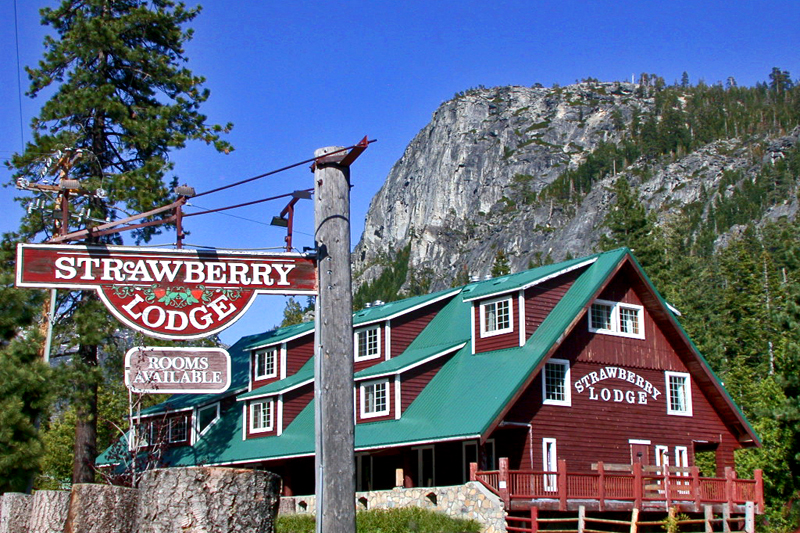
Strawberry Lodge, Kyburz, CA
Highway 50 Tahoe road-trip regulars will be familiar with this former Pony Express stop (right). Located off the side of the road in the nano-community of Kyburz, Strawberry is 20 minutes from South Shore. It’s seriously old-school, in that musty, funky way, with bad taxidermy, historical oddities, and is a much-loved Lake Tahoe institution.

With 31 rooms starting at just $49 a night (some are European style, with a shared bath), it’s hard to pass up, especially when you consider the proximity to all manner of vices, ranging from drinking (please don’t attempt to drive back) and gambling, to outdoor recreation. I love it because it’s one of the last remnants of old Tahoe, in a pastoral mountain setting. Strawberry also offers cross-country skiing, and the restaurant and bar can get hopping, sometimes with live music.

Sun Valley Lodge, Idaho
Built in 1936 at America’s first destination ski resort (with the world’s first chairlifts), the SVL was considered cutting-edge. It offered “every amenity a skier could possibly imagine.” Today, the 148-room property has been completely refurbished into a luxury hotel, complete with glass-encased swimming pool, yet it retains its majestic timber-and-stone facade and stately atmosphere.
P.S. Hemingway slept here.

Timberline Lodge, Mt. Hood, OR
Celebrating its 76th year, this National Historic Landmark (lobby, right) was built at a time when American heritage and the spirit of adventure crashed head-on with the Great Depression. FDR heralded the lodge as a “testament to the workers on the rolls of the Works Progress Administration,” which funded most of the property’s construction. The lodge shut down twice, once during WWII, and again in 1955, as it had fallen into disrepair. Under a new lessee, it was restored to grandeur and reopened later that year.

Located less than 90 minutes from Portland, Mt. Hood is a favorite local’s ski area. Timberline is built in the classic Pacific Northwestern lodge style, constructed primarily by hand of native timber and rock. The bright rooms are upscale rustic, with wood paneling, thick comforters, and stone fireplaces: all the trappings for a cozy getaway.

Alta Peruvian Lodge
, UT
Located at one of Utah’s premier ski resorts, this three-story wooden lodge had an unlikely start as a pair of barracks buildings in Brigham. They were relocated to Alta in eight pieces, and reconstructed into a 50-room lodge that opened in 1948. In 1979, an architect was hired to gussy up the property, although by today’s standards, it retains a retro Alpine charm (the kelly-green shutters decorated with Edelweiss, for example).

Rooms are straightforward and more motel than mountain lodge, but a fantastic deal, starting at $129 for a dorm bed. Prices include all meals, served family style in the lodge dining room, and free shuttle service to Alta Mountain and Snowbird. There are also twin and queen rooms with a shared or private bath, as well as bedroom suites. As for why the property is called the Peruvian? No one knows, although possibly it’s for a nearby landmark, Peruvian Creek.

Nordic Inn, Crested Butte, CO
Reopened on December 15, 2012, under new ownership, this beloved, 28-room Alpine lodge (right) opened over 50 years ago. Located just 500 yards from the slopes, the Nordic has refurbished half of its spacious rooms, which are now kitted out with hardwood floors, down comforters and pillows, and gorgeous Colorado beetle kill pine woodwork. The remaining rooms (which are a colorful ode to the ’80s, and a screaming deal for ski-in lodging) will be redone by June 1.

P.S. Ski lodges aren’t just for winter! Many are open year-round, and summer is also peak season for outdoor recreation.

[Photo credits: Tamarack, Mammoth Mountain Ski Area; Strawberry, 50Cabins.COM; Sun Valley, Sun Valley Resorts; Nordic Inn, Ken Stone]

Budget Guide 2013: Las Vegas

If the thought of Las Vegas conjures up images of flashy clubs, glitzy shows, an endless parade of limousines and eye-wateringly high table limits – you’re not entirely mistaken. This is a city where high rollers come to play and $3000-a-glass cocktails or $40,000-a-night hotel rooms are on offer for those with cash to burn.

However, the good news is you don’t need to have deep pockets to enjoy Las Vegas. The city has experienced a recent surge in hotel room capacity because of a series of new properties that opened during the depths of the recession. That timing means they’ve had to discount rates in order to keep occupancy up and other hotels have followed suit.

Downtown Las Vegas – which has traditionally offered better prices than the Strip – is also drawing more visitors thanks to its ongoing renewal. Trendy bars like The Downtown Cocktail Room, The Griffin and recently opened prohibition-style lounge Commonwealth have been growing in numbers much to the delight of hipsters. Decent bang for the buck also makes them a great draw card for the budget traveler.

Hotels

When choosing a cost effective hotel, be sure to factor in the amenities and entertainment as well as the price, and remember that even upscale hotels offer excellent deals from time to time, making them a great value for the money.

A few more points to keep in mind when booking accommodation:

Hotel rates in Vegas vary dramatically depending on when you’ll be staying and when you book. Mid-week stays will be markedly cheaper than weekends, as long as there are no major conventions or events going on.

For the uber budget conscious, note that while Vegas does boast a handful of hostels, they tend to be in out of the way or in somewhat unsavory areas. So rather than paying $10-15/night for a dorm bed, share a room with friends at one of the hotels below for not much more.

To get the best rates, do a thorough search on online booking sites like Expedia and Kayak and then call the hotel to check current rates. Most will match a cheaper deal you find for their establishment online, and some will even knock off 10 percent of that price.

Beware that many hotels in the city charge a daily resort fee – it’s not always clear when booking but it can add a significant amount to your final bill, so always ask.

Here are a few options:

Main Street Station. Located just two blocks from Fremont Street in Downtown Las Vegas, this train-themed hotel is heaven for the history buff. Packed to the brim with antiques, the hotel even has a piece of the Berlin Wall – although ladies will have to enter the men’s restroom to see it. The hotel’s microbrewery and restaurant, Triple 7, serves up award-winning brews and a free shuttle service whisks guests to and from the Strip. The hotel doesn’t have a pool, although guests are welcome to use the facilities at the neighboring California Hotel. From $38. No resort fee but a $9.99 charge for Wi-Fi. mainstreetcasino.com 200 North Main Street, Las Vegas, NV. 89101.

The Stratosphere. This 1149-foot tower situated past the north end of the Strip just spent $20 million revamping its décor, restaurants and sky-high bar. The hotel is a bit out of the way of the action, but what it lacks in location, it makes up for in price. Guests still have relatively easy access to the rest of the Strip via bus, which stops outside the hotel; monorail, which is a short walk away near the Sahara Hotel; or by driving and making use of the free valet parking. Hotel guests are allowed free visits to the observation tower, which provides great views of the Strip. They also have access to two pools and a fitness center, but will have to pay for Wi-Fi. From $31 plus $7.50 daily resort fee. stratospherehotel.com 2000 Las Vegas Boulevard South, Las Vegas, NV. 89104.

Luxor. This three-star hotel in the shape of a sleek black pyramid is located at the southern end of the Strip and offers a great value for the money. Guests at the Egyptian-themed resort receive free pool and gym access, two free drinks per stay, Internet access and free parking. The hotel also boasts a newly revamped food court and a new interactive center for sports fans. Rooms are located in either the pyramid itself (complete with slanted elevators that provide access to the higher rooms) or the adjacent towers, which are newer. From $38 plus $18 daily resort fee. luxor.com 3900 Las Vegas Boulevard South, Las Vegas, NV. 89119.

Eat and Drink

Tacos El Gordo. This chain, which started in Tijuana, Mexico, is known for their authentic street-style tacos. Fillings include spicy pork, carne asada and carnitas, as well as tripe, tongue and brains for the more adventurous foodie. Tacos are small but cheap at $2 each and are topped with onions, cilantro, guacamole and various sauces. You can also grab a quesadilla, tostada, or fries loaded with guacamole, sour cream and your pick of meat. Bottomless soft drinks are also on offer. Don’t expect table service here – you’ll be ordering food at various meat “stations” and then paying at the cashier. The restaurant has a location downtown as well as one on Las Vegas Boulevard in a strip mall just north of the Wynn Hotel. The Strip location is open until 3 a.m. on weekdays and 5 a.m. on Fridays and Saturdays, making it an ideal spot to grab some late-night munchies.

Secret Pizza. Inside the swanky Cosmopolitan Hotel you’ll find a cheap and unassuming pizza place sure to satisfy late night cravings. Hidden away down an alley on the third floor of the hotel, the signless restaurant serves up New York-style, thin-crust pizza to hungry clubbers. The hidden pizza joint serves up pies and slices with a range of toppings, including white pizza, homemade meatballs, cheese and pepperoni. A slice will set you back around $5.

Buffets. We couldn’t talk about eating in Las Vegas without mentioning the buffets. There are more all-you-can-eat dining options in this city than you could possibly work your way through, with just about every hotel offering at least one buffet. As a general rule, buffets are cheapest earlier in the day (so breakfast or lunch will be a better deal than dinner). If you’re eating downtown, you’ll find plenty of lunch buffets around the $7 mark, and dinner buffets for about twice that price. One notable option on the Strip is the Buffet of Buffets. This is a day pass offered by Harrah’s that gives you access to buffets across their various properties (which include Paris, The Rio, and Planet Hollywood among others). For $50 you can eat as much as you like over 24 hours. Just beware that some of the premium buffets like the over-the-top one at Caesar’s Palace will add a $15 surcharge on top of the pass.

Activities

Pool Partying. Without a doubt, gambling is the number one activity in Las Vegas, but if you’re looking for other ways to have fun, hit up one of the city’s many pool parties. These daylong parties feature sizzling beats, bronzed bodies and typically, very pricey booze; however, the good news is you can often get into the parties for free. Some of the bigger venues include Rehab, located at the Hard Rock Hotel, and Wet Republic, at the MGM Grand. A more budget-friendly (and relaxed) option is the Venus Pool Club at Caesar’s where you can throw back a beer for around $8. Admission costs $10-30 depending on the night, but ladies will almost always get in free and men are often handed free passes too.

See a half-price show. Vegas has countless shows taking place every night, including comedy shows, concerts, dance performances, magic shows and acrobatics. Popular shows include The Jabbawockeez, Absinthe and various Cirque du Soleil performances, but there’s really something for everyone. You can buy tickets for half the box office price by visiting tix4tonight, which has a number of locations along the Strip.

Free entertainment on the Strip. There’s no shortage of things to see on the Strip, and wandering through the various themed hotels is an activity in itself. Experience the canals of Venice, see the Sphinx, or take your photo in front of the Eiffel Tower. Nature lovers can enjoy the Conservatory and Botanical Gardens at the Bellagio – the horticultural displays are constantly changed to suit the season. You can also see flamingos, along with a variety of other birds in the Flamingo Hotel’s wildlife habitat. Vegas hotels also put on a number of free performances to draw in the crowds. At Circus Circus, the world’s largest permanent circus comes alive at 11 a.m. daily, where you can see new world class acts like the Ethiopian foot juggler or the aerial silk artist from Italy. In front of The Mirage, a giant volcano erupts every hour from 5-11 p.m. The Sirens of TI is a 20-minute show featuring hip-swinging sirens and swash-buckling pirates that’s somewhat risqué. It takes place nightly in front of Treasure Island. For something tamer, take in the fountains at the Bellagio, which dance to music every 15 minutes from 7 p.m. onwards, and every 30 minutes during the afternoons. The Bellagio has begun adding new “dances” to the fountains’ repertoire.

Take a Stroll Downtown. If you venture downtown, check out the Fremont Street Experience. The historic street is home to the largest LED screen in the world in the form of a giant canopy over a pedestrian walkway. Visitors can watch a dazzling display every night on the hour, and the light show is usually accompanied by music and other live performances. While you’re downtown, don’t forget to check out the Neon Museum featuring original neon signs that once glittered across the city’s casinos. The museum is made up of several components: the Downtown Gallery at Fremont Street and Las Vegas Boulevard displays restored, illuminated signs; while the Neon Boneyard is an outdoor museum home to donated and rescued signs. The Neon Museum is just the start of a grand plan to revitalize the downtown area (after Zappos relocated to the city, it set up the Downtown Project, which aims to completely transform Vegas’ urban core) so keep an eye out for more arts, music and cultural developments in the months and years to come.

Get Around

To get to and from the airport, you can take bus routes 108, 109, or the Westcliff Airport Express. A single ride costs $2 – buy your ticket at the bus stop vending machine before boarding. Alternatively, a number of shuttle services ferry passengers between the airport and hotels on either the Strip or downtown. Most cost $7 for Strip hotels and $8.50 for downtown destinations. A taxi from the airport will cost around $15 depending on the route.

Las Vegas is well served by public transport and most visitors will be able to get around sufficiently on the double decker bus known as The Deuce. The bus runs between downtown and the Strip, making stops at most major hotels. The Strip and Downtown Express Bus (also known as the SDX) runs along a similar route but is much faster due to the limited stops. The Deuce runs 24 hours a day, while the SDX starts operating after 9 a.m. Both run every 15-20 minutes. Passes can be purchased at the vending machines located at bus stops. They’ll set you back $6 for two hours, $8 for a one-day pass, or $20 for three days.

A pricier option is the monorail, which runs from the MGM Grand on the south end of the Strip to the Sahara at the north end. The line runs behind the hotels and casinos (rather than along Las Vegas Boulevard) and takes 15 minutes to complete the route. Tickets cost $5/single, $12/one day, $28/three days, or $43/five days.

Budget Tips

Free Wi-Fi. If your hotel charges an extravagant fee for wireless Internet access, it’s worth knowing that the various MGM properties provide free Wi-Fi to the public. The hotel group offers complimentary service in its casinos, pools, lobbies and restaurants – and you don’t need a password or room key to access the network. At the time of writing, Wi-Fi is already available at the Bellagio, Mirage, Mandalay Bay and MGM Grand and is being added to the Monte Carlo, Luxor, New York New York and the Excalibur.

Day passes to hotel pools. You don’t have to be a guest at one of the upscale resorts to use their amenities. For as little as $10 per day you can gain access to the pools of many of the hotels along the Strip. It’s great if you’re trying to save on accommodation costs but still want to be able to enjoy some of the luxe facilities the city has to offer. You can see a list of pools open to the public here. A particularly notable pool is The Tank at the Golden Nugget, which boasts a 200,000-gallon shark tank with a water slide that runs through it before dumping you in the pool. Cover charge for non-hotel guests is $20.

Drinking on the cheap. One of the cheapest places to drink in Vegas is in a casino, since most of them serve free alcohol to gamblers whether they’re high rollers or only playing 1-cent slot machines. Just remember to tip the server $1 per drink or the service will quickly dry up. Many bars and vendors along the Strip also sell cheap frozen daiquiris by the yard glass – since you’ll rarely be prevented from taking a drink from one casino or bar to the next, it can be a cheap way to have a big night.

Room upgrades. Want to score a better hotel room than the one you paid for? Try the $20 trick. Simply slip the hotel receptionist $20 when handing over your credit card and ask if any upgrades are available. If you’re staying at a budget hotel, you may get away with tipping significantly less. You can read more about the success rate of this strategy at various Vegas hotels here.


[Photo credit: Flickr user David Stanley]