Rome – 3 days in Italy

With the bustle of a large European metropolis and the detritus of a monumental past, Rome delights with a frenetic pace and antiquities lurking innocuously around each bend in the road. Here, history has been built on top of history for thousands of years. Seeing bankers in candy red Alfa Romeos zipping by millenia old ruins frames the endurance of this old city. Each sediment in time is visible and speaks to the ancient tale of decaying empire and modern function. The past is everywhere. You may be taking a stroll to sample some Trippa for a late lunch and accidentally stumble upon the Pantheon. There is a certain beauty to this unplanned chaos, and the overlapping of ages is historical mayhem at its most charming.

Rome is estimated to have been settled over ten thousand years ago. It has been a destination for a very long time. It is said that all roads once lead to this settlement on the Tiber. Thankfully, getting to Rome is inexpensive care of European budget air lines. Easyjet flies to Rome from several European cities such as Paris, London, Berlin, and Amsterdam for under $200 round-trip. Three days is plenty of time to see the highlights of Rome, but budget more time to truly understand this storied destination.

%Gallery-119063%

Day 1 – Roam the streets of Old Rome

One of the most amazing qualities of Rome is the integration of the ancient city into the modern metropolis. Most ancient sites beautifully disturb the modern order of things. On an old square, a McDonald’s faces the Pantheon in a worthy example of the strange compromises the present has made with the past. Due to this integration of the historical and the proximity of many Roman landmarks to each other, Rome is a great city for wanderers.

Start at the Colosseum, and take in the crumbling feat of ancient engineering. The queue at the Colosseum can be rather daunting, but booking tickets in advance or purchasing a Roma pass bypasses the line. Here is a great online resource for line skippers. Around the Colosseum, also seek out the Arch of Constantine. It is hard to miss.

From the Colosseum, start heading northwest towards Foro Romano, or the Roman Forum – the ancient seat of Roman government. It is a ruined old structure, and its considerate ambitions can be ascertained by the remnants. The Foro Romano is just east of Palatine Hill – one of the seven hills of Rome. The Circus Maximus, or old chariot racing ground, is just on the other side of the hill.

Continue northwest along Fori Imperiali road and slowly make your way to the heart of Rome. You will pass Foro Traiano, Piazza Campidoglio, and several other breathtaking landmarks. Eventually, if you stay the course, you will arrive at the doorstep of the Pantheon. The Pantheon is such a feat of engineering that it is still the world’s largest unreinforced concrete dome. During the renaissance, master architects such as Brunelleschi studied the Pantheon’s construction to reverse engineer advancements in the architectural field. This was 1300 years after the Pantheon’s construction. To call the Pantheon a marvel would be an insult. It stands as a testament to conquering impossibility.

Next the Pantheon, duck into Tazza D’Oro for some caffeine rejuvenation. Tazza is accused of making the best cappuccino in Rome. The place is busy and confusing. Follow someone who looks like they know the lay of the land.

Head north and east to the Trevi fountain, where well wishers toss away an estimated 3000 Euros per day. It is said that if you toss a coin into the Trevi fountain, then you will be guaranteed a return trip to Rome. North of the Trevi fountain is the Spanish Steps – the longest and widest staircase in Europe. Climb from the Piazza di Spagna to the top and cherish the view out over Rome.

For dinner, find a busy restaurant and order a lot of food. Rome is a mecca for food and has multitudes of delicious options. It is difficult to find a bad meal in Rome, so be adventurous. Hostaria Antica Roma on Appian Way is highly recommended.

Day 2 – Vatican City and Sistine Glory

Vatican City is a sovereign city state ruled by the Pope. With a population of less than a thousand, and only 110 acres in total size, the Vatican is considered the smallest country in the world, edging out the micro-state of Monaco. This center of the Catholic world boasts immaculate gardens, a heavenly basilica, and one of the top museums in the world.

The best way to reach the Vatican is on foot by crossing Ponte Sant’Angelo over the Tiber River. Castel Sant’Angelo is framed gloriously between winged angels on both sides of the bridge. The castle is a great first stop of the day, and houses a museum and Hadrian’s tomb. Castel Sant’Angelo has been a tomb, a castle for the popes, a prison, and also figures prominently int the novel Angels and Demons by Dan Brown.

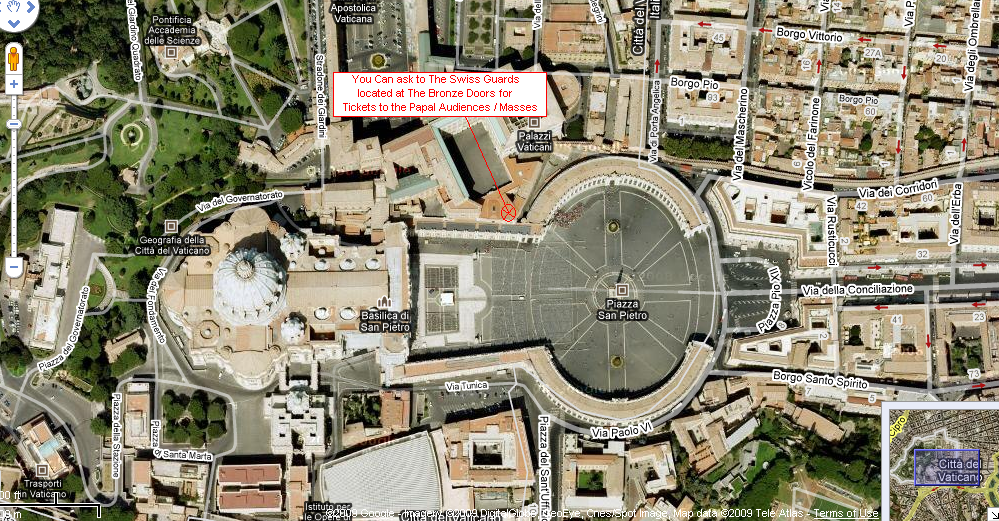
West of Sant’Angelo is Vatican City. Entering on Via della Conciliazione is probably the most dramatic way to approach the holy place. Once in Vatican City, take in the breathtakingly large Piazza di San Pietro (St. Peter’s square) before entering the basilica. The square boasts an obelisk that was relocated from Egypt almost two-thousand years ago.

The height of the Michelangelo designed dome in St. Peter’s Basilica is so lofty that you could fit the entire statue of liberty within the dome with room to spare. The interior of St. Peter’s is a heavenly place, festooned with gold finery and artistic masterpieces. You can climb to the top of the dome for a stunning view out across Rome, or take to the crypts beneath the marbled interior to check on some papal tombs.

If you happen to be in Rome on a Wednesday, then you can be blessed by the Pope himself. He hands out blessings at 10:30am on Wednesdays. Check with your hotel or guesthouse to arrange tickets for the event. The Swiss guard also hands out tickets on Tuesdays from their post near the bronze door. Be sure to check the Pope’s schedule before getting too excited about being blessed. He is a busy man and routinely leaves his Vatican home.

The Vatican Museum is my favorite museum in the world. From entire rooms filled with the works of masters to hallways covered with brightly painted maps of an uncertain world, this place is an unbelievable experience. Budget plenty of time to take it in. The museum is laid out to move you through several gorgeous rooms and immaculate hallways before climaxing at the Sistine Chapel. The museum is free the last Sunday of each month, and is not open any other Sundays. The rest of the week is fair game.
Finish your day with a stroll down the Tiber river just as dusk blankets Rome.

Day 3 – Trastevere and personal interests

With so many options around Rome, pick something personally interesting to do on your last day. Take a cooking class, check out the art at Galleria Borghese, go to a wine tasting, explore catacombs and crypts, check out Florence (only an hour and a half away by fast train), go to a football game, or perhaps just take to some serious shopping.

On your third night in Rome, spend some time in Trastevere. Trastevere is a cool neighborhood on the west bank of the Tiber filled with locals, expats, artists, and college students. It is a great place to sample authentic Roman food, explore, and get inexpensive lodging. The area feels less like a museum than ancient Rome and is a great place to get in touch with the city’s less touristy side.

All photography by Justin Delaney

Schengen and the disappearance of European passport stamps


Creative new use for border crossing posts at German/Austrian border.

In the late 1980s, an American spending a summer traveling across Europe with a Eurailpass would see his or her passport stamped possibly dozens of times. With a few exceptions, every time a border was crossed, an immigration agent would pop his or her head into a train compartment, look at everyone’s passports, in most cases stamp them, and move on. Every Eastern Bloc country required visas, some of which could be obtained at the border and others of which had to be applied for in advance.

Today, an American can enter the Schengen zone in Helsinki, fly to Oslo and then on to Amsterdam, proceed by train through Belgium, France, Italy, Slovenia, Austria, Hungary, Slovakia and Poland, then by bus to Lithuania, Latvia, and Estonia, and then by ferry back to Helsinki before catching a flight to Athens and landing in Greece without once needing to submit a passport to a border guard’s scrutiny.

The development of the Schengen agreement across Europe has altered the geopolitical map of the continent in many ways. For tourists, the development of the Schengen zone has simplified travel by drastically reducing the number of times a passport can be checked and stamped as national borders are crossed.

The Schengen Agreement is named after the town of Schengen in Luxembourg. It was here in 1985 that five countries-Luxembourg, Belgium, the Netherlands, West Germany, and France-signed an agreement to essentially create borderless travel between them. A model for this agreement had been created years before by the Benelux countries (Belgium, the Netherlands, and Luxembourg), which eliminated border controls back in 1948. The Nordic countries also did away with internal border posts, in 1958.

In 1995, the five original Schengen countries plus Portugal and Spain inaugurated the zone. In 1997, Austria and Italy joined. Greece followed in 2000 and the five Nordic countries joined in 2001. In late 2007, nine more countries joined the Schengen zone; most recently, Switzerland signed up in 2008.


Abandoned border crossing between Slovakia and Hungary.

Today, 22 European countries are part of Schengen. Every European Union country (save the UK, Ireland, Bulgaria, Romania, and Cyprus) belongs. Other members include EU holdouts Iceland, Norway, and Switzerland. The European microstates present a few complications. Monaco’s borders are administered by France, which makes the tiny principality a part of Schengen, while Liechtenstein’s accession, approved by the European Parliament in February, is pending. San Marino and the Vatican are de facto versus official members, while mountainous, landlocked Andorra remains outside of the zone altogether.

There are five EU countries not currently part of the Schengen zone. The UK and Ireland (as well as the Isle of Man and the Channel Islands) operate a Schengen-like agreement called the Common Travel Area. Neither country is obligated to join the zone.

Romania, Bulgaria, and Cyprus, however, are all bound by treaty to eventually join. Romania has fulfilled all the criteria for joining Schengen and Bulgaria is close to fulfillment as well. These two countries will accede together, likely later this year. Cyprus presents a more complicated situation given the division of the island between the Republic of Cyprus in the south and the largely unrecognized Turkish Republic of Northern Cyprus in the north.

With the coming accession of the Western Balkans to the European Union, the Schengen zone will almost definitely continue to grow. Might it one day cover the entire landmass of Europe? Check back in two decades.

[Images: top image Flickr | Mike Knell; middle image Flickr | jczart]

Spring Break deals: Fares up overall, best deals can be found to Florida, Europe

The folks over at Bing Travel have been studying up on 2011 Spring Break airfare, and we hate to break it to you, but they’ve found that the average airfare cost is up more than 10 percent over last year, to $489. But the airfare increase doesn’t have to stop the beach party. If you choose wisely, there are still plenty of Spring Break deals to be had.

Bing’s Spring Break Travel Forecast says that lower fares on flights to Florida (particularly Fort Lauderdale, Jacksonville, Miami, Orlando and Tampa) can still be found. The average fare for Boston to Jacksonville is $233, and you can fly from San Francisco to Tampa for $300.

And while many overseas airfares have risen since last year, average airfares from several U.S. cities to Paris, Amsterdam and Rome have dropped as much as 13 percent over Spring Break season fares in 2010.

If you are just settling into spring break planning mode, here are some tips from Bing on finding the best spring break deals:

  • Be Flexible. Now we would never suggest skipping a day of classes, but, ahem, you will do better on airfare if you’re not trying to travel on weekend days like your Spring Break brethren. Monday to Monday or Tuesday to Tuesday fares will almost always be better. And if a school schedule isn’t determining when you vacation this spring, you will likely save money by going at the beginning of March or April rather than the middle of either month.
  • Use Online Tools. You can monitor your airfares and get notices when they drop on a certain route from a number of different online services. Bing’s Price Predictor shows you whether airfares on your chosen route and dates are rising or falling, to help you decide when to buy.
  • Be Aware of Hidden Fees. Be sure you know what you will be charged for checked baggage, overweight luggage, aisle or exit row seats before you hit the airport.

Bing is giving away five $100 travel stipends for 2011 spring break travel on Twitter. To enter, tweet @fareologist with where you’d like to go for spring break. Check out the contest’s official rules before entering.

[Image credit: Flickr user Dawn Huczek]

10 unforgettable experiences in Venice, Italy

Visiting Venice is a lot like living in a painting. The colors and reflections feel ephemeral. You blink and the picture changes. The size of Venice ceases to exceed its usefulness as no corner, road, bridge, or shop seems wasted or useless. Each thing plays a part in defining her character. The peeling paint reflects glories of the past, with the new layers an homage to the upkeep of a starstung legacy. The beauty is so effervescent that even a blind man could make a career as a photographer here. While people may come and go, none forget. Hemingway hunted, Napoleon conquered, Monet painted, Leonardo invented, and millions more have gasped and gawked in the shadows of this most storied settlement. It is to be savored like some early morning dream that surreptitiously impacts the remains of the day.

In Venice, the ambiance alone is so beautiful and otherworldly that just wandering aimlessly provides fantastic results. Beyond errant exploration though, Venice provides many gorgeous sights and enchanting islands for travelers to explore. Here are 10 things to do in Venice and around the lagoon.

%Gallery-116624%
Carnevale
It was a damp Venetian evening, and I lobbed my luggage off the Vaporetto at Piazzale Roma. A massive crowd buzzed about the station, cackling and hooting. It was mid February, and I had not prepared for such crowds. During my flight in from arid Sharm el Shiekh, I had envisioned a wintry Venice where steps echoed across abandoned squares and snowflakes fell undisturbed to the ground. I was greeted with the opposite. A raucous party of some sort was in full swing. As I stood, trying to make sense of the madness at the station, a line of eight Lego men walked past, robotically one arm before the other, in slow deliberate motion. They disappeared into a menagerie of goblins, Baroque aristocrats, and tourists firing off rounds of photographs like young mujahedeen soldiers. I had unintentionally staggered upon Carnevale – a treat for the over prepared and uninformed.

Carnevale starts about two weeks before Ash Wednesday and ends on Shrove Tuesday, more commonly known stateside as Fat Tuesday. The costumes were introduced as a way for revelers to obscure identity and social class, allowing equal opportunity for debauching. The party spreads out across the heavily trafficked parts of Venice, with evening performances in Piazza San Marco and hordes posting up along the Rialto Bridge. While many European students make the trip to party, it is notably tamer than Mardi Gras, catering to a higher end demographic.

The Original Ghetto
If you have ever found yourself contemplating the etymology of the term “ghetto,” but were to lazy to do the wiki legwork, then you will at last be united with the term’s origin. The term is derived from the Venetian word for slag (gheto – a byproduct of smelting metal), and was attributed to the Jewish neighborhood in Venice that shared an island with a metal foundry. The old neighborhood still stands and is, in fact, the original ghetto. This ghetto was once the heart of the Venetian shipping empire and the inspiration behind Shakespeare’s Merchant of Venice. To reach the ghetto, exit the San Marcuola station along the Grand Canal Vaporetto and head northwest.

Piazza San Marco
At the heart of Venice is one of the most ambitious and breathtaking plazas in the world. A vast open space flanked by historic sights, its gravitational pull has attracted travelers for hundreds of years. The Clock Tower, Basilica di San Marco, Campanile di San Marco, and Palazzo Ducale are some of the most popular sights in Venice and each is situated on the Plaza. While this is the undisputed tourist destination for cruise boat daytrippers, even the most jaded anti-mainstream traveler will marvel at San Marco’s splendor.


Burano
Burano is an explosion of color. A residential archipelago about 30 minutes from Venice, Burano boasts buildings in every color as if created by a kid gone mad with a box of crayons. An order exists among the technicolor chaos though, as the government controls specificity regarding color choices for each home. If one of the 2,800 residents decides to paint, then he must first have his choices approved by the government. This process has fostered an aesthetic that is more Curacao than Caravaggio. While Venice has no shortage of photogenic subjects, Burano is the most vivid and unlikely. Even the locals’ hanging laundry bursts with a myriad of colors. Be sure to bring a camera and drop by a bakery to sample some S shaped Burano cookies. To reach Burano, take the Vaporetto on the LN line from Fondamente Nuove, and depart when you hear the Italian man shout “Burano, Burano.”

Torcello
Once a heavily populated island and Byzantine settlement, Torcello is now largely ruins and farms. A malaria epidemic and dead lagoon transformed a bustling trading hub with the East into a veritable no-man’s land in the Twelfth century. Today, the population hovers around 20, and is most recently noted as being a favorite hunting ground for Ernest Hemingway. Torcello is a quiet place to stroll through history undisturbed passed sheep and edifices of the past. A main draw is the cathedral of Santa Maria Assunta, built in the Seventh century. It is one of the few remaining structures from Torcello’s boom days. Torcello Island is located directly across from Burano and can be reached by Vaporetto or private boat taxi.

Murano
In the late Thirteenth century, after repeat fires in Venice were attributed to the foundries used by glassblowers, the craft of glassblowing was outlawed within the city walls. The blowers relocated to the island of Murano in the Venice lagoon. To keep the craft of glassblowing as secretive and local as possible, the blowers were not allowed to set up shops beyond the lagoon, and if caught doing so, would be brutally separated from their hands. This insured Murano’s continued status as the center of the glass blowing world. A visit to Murano is not complete without dropping by a glass studio and watching artisans blow some fine pieces using red hot furnaces while they carelessly drink cold Peronis. To see a glass blowing demonstration look for a “Fornace Glass” sign exiting to the left at the Colonna Vaporetto stop. To reach Murano, take the LN line from Fondamente Nuove.

Gondola Ride
Few things are as romantic and storied as a trip down the Grand Canal in a Gondola. Gondoliers are almost entirely male and wear the signature black and white striped shirts. Reportedly, there is a lone female gondolier among the ranks of nine-hundred that ply the waterways as a trade. Negotiating with a Gondolier can be difficult, but the walk-away tactic could knock five to ten Euros off of the price. Eighty Euros for forty minutes is fairly standard, though expect to pay more between 7pm and 8am. The best time to ride is near dusk, follow it with dinner at an authentic Venetian restaurant like Al Covo.

Sunset over Lagoon, Gelato in hand
Sitting on the banks of the lagoon in San Marco, with a gelato-filled cone in hand, is a beautiful way to end the day. Watching the sun disappear beyond the beauty of Venice feels like being a smudge in some dusky Monet painting.

Charting the reign of the Doge
The Doge ruled Venice for over a thousand years. They built grand palaces and ruled undisturbed until the eighteenth century. Perhaps their most impressive contribution to the Venetian landscape is the Palazzo Ducale (Doge’s Palace) adjacent to Piazza San Marco. The palace holds a variety of splendor that reflects the wealth of Venice’s rulers, but some of the most interesting features are those that do not glisten and shine. A damp jail that once housed Cassanova, as well as various torture chambers, speak for the darker side of Venetian politics. Entry to the Palazzo Ducale costs 13 Euros, but opt for the 16 Euros admission which includes the secret passageways tour.

Lido
Off the beaten track, Lido is a seven-mile sandbar southeast of Venice – an authentic sliver of beaches and film festivals. The annual Venice Film Festival takes place in early September, and during the summer months, travel cognoscenti from all over Europe spread out across the chic beaches. Renting a bicycle will allow the speed to explore the long narrow island, and be sure to watch the sun set behind Venice to the west. Accommodation is cheap relative to Venice, so for travelers on a budget, Lido is a great option. The island can be reached via Vaporetto from Venice or by using the Alilaguna Waterbus from the airport.

Tod’s shoe company to restore Rome’s Colosseum

The Colosseum in Rome will get some much-needed repairs thanks to the sponsorship of Tod’s, an Italian luxury shoe manufacturer, the BBC reports.

The restoration will cost about 25 million euros ($34 million). The iconic gladiator arena is right next to a busy road in a polluted city, and a subway line runs close by. Many stones have shifted and require bracing, and the whole things needs a good wash.

Don’t expect to see a dramatic change soon, though. Restoration won’t even begin until the end of 2011 and will take two and a half years to complete. The Colosseum will remain open the entire time, although some parts will almost certainly have to be put off-limits on a temporary basis.

Many of Italy’s monuments are in a sad state of disrepair. The problem received international attention last year when several ancient structures collapsed in Pompeii.

[Photo courtesy user AlexSven via Gadling’s flickr pool]