Hikaru Dorodango: Shiny Mud Balls from Japan

No one knows the true origins of Hikaru Dorodango, only that this process of shaping mud into perfect spheres originated in Japan. Like an Asian version of the American mud pie, school children across Japan spend hours and hours playing in the mud, combining water and dirt in their hands, and sculpting it into a perfect, smooth globe.

“The children soon became attached to their mud balls and treasured them even if the shape was bad or if they did not shine,” reads this historical account of the process. With enough attention and a soft polishing rag, a once-dull ball of dirt can acquire a surprising amount of luster similar in size and sheen to that of a billiard ball.

There are a few guides online where you can learn to replicate this Japanese tradition, and pass the process onto your kids in conjunction, perhaps, with a mini geography lesson. If you don’t have kids, that’s alright. A little dirt never hurt anyone — adults included.

This article at Web Japan offers the easiest instructions, while Dorodango.com’s tutorial is more in depth. This website offers another guide, and even includes how-to pictures and a video [wmv] to guide you and your kids along the way to perfecting the process of Hikaru Dorodango. [via]

The World Tour Compatibility Test

We all know that travel can often serve as a good test of a relationship. Here’s a couple that set out to see what would happen to them after taking to the road together. Over at Memoirville, a place where writers can test out their true-life stories, I came across the World Tour Compatibility Test, defined as, “Part travelogue and part convoluted love story…a series of true stories set in exotic locales, as two American writers decide whether to break up or move in together.”

After only two months of dating, Elizabeth Koch, Executive Editor of Opium Magazine and Todd Zuniga, her boyfriend and co-editor, planned a 5-week trip they dubbed “The Opium World Tour.” Their travels took them first to China, then Japan. There were additional destinations after that, but those chapters have not yet been revealed. (A clever way to hook you into wanting to buy the book when it comes out, huh?)

The writing is fresh, funny, heartbreaking…so you may just get hooked. But then you’ll be left hanging with the rest of us. Do they split the rent or split up? As Elizabeth explains, “The ending isn’t happy, but it’s not sad. It’s complicated. Realistic.” Elizabeth began sharing her work-in-progress memoir on December 1, 2006. The tenth and final installment of the story (so far) was posted on May 3, 2007. It’s easy to follow along on the Memoirville website.


The World’s Longest Tunnels

The Gotthard Base Tunnel (map), a railway tunnel in Switzerland, isn’t complete yet, but in 2015 — after 22 years of construction — it will be the longest transportation tunnel in the world, running 35 miles through the Swiss Alps. It will eventually cut the travel time between Zürich and Milan from 3.5 hours to 2.5. Four tunnel boring machines are working the job: “2 southbound from Amsteg to Sedrun, 2 northbound from Bodio to Faido and Sedrun,” according to Wikipedia. The machines cut away at the rock at a rate of 100 feet per day in optimal conditions. That explains the 22 years of construction!

The Seikan Tunnel in Japan is the current world record holder, clocking in at 33.49 miles. Almost half of the length runs under the Tsugaru Strait, which connects the island of Honshū to Hokkaidō in northern Japan, and bridges the Sea of Japan with the Pacific Ocean. The tunnel opened on March 13, 1988, after 17 years of construction. Two stations are located in the tunnel: Tappi-Kaitei Station and Yoshioka-Kaitei Station, both of which were the first train stations in the world built under the sea. Yoshioka-Kaitei has since been demolished to make way for the Hokkaido Shinkansen project, which will eventually facilitate high-speed trains in the Seikan.

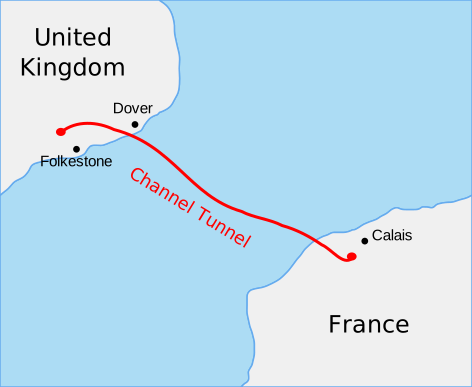
The Channel Tunnel, or Chunnel (map), linking the United Kingdom and France under the English Channel, takes the second (completed) spot at 31 miles long. While it’s a few miles shorter than the Seikan Tunnel, the Chunnel’s underwater segment is longer than that of the Seikan, making it the world’s longest underwater tunnel. The construction took 13 7 years, from 1987 to 1994, with over 13,000 workers involved in construction. Eleven tunnel boring machines were used — 6 on the English side, and 5 on the French side — and the sides met on December 1, 1990. 8.2-million passengers traveled the Chunnel via Eurostar in 2005, and numbers are expected to grow even larger when the Channel Tunnel Rail Link extends to London later this year. When the link is completed, a train trip from London to Paris will take 2 hours and 15 minutes.

The Lötschberg Base Tunnel in Switzerland runs 21.5 miles from Frutigen, Berne to Raron, Valais. When it opens in December of 2007, it will be the longest land tunnel in the world until the Gotthard Base Tunnel opens in 2015. “To dig the Loetschberg, some 16 tons of explosives were used and enough rock was excavated to pack a freight train 2,500 miles long – stretching across Europe from Lisbon, Portugal, to Helsinki, Finland,” according to this report from MSNBC.

One for the Road: Japan – A Traveler’s Literary Companion

Whereabouts Press publishes a small but well-done series of literary guides for only a dozen countries (like Mexico, Chile, Israel) and a few cities (Amsterdam and Prague). A few months ago I devoured their 2006-released Japan edition: Japan: A Traveler’s Literary Companion is a magical collection of original works by Japanese writers that have each been translated into English.

The stories are organized geographically, taking readers along on journeys to places like Osaka, Kobe, Kyoto, Kumano, Okinawa and Tokyo. Donald Richie’s foreword points to the concept of “furusato”, a term that carries more meaning than its translation “hometown”. This theme of revisiting or returning weaves through all the stories, as each one paints a picture for the reader of the deep relationship that exists between person and place.

There seems no better way to explore the culture of another country (besides actually being there) than by reading literature from a variety of voices native to the land. This is an excellent place to begin any journey through Japan.

World Atlas Rubik’s Cube

I don’t think I’ve ever successfully solved a Rubik’s Cube without cheating, and with this world atlas version, I don’t think it’ll get much easier. For about USD $20, you can order your very own Rubik’s Cube atlas from this Japanese company. Just don’t un-solve the cube and get lost, or you might be forced to learn how to decode this little bugger before finding your way home. [via]