Happy Birthday, Hubble Space Telescope!


The Hubble Space Telescope has been in orbit for 22 years today, and to celebrate, NASA has released this awesome image of the Tarantula Nebula, also known by its less romantic scientific name of 30 Doradus.
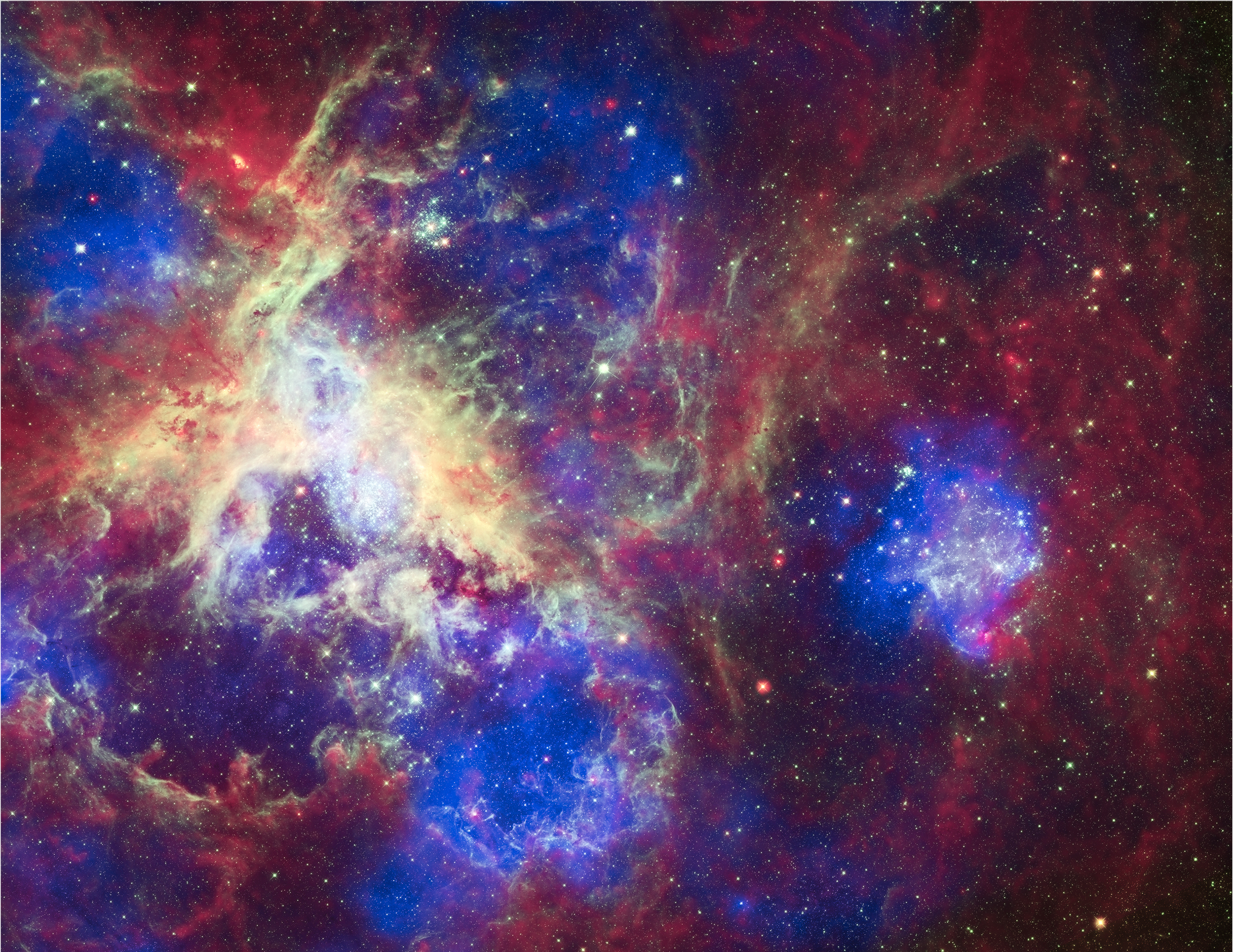
A nebula is a massive cloud of gas and dust in which some areas are coalescing and igniting into stars. The Tarantula Nebula is located in the Large Magellanic Cloud, a galaxy orbiting our own Milky Way galaxy. The light comes from thousands of stars in its center that illuminate the clouds and filaments around them.

In addition to being one of the most groundbreaking scientific instruments of the late twentieth century, Hubble is a team player. This image is a composite from the Hubble and two other space telescopes: Chandra X-ray Observatory and the Spitzer Space Telescope, an infrared instrument my super-cool astronomer wife uses. NASA says:

“The Hubble data in the composite image, colored green, reveals the light from these massive stars along with different stages of star birth, including embryonic stars a few thousand years old still wrapped in cocoons of dark gas. Infrared emission data from Spitzer, seen in red, shows cooler gas and dust that have giant bubbles carved into them. These bubbles are sculpted by the same searing radiation and strong winds that comes from the massive stars at the center of 30 Doradus.”

Happy Birthday, Hubble!

Photo courtesy NASA. To see the image in its full 3000-pixel glory, click here.

Visit NASA’s Control Room And Launch Pad In This Behind-The-Scenes Tour

We may not be flying into space anymore – at least not on the government dime – but the idea of visiting the Kennedy Space Center still puts a sparkle in our nerdy little eyes, particularly when we heard of this new package.

For the first time in more than 30 years, NASA is allowing Kennedy Space Center Visitor Complex guests inside the Launch Control Center – where NASA directors and engineers supervised all of the 152 launches for the space shuttle and Apollo programs.

The KSC Up-Close: Launch Control Center (LCC) Tour, the second in Kennedy Space Center’s special 50th anniversary series of rare-access tours, takes visitors inside Firing Room 4, one of the LCC’s four firing rooms and the one from which all 21 space shuttle launches since 2006 were controlled.

Inside Firing Room 4, visitors will pass by the computer consoles at which engineers monitored the computerized launch control system’s thousands of system checks every minute leading up to launch. They’ll see the main launch countdown clock and many large video monitors on the walls, and enter the “bubble room,” with its wall of interior windows through which the Kennedy Space Center management team viewed all of the proceedings below.The LCC Tour opens June 15 and will run through the end of 2012 with a limited number of daily tours.

Prefer to see the rockets themselves? You can do that too. That tour, which began this past November, takes visitors inside the 525-foot-tall Vehicle Assembly Building (VAB), the massive building adjacent to the LCC where the Apollo Saturn V rockets and space shuttles were assembled.

“This is another very rare opportunity that NASA has worked with us to provide – access to the Launch Control Center,” said Bill Moore, chief operating officer of Kennedy Space Center Visitor Complex. “It might be another 30 years before guests will receive a behind-the-scenes opportunity like this again.”

The LCC Tour is led by a trained space expert, giving visitors an insider’s view of the space program from launch preparation to liftoff. The tour also includes drive-by views of Launch Pad 39 and culminates at the Apollo/Saturn V Center, where visitors can resume the regular tour. Price is $25 for adults and $19 for children ages 3-11 plus tax, in addition to admission.

Photos: Space Shuttle Enterprise’s Epic Final Journey


Seeing NASA’s Space Shuttle Program come to a conclusion has been tough on space travel geeks. Luckily, over the past few months, NASA has given us a few final treats as the shuttles make their way to their new museum homes.

The journey of Space Shuttle Enterprise has been particularly epic because of its barge trip on the Hudson River this week. In order for Enterprise to get to the Intrepid Sea, Air and Space Museum, located on New York City‘s Hell’s Kitchen waterfront, it had to sail down the river past some of the city’s major landmarks. In case you missed it, here are some photos of that most unusual barge journey past the Statue of Liberty, the new Freedom Tower being built at the World Trade Center site and the buildings of lower Manhattan.

%Gallery-157716%

Space Travel Update: Man On Mars, Soon

As the SpaceX Dragon mission to the International Space Station comes to a successful close, the future of space travel comes a bit closer. That’s good news for NASA and America’s refocused space program. But they better not get too comfortable with their accomplishments so far, another company already has plans for a human settlement on Mars by 2023.

Mars One plans to send the first crew of four astronauts on a seven-month journey to Mars by April 2023 to establish the first human settlement. Sending a new team to the settlement every two years, the plan calls for over 20 humans to live and work on the red planet by 2033.

“A manned mission to Mars is one of the most exciting, inspiring and ambitious adventures that mankind can take on,” says Mars One on its website. “We see this as a journey that belongs to us all, and it is for this reason that we will make every tread a step we take together.”

To finance the operation, Mars One plans on bringing all of us along on the ride, watching and helping decide as the teams of settlers are selected, trained and prepared for the mission.
Secretly working out the plan since early 2011, the Mars One team has met with international aerospace companies who can design and deliver the essential hardware components for the Mars mission.


[Flickr photo by NASA’s Marshall Space Flight Center]

Commercial Space Travel Set Back But Not Discouraged

Commercial space travel, well on its way to replacing traditional space exploration, took a step back Saturday, aborting a mission to the International Space Station (ISS). Just a little step back though – the launch is set to try again early Tuesday after swapping out a faulty part.

SpaceX scrubbed Saturday’s mission less than a second before liftoff after high temperatures were detected in one of the rocket’s engines.

After Tuesday’s re-launch, SpaceX will fly its Dragon capsule to the ISS to test sensors and propulsion systems, both of which have never before operated in space. If all systems are go, the unmanned capsule will practice docking at the ISS.

Saturday’s scrubbed launch is a good example of why America’s space program is headed in this “commercial” direction. Hours after the scrub, SpaceX had the solution to the problem in place and had moved on to planning for Tuesday’s re-launch. Run the old NASA way, detailed systems engineering, computer simulations and time-consuming analysis would have taken much longer and cost much more.

NASA, fully supportive of SpaceX to the tune of $2 billion, is excited and prepared.

“We’re ready to support when SpaceX is ready to go,” Alan Lindenmoyer, Manager of NASA’s Commercial Crew and Cargo Program, said in a press conference Saturday.

The new era in space exploration is coming; it’s just been slightly delayed.


Flickr photo by IronRodArt – Royce Bair (NightScapes on Thursdays)