Do you have 25 million Euros burning a hole in your pocket? (That’s $33 million for U.S. readers!) Then perhaps you’d consider bidding on your very own tropical paradise, which is up for auction on eBay. The 225-acre island is located near Fiji, and is approximately 1 mile long and 1/3 of a mile wide. It reaches elevations of 150 feet and is surrounded by a 5000 acre lagoon that promises underwater visibility to 200 feet and year round temperatures of 80ºF.
That’s not all you’ll get for your hard earned money however. The island is also home to a “world class” resort. Well, it will be a world class resort when it is finished. It is currently about 80% complete, with another six to nine months of construction time necessary to finish it all up. The resort offers some nice amenities however, including a dining pavilion, full spa, and 21 guest villas, complete with fancy furnishings and hot tubs for two. Access to the island is gained via a 3400 foot long airstrip, which runs right by the 9 hole golf course.
Adventurous travelers will find plenty to do on the island, as the waters are excellent for diving and snorkeling, and there are nine caves available to explore should you choose to go spelunking. Prefer to just sit on the beach sipping a fruity drink? You can do that too, while spotting local wildlife, which includes the leather back sea turtles and rare coconut crabs.
Seems like quite the deal if you’ve got the spare change available. Sadly there is no “buy it now” discount on this eBay item.%Gallery-65115%
Each week, Gadling is taking a look at our favorite festivals around the world. From music festivals to cultural showcases to the just plain bizarre, we hope to inspire you to do some festival exploring of your own. Come back each Wednesday for our picks or find them all HERE.
Every year Catholic observers around the world celebrate the holiday of Corpus Christi. The festivities represent a Christian feast in honor of the Holy Eucharist. But in the Spanish city of Castrillo de Murcia, they like to do things a little differently. With colorful costumes, religious processions, mystery plays, mock terror and a uniquely Spanish ceremony that involves jumping over babies, also known as “El Colacho.”
Starting in late May or early June and lasting for five days, visitors will witness a series of rituals that are a mixture of traditional Spanish folklore and religion, each designed to cleanse evil from the little town. It works like this: a group of local men representing evil are denoted as the Brotherhood of Santisimo Sacramento de Minerva. These men are responsible for organizing the celebration. They are then split into two groups; the El Salto del Colacho (the devils), who wear brightly colored red and yellow costumes and will later jump over the babies, and the El Atabalero, who dress in black suits with large sombreros and carry large drums. Oddly enough the men who play these strange roles do so as they feel their lives have been cursed in one way or another. Taking part in the ceremonies is believed to eliminate the evil perceived to be plaguing their lives.
Wondering what happens next? Keep reading below to learn more about one of Spain’s craziest festivals.
On the chosen Wednesday, the festivities begin with the Brotherhood terrorizing the town’s people with whips and batons. Their evil pranks last till Sunday when the holy activities begin. Citizens decorate their houses with flowers and create small altars. Wine and water placed on the altars represents the blood of Christ and the baptism by water. The Eucharist symbols are meant to be consumed by the procession observers.
The procession begins, comprised of clergy and local children who are celebrating their first Holy Communion. The group starts at the church, winds around town and returns to the church. This activity is symbolic of holiness, capturing the perceived evil and laying it before God.
Finally, the festival’s most curious ritual, the baby jumping, is ready to begin. Infants from newborn to 12 months of age, dressed in their Sunday best, are brought to the street and laid in two rows on full-sized bed mattresses. As soon as the procession ends, the men chosen as “the devils” burst out of the church and run down the street toward the babies.
One by one, they jump the full length of the mattresses and over the unassuming children. The devils immediately run out of the town. This bizarre sight represents evil being cast out of the town and taking the sins of the infants with them. The babies are considered to be as cleansed as if they had been baptized. A fresh start for the newborns and another year cleansed from sin in the Spanish town of Castrillo de Murcia.
** Images courtesy of the Wikimedia Commons Project **
We talk a lot here at Gadling about annoying airline passengers, from the guy who smashes our knees by reclining his seat back as far as it can go, to the self-righteous fellow who simply must convert us before the plane lands.
Two women in England have them all beat–they tried to smuggle a dead body on board. The unnamed women were stopped at Liverpool’s John Lennon Airport on Saturday as they wheeled their “sleeping” relative up to the gate for a flight to Germany. Airport officials became suspicious and when they began to ask questions about the 91 year-old man, the duo’s story quickly unraveled.
By covering the man with a blanket and putting sunglasses on him, they apparently thought they could slip by security. Perhaps they were inspired by the Australian who got a bag labeled “bomb” past security or the United flight that had a stowaway scorpion.
The two suspects, who the police have identified only as women aged 41 and 66 from Oldham in Greater Manchester, have been charged with failing to report on death and have been released on bail pending an investigation and, most likely, a trial.
The Loch Ness monster may have gone extinct, but there are still mysteries in the lakes of the British Isles. Residents near Stonebow Washlands in Loughborough, Leicestershire, have been warned to keep their children away from the water after a mysterious beastie devoured some ducks.
There’s no clear description of the “monster”, but a witness tells a grim tale of seeing ducks get sucked into the water, never to be seen again.
Nobody is sure what it is, but the chairman of the Charnwood Wildlife Protection Group has confirmed that the lake’s duck population has decreased noticeably since the sightings. While most observers believe it to be some sort of locally uncommon fish like a catfish or pike, there’s also the hint of a good old-fashioned mystery.
Considering how much money the residents around Loch Ness have made off of unconfirmed sightings of their own lake monster, even creating a Nessie Museum and the statue pictured here, the folks at Loughborough might just be onto something good.
The Funeral Service Institute of Vienna is responsible for most of the city’s undertaking. They will cremate you, find you your ideal coffin or even have you turned into a diamond. Whatever your needs after death may be, they can probably accommodate you.
They also happen to have a museum, which is open to the public but viewable by appointment only. I would highly recommend making an appointment, as you’ll get a €4.50 personal tour (€2.50 for larger groups) from the museum’s delightfully enthusiastic curator, Dr. Wittigo Keller. The exhibit is truly fascinating. From their funeral customs to their beliefs about death, the Viennese have an intriguing cultural perspective on the big sleep.
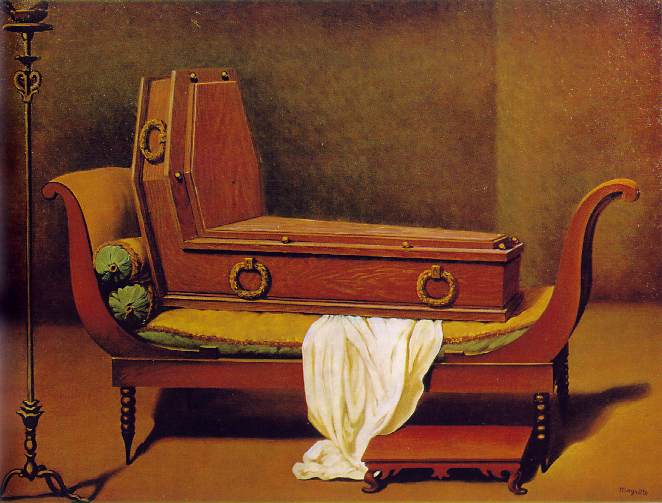
There is currently very little English-language information available about the Museum of the Funeral Service Institute of Vienna, so I’m delighted to be the first to take you on a virtual tour. Let’s start with the sitting-up coffin above.
%Gallery-88625%The Sitting-Up Coffin
Jacques-Louis David famously painted this portrait of Madame Récamier, then this coffin to go around her. Keller, the curator of The Museum of the Funeral Service Institute of Vienna (FSIV), created this coffin for a European funeral fair (which happens every three years). “It’s not practical,” he noted. Bodies must legally be buried six feet underground (below the freezing line), so one would have to dig several feet deeper to bury this coffin. Still, for the right price, he could says they could make it work.
The sitting-up coffin was one of the first things we saw at the museum, and it set the stage for an intellectual and curious look into death, rather than one filled with dread. The initial willies were shaken off, and we began discussing the new trend of creating diamonds out of the deceased’s ashes.
Diamonds Made of Dead People
You may have heard of LifeGem or another company which does this. People have been making diamonds synthetically for years (all you need is carbon, heat and pressure), and making a diamond from someone’s ashes, to some, is a beautiful way to give them metaphorical “eternal life.” Most diamonds created from human ashes are light blue, due to the chemicals in our bodies, but in the cases of people who’ve been through extensive medical treatments, the color can be different. Some companies will add chemicals post-mortum and allow you to make the diamond any color you like, but the FSIV doesn’t do that. Keller reports that it takes about 8 months to turn human ashes into a diamond, and the price for a quarter carat is about €4,680 (€14,440 for a full carat). It’s something to think about, because unless you put your desire to become a diamond in your will, your loved ones probably won’t come up with the idea.
Wearing Grandma’s ashes in a diamond necklace isn’t really any stranger than keeping her on the mantle.
Funeral Fashion
Next, we headed into a room filled with black outfits for all the various officiants in historical Viennese funerals. In addition to black, funerals in Vienna could feature red paraphernalia for military men, and for children, youths and anyone unmarried, much of the black regalia would be light blue. Keller joked that a light blue funeral meant that you were “a complete loser in this life and the next,” and added that if you’re not married, you’d best not die in Vienna.
From about 1850 to about 1930, what mourning women wore to funerals in Vienna was an extremely important matter. Every October, newspapers would publish what the proper style for funerals would be that year, and if women were spotted in last year’s style, it reflected very poorly on them and their families. Naturally, it became possible to rent the appropriate dress to wear to a funeral — in fact, this is still practiced in Vienna. Just as you might rent a gown for a ball, you can rent a mourning dress for an important funeral. Jewelry was also regulated by the annual October announcement, and Keller says that this was actually the origin of costume jewelry.
After Death Certification
Next, we headed into a room of what Keller called “rescue alarm clocks.” Production of these began around 1854 when there was mass hype about the possibility that you could seem dead and be buried, and then suddenly wake up — buried alive. There were many, many different contraptions you could purchase to prevent this horrifying fate. For example: the double-sided knife, which specially licensed doctors would stab into your heart to ensure that you were dead (you can still request this, and he says old ladies in particular sometimes do, €300), known as “after death certification.” Another rescue alarm clock was quite literally an alarm, which he demonstrated for us:
That rope would have led from a coffin directly into the dining room of the cemetery-keeper. That’s a dinner party foul.
Cultural Differences
Next, we looked at some antique children’s funeral toys, which really confused me at first. Basically, Keller explained, a funeral is viewed like a wedding, or any other important passage, and children must be taught how to behave before they can attend. So, from a very young age, children would be given funeral toys to play with so that they could learn the proper procedures and not be afraid.
On the whole, death in Vienna is regarded as a far less scary affair. Perhaps it’s because of the toys, or perhaps it’s because Austrians save money — some their whole lives — for their funerals. Farmers would buy their coffins during a good year when they had the cash and paint it to match their furniture, then use it as a bookshelf or wardrobe until they, you know, needed it. Having a savings account for your funeral or a coffin in your living room probably helps you get used to the idea of dying. “Old Viennese folk songs are all about wine and death,” said Keller. “Death goes with you to the wine tavern and follows you home at night; it’s your best friend.”
The funeral is regarded as a festival, a goodbye party. People save their whole lives to throw a good one, so that they will be remembered for that last great party they gave. “You should tell people they can learn to die in Vienna,” said Keller with a cheeky smile.
Final Details
As I mentioned, you can only visit the Museum of the FSIV by appointment, so to make one, call 501-95-4227 (country code 43) or ask your concierge. If your German’s pretty good, you can get more information here on the website. Alternatively, if you should happen to be in Vienna on the Long Night of the Museums (the first Saturday in October, when museums stay open late), you can test out the coffins. Literally. They’ll put you in a coffin, close it, and leave you there until you knock. According to Keller, last year, 1,500 people did just that. The oldest was an 88-year-old woman. “The girls are much braver than the boys,” he noted cheerfully.
My visit to Vienna was sponsored by the Vienna Tourist Board and Cool Capitals, but the opinions expressed in the article are 100% my own.