Nuclear site tourism, courtesy of Iran

Iran is, no doubt, a fascinating country to visit. As James Vlahos writes in this New York Times article today, being “an American in Iran” is not as scary as the Axis of Evil rhetoric might suggest. He found the people of Iran to be friendly, the history to be incredible, and the religious/political discussion civilized.

Iran has been pushing to attract more tourists from Europe and America. New tourist offices have been opened in 20 countries and travel agents are being offered cash bonuses for Western tourists. Still, Iran doesn’t exactly make it easy for tourists to come. Tourist need a host (usually a commercial outfitter) and the wait for visa can last up to several months.

Mahmoud Ahmadinejad, the president of Iran, wants to make Iran a truly unique destination. He announced that tourists will soon be able to visit the country’s controversial nuclear sites. It is hard to think of a more romantic getaway trip for Valentine’s day…

Painful lesson on stray pets in foreign countries

Have you ever been tempted to save that “poor little puppy’s” life by airlifting it from its miserable life in Egypt, Greece or Asia, and bringing it home, so you can pamper it with vitamin bones and pet spa treatments? I have friends who have rescued a puppy from one of the Greek islands (don’t ask how they got her on the plane) and after 10 years, they are still enjoying each other’s company in DC.

However, after reading this blog on latimes.com, you might want to stay away from stray pets for a while. Especially in Iraq.

Apparently, the rule for troops about wild animals in Iraq is very clear: Leave them alone, no matter how cute they are. But what’s a soldier, missing his pets from home, to do? One young Marine could not resist a stray cat in an Iraqi village. As he was holding the cat, the animal went on a biting and scratching jag, “striking the Marine in a vulnerable spot”. The Marine ended up being evacuated for medical care. He will certainly have some good stories about his war wounds.

Prefer your lucky rat deep-fried or grilled?

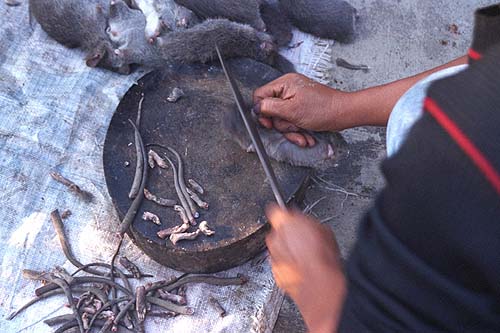
To welcome the Year of the Rat, some people in rural Taiwan and China have increased their rat consumption accordingly. Reuters reports that a rural eatery at Taiwan’s Chiayi county, serves 10 rat-themed dishes, including rat soup, black pepper-dipped and deep-fried rat. The diner goes through around 18 kg (40 lb) of rat meat per day.

Here is the “Rat-at-Chewy” video by Reuters, depicting the way rats are prepared and eaten. I wouldn’t suggest watching it before lunch.

Rat meat apparently became popular in rural Taiwan in the 1940s and 1950s among people who could not afford chicken or pork. At least we know that if the sub-prime mortgage crisis gets any worse, there are enough rats in New York to fill every American man, woman and child.

Dragon tourism. Yes, DRAGON tourism.

I’ve always had a strange desire to be in a Jurassic Park film. The last time I was at Universal Studios, I remember seeing the dinosaurs in an utter state of awe as I imagined how life would have been if these creatures still existed.

Dragons on the other hand, I’ve only read about in story books and would never have imagined that there are 2,500 of them walking freely on Indonesia’s Komodo Island. Yes my friends, there are humongous carnivorous lizards — some that are 10-feet long — walking at their own liberty, on our planet!

17,000 people visited Komodo National Park last year, a number not too high perhaps only because of the lack of tourist facilities on the island. (I imagine if you are visiting an island with dragons, the more tourist facilities around, the higher your likelihood of visiting, no?). As for me, my explorer spirit doesn’t include being dragon-fearless: I’d jump out of my skin and run for my life if I ever encountered one.

Also, according to National Wildlife Magazine, the thick saliva of the dragon is known to kill the animals it bites and some researchers are risking their lives to find out what is in the saliva that kills other animals, and not the beast itself. They think that perhaps it’s saliva has strong immunity properties or some natural antibodies in it’s blood that could be harnessed for human health.

The wonders of nature often leave me speechless.

Year of the Rat: Bring some luck into your life

With the Year of the Rat starting today, it’s not too late to attract good luck in order to make 2008 the best ever. Here are three ways. The first two I have tried.

Get a miniature orange tree– When we lived in Singapore we bought an orange tree every year right before Chinese New Year. The experience reminded me a bit like buying a live Christmas tree. Vendors selling these trees popped up all over the city. Size, cost and amount of oranges all figured into our decision making regarding which to buy–even the style of the pot was part of the package.

We set our tree out on the patio of our apartment and managed not to kill it for awhile. I can’t remember if we had any more good luck than normal, but I loved having such a bright, cheerful plant thanks to the oranges that were not much bigger than a golf ball.

Buy bamboo–Unlike our orange tree that didn’t last a year, (it was us, not the tree), bamboo plants will last awhile if you remember to change the water. In Taiwan, we bought bamboo just in case one of these plants would bring us good luck. I can’t say if any of them did, but I loved browsing the choices before making a purchase. The most expensive ones are grown into shapes. Like Christmas trees and orange trees, the size figures into the price as well.

Put away your scissors–Bringing good luck into your house can also be as simple as putting away sharp scissors and knives. If they are out, you can “cut” your luck.

For more Chinese New Year tidbits about how to improve your fortune, check out this link to the Chinese Culture Center of San Francisco.