You think your train is crowded?

You could live in China. This week, weather issues and transportation shortages are creating a tight squeeze on holiday travel. Four hundred thousand Chinese were stuck at the Guangzhou railway station earlier, where a full out stampede broke out when a train pulled up for loading.

CNN has some interesting video of the station (click on the ‘huge crush’ link), showing lines of police wrapped around a sea of people surging back and forth. You can see several poor souls falling over and getting swallowed by the tides of Chinese. Scary. And according to the article, this is half of what the volume was earlier last week.

Why hasn’t the Chinese government prepared for this spike in activity? Is it all really related to crummy weather? Either way, I’d hate to be in the middle of this debacle.

I’m never complaining when I have to stand on the subway again.
Dollar: the not-so-universal travel currency

If the dollar continues its downward spiral this year, it may be necessary for people to switch from dollars to euros for their travel cash.

According to this NY Times article yesterday, many countries are no longer willing to take dollars instead of their currency as a way to get into museums, and pay for hotels and restaurants. While many countries in Latin America still happily accept the dollar because they currencies are either pegged to the dollar or it is the dollar, an increasing number of countries in Asia and Africa, for example, prefer the euro over the dollar.

The Taj Mahal, for example, no longer accepts dollars for the entrance fee. Tourists used to be able to pay $15 to get in. Now, they are required to only pay in rupees (750), which is actually $19. You would think they would just increase the entrance fee in dollars, but maybe they actually really don’t want dollars.

First A380 flight in Europe: March 18

Singapore Airlines currently flies both of the only two operating Airbus A380 airplanes in the world on the Sydney-Singapore route. The third plane, also purchased by Singapore Airlines, will operate on the London – Singapore route, starting March 18. This will be the first commercial flight with the world’s biggest plane in Europe.

Tickets for this flight are already on sale, starting at 550GBP (approx. $1100). First class tickets have not been priced yet. The Singapore Airlines A380 has 471 seats available in three classes: 12 seats in their ultra-luxury suites (see picture), 60 seats in business class and 399 in economy.

Those luxury suites don’t look too bad. I don’t think I want to know how much they go for.

%Gallery-9672%

Walking from the UK to India with no money

You think walking from Bristol to Gandhi’s birthplace in India–through the war-torn Afghanistan–is bad enough? Try doing it with no money in your pocket. A 28-year-old British man, Mark Boyle, started his 9000-mile journey on Wednesday with just a few T-shirts, a bandage, sunscreen, a knife and spare pair of sandals.

Boyle is an ex-dotcom businessman who is planning to walk 15-45 miles a day and not touch any money, credit cards or travelers’ cheques the entire time. Why, you ask? To show his faith in humanity and get back to a more communal way of living.

You can follow his journey here.

Will fingerprinting replace need for a passport?

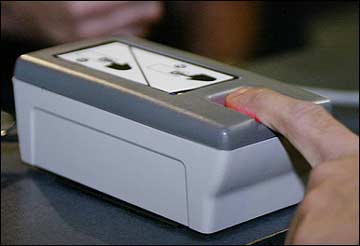
Scandinavian airline SAS has introduced finger-print check-in on a domestic flight from Stockholm to Gotenburg in Sweden. Its purpose at the moment is to make sure that the person who checks-in luggage is the same as the person boarding the flight, a sure advantage for airport /on-flight security.

On a domestic level, this makes sense as check-in procedures are relatively lax when traveling within the country, and even within the EU for that matter; but they plan to eventually make it an international check-in system.

Fingerprinting at airports is not new. The US introduced it a while ago as an added security check for visitors to the country; the UK has a similar system, but not restricted to visitors; and Dubai has had a retina scan system for a while now. This makes it impossible for people to travel with fraudulent documents.

Dubai went beyond finger-printing for security purposes when they introduced the eGate card — a check-in option for Dubai-based frequent travelers who don’t want to stand in line to get their passport stamped. If you have this card, you swipe it to enter/exit the airport, match your finger-print on a screen and you are through.

So the question is: will we eventually be able to travel without any printed form of identification? If you are finger-printing and retina-scanning anyway, other than to have a stamp, what do we need passports for?