A Wild West Ride in Australia

When I was looking for a photo for my Wild West World amusement park post, I found out about the Wild West Adventure Falls ride in Australia. It’s located in Warner Brothers Movie World on the Gold Coast.

This ride is the largest theme park attraction in Australia and it sounds like a blast. There is a geyser, wagon train, an Indian reservation and a ghost town in the mix of this part roller coaster, part water ride thriller.

When I went Australia, I was on the other side of the country near Perth and Fremantle. The Gold Coast part of the country looks to me like it’s a bit like going to Orlando or Los Angeles where there is an attraction at every highway exit. It’s south of Brisbane and touted as a tourist destination hotspot.

As much as I like theme parks, it’s curious that someone might spend all the money for the flight to Australia and head to theme park central for their vacation. But, then, people spend all the money for a plane ticket to the U.S. and spend all their time in amusement parks here. This is just something I thought about when I looked up Wild West Adventure Falls.

A Canadian in Beijing: Accessibility? If You Roll When You Stroll, 麻

[???? ? Troublesome, Inconvenient, Bother!]

I’ve been here for almost three months now (well, eleven weeks to be precise!) and I’ve been collecting images and information about accessibility in Beijing throughout my time. By this, I mean I’ve been looking around at the wheelchair access or lack thereof here.

I shouldn’t suggest that there’s no access here in Beijing. There are a few noticeable efforts that have been made. But, overall, I’d say that there’s lots more to be done to make this city more open to chairs and the people who occupy them.

If you walk on wheels, Beijing will be a tough place for you.

The sidewalks are bevelled. These kinds of designs in the sidewalk are for the blind, I am told. It enables blind people to feel the sidewalk’s center and to follow the subway corridors or the outdoor sidewalks more easily. For someone in a chair, however, these kinds of raised parts of the walkways would get tiring fast. Tiring and annoying, I’m sure.

What’s more, the steps in all the subways have a raised lip on each individual stair. Not that you’d enjoy going down sometimes more than fifty steps at one time (not all entrances and exits have escalators but most do), but if you had to descend even a few stairs in your chair, you’ll be met with a speed bump each time. I’m imagining that this would also become annoying.

But, once you get into main part of the subway, each car has a wheelchair section where there are no seats. I have never seen a chair here, just people standing. I’m wondering if this is because it’s so treacherous and steep to get down the steps and many winding corridors into the subway itself. Still, at least it exists.

Should we credit partial solutions for being part-way to complete, at least? Or, is “partial solution” an oxymoron?

Otherwise, I have seen the occasional ramp, especially at more tourist-friendly places. Here at the Summer Palace, there’s a ramp into most of the courtyards. Traditional Chinese courtyards generally have the kind of doorways that require one to step over a threshold. Sometimes these thresholds are more than a foot high! That doesn’t work too well for wheels and so these ramps enable all visitors to enter.

At the Summer Palace, I also noticed this sign before entering one of the park areas. It wasn’t clear which way was really ideal for the rolling stroll, but when I followed one of those arrows, it led to this steep climb that included occasional steps as well. So, if you were in a chair, your arms wil be mighty tired here and you’ll have only climbed half-way up the hill!

I have also seen a few ramps recently on sidewalks or outside of restaurants. This one appeared outside the Beijing Art Gallery near the parking lot.

This one is a new addition to a local restaurant in the Gu Lou area near Hou Hai.

Finally, there is almost no option for chairs on sidewalks, especially when there’s any construction going on, which, as you may recall in this post, seems to be happening at every turn. The obstruction of sidewalks in that process is rarely a concern here, forcing pedestrians onto the roadways quite reguilarly. As a result, I have seen several wheelchairs being pushed along the street, which becomes the only option. This series of images shows a woman pushing a chair in the same zone as the bikes and taxis. All have wheels, of course, but I think I’d prefer not to compete for space with a cab driver looking for side-of-the-road fares!

Here is a bike swerving around them:

Here they are being passed by a taxi.

Here they are about to swerve around a parked car. Yikes!

Anyway, the best wheelchairs that I’ve seen here are the motorbike chairs. I mean, if you’ve been forced into the same travel spaces as the motorized vehicles, why not motorize your chair, right? If you can’t beat ’em, join em! These are really cool looking with seating in front (the main driver) and then room for someone to sit comfortably behind as well. When I saw one, I thought it would be cool to ride on it. (Pictured at the top of the blog and here is a view of its backside.)

I think it’s rather sexy, myself.

All in all, I’m hoping they’re building in more accessibility into this city as a result of the coming Olympics and resulting increased tourism. As it stands, the city could use it. The attitude towards disability issues or, more appropriately, differently abled issues is rather slack and/or absentee. Some of my Chinese friends just shrugged when I mentioned it, like it was really something they hadn’t thought of before and/or didn’t feel the need to spend much time thinking about.

I have heard that traditional China kept those with disabilities separated from those without. I don’t know much more than that, but this was said in passing once and it stuck with me. Maybe in North America, we have become more accustomed to integrating everyone, regardless of what their walking legs look like, into a full society. I think China is coming along on these points recently, but it needs a push from behind.

It needs a little nudging around the parked attitudes of the past and into the diverse traffic of the future.

And hopefully this future will include sidewalks that will accommodate wheels and feet at the same time!

Smooth surfaces whether you stroll or roll.

A Canadian in Beijing: Food is Free at KTV

I know that I already posted about the inevitability of karaoke here in China. What I haven’t told you about yet is the amazing KTV phenomenon. Here in Beijing, there are several locations of KTV, or “Partyworld” as it’s also called, where people come to sing karaoke as a social activity. I’m not talking about a bar here that has one karaoke machine.

This is a karaoke factory.

It seems like this is one of the most popular activities here. After going out to a bar and drinking several drinks, people often come to KTV and sing all night long. In fact, after midnight, it is significantly cheaper and a person can book a six-hour block from midnight until six a.m. And, many people do.

Not to mention the fact that food is free after midnight.

(Musician Rule #1: Go for the free food!)

These establishments are like giant hotels. At least, that’s what they resemble aesthetically, but the rooms you are renting aren’t for sleeping; they’re for singing. Group after group file into KTV and then disappear into private sound-proofed rooms to hold a microphone in a death grip and belt it out until the wee hours.

You arrive into a marble lobby with plush chairs and staff in uniforms. They usher you upstairs to one of the floors with available rooms (and sometimes they’re all booked up!) and then you are given a private room that consists of several couches, tables, a television (on which the karaoke videos and lyrics are displayed), a closet for your things and sometimes even an adjoining bathroom. Oh, and there are also percussion instruments available just in case you want to bang along. Brightly coloured, they reminded me of kid’s toys and so I bounded over to them and made a racket for a few minutes in the spirit of my inner child.

Each room has a number on the door and a circular window so that the staff can peer in to make sure all is going well and you aren’t in need of any additional beverages. It almost makes me think of a ship, these circular windows, and it made me chuckle quietly to myself whenever a server’s head would pop up in the circular window with curious eyes.

But, last but not least, the number one thing about KTV is the free food after midnight. There is a huge cafeteria-style kitchen area and between midnight and one a.m. (I’m pretty sure it’s an hour long buffet, though it could be two hours?), the food is completely free and there for the taking. So, after the night of partying, this is the place where people come to eat and then continue partying! Alcohol is not free, but non-alcholic drinks are. Both can be delivered right to your room by placing an order with a server.

When I was there, the diversity of the other KTV attendees was astounding. There were groups of young teenagers and groups of businessmen in suits and ties. Everyone looked happy and full of melody. People were singing in the hallways and humming songs as they chose food around the cafeteria. Here, singing is normal and not something just done in the shower or in the shy privacy of one’s home. And singing well is not a prerequisite. On the contrary. I think the appropriate way to sing here is just with enthusiasm… and spirit. Yes, that’s exactly it.

When I walked back to our room with my loaded food tray, I was amused by all the different sounding songs I heard coming from the various rooms. These songs were in what sounded like the insulated distance because of the soundproofing, but outside of each room they could still be heard faintly.

As I was walking slowly along the corridor, one of the doors swung open and another customer exited their room. As the door widened, it was like a vacuum of sound had been released into my ears. I saw inside for that instant and caught sight of a middle-aged man clinging to his microphone with both hands and giving it all he had. He was bent at the knees and his head was thrown back, eyes closed and focused, shirt and tie dishevelled and loosened. He was singing in Chinese and he was pouring his heart into the words. When the door swung shut once more, the image was gone and the sound was muffled again. It was just a flash but this visual will stay with me and will forever be associated with the three letters: KTV.

It was his big moment. . .

I smiled and continued down to the hall to our room and my group of friends. When I came in, two of them were in the midst of a cheesy eighties duet and singing into each other’s eyes. The rest were sprawled on the couches or sitting on stools and watching either the singers or the videos with mild interest.

I say “mild” because these videos are terrible. They’re not the original videos, of course, and sometimes the cinematography is atrocious. Especially for the English songs, they are really outdated images showing non-Asian people dressed in eighties or early nineties fashions parading across the screen. The transcription of the lyrics, too, is often wrong. Sometimes it’s so wrong that it’s hilarious, rendering us unable to sing anymore because we are laughing so hard.

What a crazy experience.

Here is a place where people can pretend they’re performing for thousands of people in the way they deliver the lyrics and pose with the microphone, but it’s just your group of friends or family looking on as though this is normal. And, after a few moments, it is normal. Anything is normal if you let it normalize, right?! In the end, there is really no performance going on at all. It’s just about singing. It’s therapeutic. It’s cathartic.

It’s the release.

The eating, drinking and socializing is a sidebar. In fact, some of my friends like to sing for six hours straight and never get tired.

That’s not me.

After my food, I was ready for bed. I took my leave after singing a few cheesy tunes like “The Greatest Love of All” and “Somewhere Out There” with my friend (it’s a duet, of course!) The English language selection is wide but super cheesy. Despite being a lover of some cheesy eighties songs (ach-hem… like Air Supply’s entire catalogue, as mentioned), I can only listen for so long before I’m ready to move on.

I left humming a tune, of course. I’m not sure which song exactly, but it doesn’t matter. What matters is that my vocal chords were being used and celebrated.

I always say that everyone can sing. It’s true. Everyone can.

KTV makes it possible.

And popular.

A Canadian in Beijing: Vegan Mandarin Language Survival Guide

When I first arrived in China, I wrote a post entitled: “Vegan in China, Part 1.” It was pretty negative all around. Why? Because I was hungry! About half-way through my trip, I followed that post up with a piece about the presence of an active vegetarian and vegan society here in Beijing. I would consider that my “Vegan in China, Part 2” post, although it wasn’t titled as such. This, then, should be considered my “Part 3” post, as it’s now at a point where I’m posting to help the next traveller get through these food dilemmas rather than posting in the hopes that someone will help me!!

I’m on third base and I’m heading home.

(to my own kitchen! I can’t wait to do some full-scale cooking again!)

Because I have experienced the trials of getting my language skills to the point where I can successfully feed myself, this post includes the explanation of some necessary short phrases in Mandarin for a person who fits this description:

  • non-Chinese speaking
  • vegetarian or vegan
  • who is in a restaurant
  • that isn’t necessarily vegetarian
  • and staring at a menu
  • that isn’t written in English
  • and is nearly faint with hunger

Good luck!

The following sentences I have found to be very useful. I have written them out in both “pinyin” (their sounds) along with the tones (the numbers in brackets) for those who have some knowledge of Chinese pronunciation. They are followed by the actual characters and then the translation, all of which is set off in the boxes below.

Under each box, I have explained how to actually say these sentences. This isn’t official and I’m not a linguist (let’s state the obvious right off the top!) but these are common English words or close approximations which can help an English speaker find these sounds without much difficulty. At least, here’s hoping!

So, let’s start off with the basic greeting and ice breaker. This is good to say when the waiter or waitress approaches your table and looks at you expectantly. It’s both a greeting and a comment, and it’s very casual and so it will probably make them laugh or smile if they’re not completely overworked and miserable to begin with!

Pronunciation Approximation: Knee-how, woe doe kuai euh seuh le

Here “kuai” is like the sound of “kw” put with the word “eye,” also known as one of the casual words for the currency here in China. Also, “euh” is like the vowel sound of the word “wood” in English. Just take off the “w” and the “d” and that’s your sound. If that doesn’t work for you and you speak any French, then this sound is also the sound of the French letter “e.” Another tip is the tail end of the German word “adieu” but with the German pronunciation! Finally, these three words “euh seuh le” all rhyme. I left “le” as it stands in its pinyin form because almost everyone pronounces that one correctly on first sight!

Other options include: “Wo hen e” 我很饿! or “wo feichang e” 我非常饿! = “I’m very hungry” and “I’m extremely hungry,” respectively. Pronunciation Approximation: “woe hun euh” or “woe fay-chong euh.”

Next, we’ll move to the crux of the issue. You’ve just expressed that you’re really hungry but this isn’t going to be easy. This is a great place to also put the opening “I am a vegetarian” statement (see image that starts this blog.) It can either follow #2 or precede #2. The word “but” is “danshi” and can easily be removed at anytime. It’s just a filler here.


Pronunciation Approximation: Dan sheuh, woe e dee-are roe yeh boo cheuh

Here the “e” is just as it looks. It sounds just like the letter “e” in English as though you’re naming the letter in the alphabet.

Next, you need to acknowledge the fact that you’ve no idea what’s happening on the menu that has been set before you and you need the server’s help. I can teach you how to say “I don’t understand this” or “I can’t read Chinese,” but that’s just boring. Why not enlist their assistance in the process? You can wave your hand at the menu and/or close it altogether. Most people assume that foreigners can’t read Chinese anyway, and so I think it’s unnecessary to state the obvious if this is the case.

The following is a casual and friendly way to request their help ordering. Since they already know that you’re not a meat eater, they will now (ideally) only suggest vegetarian options! Feel free to repeat the statement above (#2) to reinforce your point.

Pronunciation Approximation: Knee gay woe tway gee-anne gee geuh bah

Don’t forget that “gee” is not a hard “g” but a soft “g.” This is the fifties word of “darn,” for more context! Also, If you’re still having trouble with that “euh” sound then here is another tip: this “geuh” is the beginning of “good” without the “d” at the end of it.

Now, here’s yet another point of clarity. Sometimes the server will respond to your request for their suggestions (above) with yet more questions about what you’re interested in, i.e. what flavours you’d like, whether you can eat hot foods, etc. If you don’t speak Chinese, this will all be fired at you with questioning eyes and it will only be responded to in return by your questioning eyes of complete confusion. Generally, if you don’t know what has been said to you, keep the doors open! This comment, below, encourages them to be more assertive in their suggestions to you and gets you closer to food.


Pronunciation Approximation: Jeuh yao may yo roe doe keuh yee

Here, “yao” rhymes with “mao,” as in the Chairman!

Now, much vegetarian food here in China contains eggs. In fact, it’s been really hard to find soups without egg in them, for example. Dumplings are often made with eggs, as well, even if they’re not described as such on the menu. So, if you’re vegan and you don’t want your vegetable soup to arrive with egg floating in it, then this next sentence is really vital.


Pronunciation Approximation: Woe yeh boo cheuh gee dan

Next, here is another phrase that is useful for the vegans out there! Now, it’s not exactly a lie. Technically, if you’ve been a vegan for a while then your body will stop producing lactase, the enzyme necessary to breakdown lactose which is found in milk products. Thus, eating lactose will result in a great big stomach ache and some might identify this response as a typical allergic reaction! (What’s more, lots of people are lactose intolerant these days and so it’s not so rare for restaurants to hear, even in China.)

I do find this explanation works a hell of a lot better than expressing that you choose to simply not consume dairy products. In the bubble tea line-up, you’ll be sure to get a few odd stares when you just say that you don’t drink milk. An allergy makes everyone more vigilant about protecting you and their livelihood. In fact, sometimes I even use the allergy angle in English-speaking countries…

Pronunciation Approximation: Woe dway knee-oh nigh jeuh pin goa min

By “nigh” I mean the word that rhymes with “eye!” I know it’s not a very common word, but it’s still in the dictionary! Also, “goa” is just like “boa,” as in the snake!

Finally, this is your last resort. When there’s no way to get any food because you have not been understood in the least and everyone looks lost and frustrated, saying the following phrase while also cupping your hands in a small bowl and simultaneously pointing to something white (or pointing at the bowls on someone else’s table!) will surely get you some white rice. Afterall, this is a staple food here!


Pronunciation Approximation: Gay woe e wawn bye fun

Here “wawn” rhymes with “yawn” and don’t forget that the “e” is just like the sound of the English letter “e” when you’re naming it off in the alphabet.

***************************************

Alright, here lies the end of this quick-vegetarian-or-vegan-language-survival-in-a-restaurant lesson!

And, as I said in my last post, if all else fails then there are always “su baozi” (pronounced: sue bao zeuh). See this post for more information on this tasty restaurant replacement food!

But mostly, the possibilities are here and China has shown me that there is even more for me to eat in a restaurant (besides salad!) than in a typical North American restaurant. I have completely changed my tune from the Part 1 post; there’s so much out there for me to eat! My body is happy.

My official stance on the issue is this:

The visiting vegan or vegetarian should have no trouble in Beijing.

Oh, I guess you could also just print this off! Then, you can just show the server these phrases and the only reason for opening your mouth can be to put food inside it!

Haha.

Enjoy!
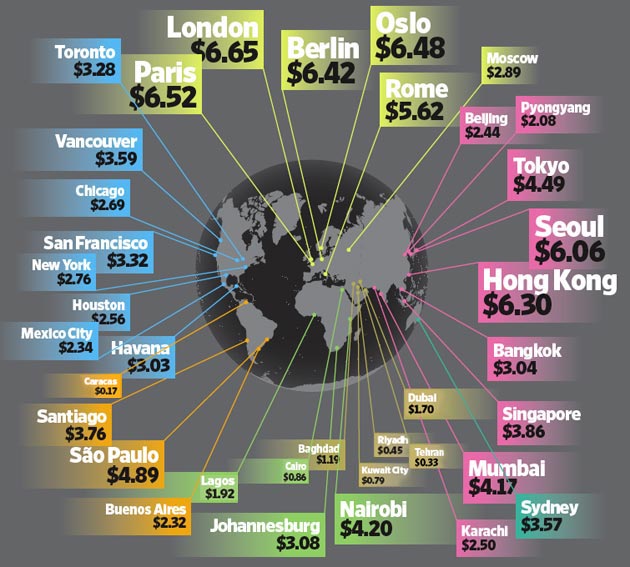
The Price of Gas Around the World

The next time you pull into the station for a fill-up, keep this in mind before you curse the prices: People elsewhere have it a lot worse than we do in America (and we tend to gripe about it the most, it seems!). Take Asia for instance — Hong Kong averages a whopping $6.30 per gallon, with Seoul, South Korea, not too far behind. Europe also pays well above what we do in America. London, Berlin, Oslo, and Paris are all well above $6 a gallon. On the low end of the spectrum, places in the Middle East like Kuwait City and Tehran, Iran, pay under 79 cents for their gas. Big surprise there!

The lowest, however, is reserved for Caracas, Venezuela. 17 cents per gallon! [via]

Related: