How Convenient: A Highway to Mount Everest

As if Mount Everest isn’t getting enough traffic and trash….China announced it would start building a highway right up to the base camp at 5,200 meters (17,000 feet) next week, the Guardian reports. They want to get it completed by next year’s Olympic Games to accommodate the influx of tourists.

Ain’t a “free” market economy grand?

Not only that, in preparation for the Olympics, China has also designed the most far-reaching Olympic torch route in history: 85,000-mile, 130-day relay crossing five continents and scaling the 8,850-meter peak of Mount Everest.

What’s next? A lift up to the top?

A Canadian in Beijing: FOR SALE! Live Animals (Trapped) in Small Cages

Walking along the sidewalk here in Wudaokou in the late afternoon and evening is not a passive exercise. The sidewalk markets take a wide space and transform it into a narrow, colourful corridor as vendors roll out their ware on square pieces of fabric on both sides and then call for your attention as you pass. That doesn’t keep people off the sidewalks, of course, but instead draws more to this small area. As a result, congestion is intense and the going is slow. If you’re not headed anywhere in particular then it’s worth the stroll. (If you’re trying to get somewhere on time, I suggest walking along the street!)

I have been taking in these kinds of street markets all over the city since I arrived and I’ve noticed one common element: there are always small, live animals for sale.

I hate to see it. Small rabbits in cages that are just slightly larger than they are with barely enough room to turn their bodies around. There are always puppies and kittens, turtles, snakes and lizards of various sizes. All of them are miserably tucked into cages or plastic cubicles and lay taking in the afternoon heat in their cells.

I can’t free them and I can’t save them . . .

I feel helpless and powerless walking by. I wonder who actually buys them and why. Do the rabbits become pets or food? And the reptiles must simply become pets, right?!

The huge box of baby chicks would make a lot more sense to me if this were a rural area. I can understand people having farms or small lots on which they would raise chickens for eggs and/or meat. Now, if this were the intention for the chicks, then I can understand wanting to sell them and wanting to buy them. But, here in the city? What would a person do with a baby chick here? Is it legal to keep chickens here? Something tells me that it’s not, especially since almost everyone lives in an apartment.

I have seen a lot of things like this here, i.e. things about China that I don’t understand and don’t want to see but simply have to accept as being part of the way it is here. I know I have my cultural background that fuels my opinions and I know there’s so much more to everything than meets the eye. Still, life here in Beijing has occasionally challenged my values and beliefs. I have chosen to sit back and take in the culture rather than passing judgements before I understand.

Two months later (and then some) and I still don’t understand the reason for selling these small animals in this way. And, I still want to set them all free in a park somewhere… which is, of course, not the answer. Nor will any amount of discussion with a vendor change the fact that they’re being sold, especially not in my third language.

About a month ago, I expressed to a vendor in Chinese that I felt sorry for the animals. I said they were “poor things” and said that their “houses were too small” (lacking the word for “cage” in my vocabulary.) The vendor just laughed at me with a look that told me he has heard it before from the foreigners and he has no time or space for it. This is his livelihood. This is his job.

Who buys them?

My friend Sarah told me that she knew two people who had bought puppies or kittens from a street or sidewalk vendor only to watch them die just a few days later. There is a compulsion to want to give one – if even just one – a safe and cage-free life and many ex-pats succumb to that urge. Apparently, these puppies and kittens are often drugged so that they appear more docile and cute while being sold (rather than active and hard to contain.) If the dosage is too high at that time that they are drugged, it eventually kills them but long after the vendor and customer have exchanged money for merchandise. I haven’t heard this since, but I was horrified to hear it at all.

Back in North America, we have done lots of work to make pet stores more humane. There is often a lot of anger towards them and over time I have noticed that most people just don’t trust these stores to care for the pets properly, preferring to find new pets at the Humane Society or the local pound.

So, buying live animals on the street is just another level altogether.

Now, when I’m strolling through the sidewalk markets, I just steer around the animal vendors. I can’t bear to see the congestion of turtles or chicks in boxes too small for their volume. I can’t bear to look at the puppies lolling in their drugged state and worry about whether or not they’ll pull through into adulthood.

After driving my gaze deep into the vendors’ eyes and telepathically communicating “how could you?” alongside of an amazed expression, I turn my head.

This technique doesn’t make it go away, however. Maybe this post will inspire more people to ask the vendors the “why?” questions – especially those fluent enough in Chinese to carry on a conversation. Until then, I can write about it.

(And always be open to other suggestions…)

A Canadian in Beijing: “Made In China” Electronics

I am exhausted. I have just spent an afternoon – yes, a whole afternoon – electronics shopping here in Beijing. Now, that does not mean what you think it means. I am not talking about going from store to store and price comparing or from mall to mall to seek out the “right” brands. No, this was in the same place for the entire time and consisted of much chatting, visiting, standing around and generally not shopping. According to my friend Traci, this was shopping “Chinese style.”

For all of my many gear geek friends, the opportunity to be in an electronics market where anything you possibly want is a fraction of the price would have been like being in a giant toy store. I can see their eyes light up at this idea and can picture them running around like children on sugar at a Boxing Day Sale at Toys R Us.

I just wanted a working camera. When my friend asked me what I wanted the camera to do, I said “take pictures!” He looked at me like I was kidding.

I wasn’t.

You see, many things are cheaper here in China. I’ve already talked about the cheaper clothes and food and services (like massage or manicures), but I haven’t yet mentioned anything about electronics. Since much of this equipment is actually “made in China,” it is a fraction of the price here compared to buying it in Canada. As I am heading home in just two weeks, I figured I’d better stock up.

My friend Rui came to the rescue again. He is Chinese and a Beijing resident and he offered to take me a nearby electronics market, which looked like a giant mall without walls. Escalators and huge signs and enormous, shiny, mirrored columns divided the stalls, but the merchandise was generally identical in each. The trick is in the bargaining and herein lies my weak point. I can bargain but I don’t know how much it’s “supposed” to be or what is actually a “good deal” here. For expensive items, I was worried about getting ripped off for simply being non-Chinese. So, as soon as I even mentioned that I needed some items, Rui refused to let me even consider going without him.

It turns out that he loves this stuff.

Like my friend Daisy, Rui is a natural at bargaining. Or, perhaps he’s just experienced for having lived in China is whole life. Whatever the reason, he’s good. What’s more, he has contacts everywhere and this electronics market was no exception. In typical “guanxi” fashion, his friend who works in one of these stalls is someone who he has done “favours” for in the past (I’ve no idea what!) and so calling on this friend now was right in-line with the give and take of this cultural phenomenon.

Rui is a Virgo. Need I say more? He wanted to very thoroughly price shop before he went to his friend for “advice.” We started the shopping marathon upstairs in this market in the slightly more ritzy shopping area by checking the “listed” prices of digital cameras. Since mine broke last week, this was my most expensive purchase and so the most important one to consider. Rui explained that listed prices are about one-third higher than they “need to be.” I was rather lax about it considering they’re still half as much money here than they are back home, but he was determined to be the shopping champion and I now understood that I had signed up for this tournament by seeking his assistance. And, hey, I’m not complaining. It was wonderful of him to help me save some money.

After this price shopping research mission, we went downstairs to where is friend worked, in the belly of this electronics monster store’s warehouse. When we arrived, we were ushered behind the counter and offered stools to sit on. Rui chatted and caught up with his friend while simultaneously playing a video game and passing around cold drinks. As usual, the presence of a strange “Canadian girl” was the subject of much curiosity, but they were all really nice to me and complimented my Chinese in typical polite fashion.

The conversation made its way around to what we were doing there, eventually, but not right away, of course, which would have been rude (he explained later). In fact, it was about fifteen minutes before the topic even arose and I was trying not to look as bored and agitated as I was feeling. (I mean, I’m really not into video games!)

I was weary, to tell you the truth. It was a hot day and this was a crowded market. I’m used to going into a store, buying an item and then leaving. This elaborate exchange was unexpected and I had to talk myself into sitting back and observing this process as part of my cultural learning rather than wanting to just leave and forget all about this mission altogether. I sat back and listened. When shopping here in China, there’s obviously no hurry. I mentally re-arranged my schedule for the day and got on for the ride.

Shopping is not a task; it’s a social process.

Eventually, a woman arrived with some cameras under her arm. I’m not sure where she came from, but she had been called by Rui’s friend. True to his word, the discount was extreme – about two-thirds off of what we’d seen upstairs just as he’d said – and she showed us two models. They weren’t exactly what I was looking for and so she left and returned again, this time with my desired model as well as another brand that she began to try to talk me into buying.

Rui explained to me in English that this was a common ploy: try to talk the buyer into something else because there is a greater profit margin on the other item and the discount is too low on the item the shopper desires. When I still wanted the same one after her sales pitch, she upped her price by fifty kuai saying there’s no way they could sell it to me for the price originally offered.

I was shocked. Usually discounts stay discounts, but now it was going backwards?

In English again, I asked Rui what was going on. He explained that this was her way of trying to block our purchase and that she probably wasn’t going to go down to the original price. I decided to just pay the extra fifty kuai and buy the one I wanted.

[Here in this market, English was the language that we were speaking as it allowed us the privacy to comment on what was happening without being understood by the vendors. I know it’s not safe to make that assumption, but it seemed to be working in our favour.]

Another thing to consider here is the different between “real” items and “knock off” items. Since this is the place where these things are made, it’s also where products are manufactured to “look like” the real thing. Rui’s friend demonstrated the difference between a real USB memory stick and a knock off one. When he held them up the only difference I could see was that the plastic casing was a little thicker on the knock off version. He explained, though, that the 2gig space on the knock off one was really just about 1gig, whereas the real ones had the full amount of space on them.

When it came to the camera, Rui insisted it be in the original box, sealed and dated by the manufacturer. He sent the woman back for a brand new box and I would never have thought of that. In Canada, the stores all carry new items (or so I imagined!) and they always come in their boxes. Had he not been there, I probably would have been sold a knock off.

In the end, this camera cost me the equivalent of $160 Canadian and I’m thrilled to no longer have to borrow a camera (though, thanks Dave for loaning me yours!) I still have no idea which stall this woman worked at or why we never went to her! I also left the market with some USB memory sticks, two USB hubs and all of the appropriate cabling and memory cards that I needed. I probably saved over $100 Canadian on all of my items thanks to Rui’s connections and bargaining. That doesn’t even count the savings that I automatically experience by buying these items here instead of at home. So, no complaints.

It took over four hours.

(I’m just sayin’…)

I was looking for some other items too, but going back again makes my bones tired. Maybe the next time I’m in Beijing.

I suppose if I want to expand my electronics inventory here in China, I’d better learn how to play some video games!

The World’s Longest Tunnels

The Gotthard Base Tunnel (map), a railway tunnel in Switzerland, isn’t complete yet, but in 2015 — after 22 years of construction — it will be the longest transportation tunnel in the world, running 35 miles through the Swiss Alps. It will eventually cut the travel time between Zürich and Milan from 3.5 hours to 2.5. Four tunnel boring machines are working the job: “2 southbound from Amsteg to Sedrun, 2 northbound from Bodio to Faido and Sedrun,” according to Wikipedia. The machines cut away at the rock at a rate of 100 feet per day in optimal conditions. That explains the 22 years of construction!

The Seikan Tunnel in Japan is the current world record holder, clocking in at 33.49 miles. Almost half of the length runs under the Tsugaru Strait, which connects the island of Honshū to Hokkaidō in northern Japan, and bridges the Sea of Japan with the Pacific Ocean. The tunnel opened on March 13, 1988, after 17 years of construction. Two stations are located in the tunnel: Tappi-Kaitei Station and Yoshioka-Kaitei Station, both of which were the first train stations in the world built under the sea. Yoshioka-Kaitei has since been demolished to make way for the Hokkaido Shinkansen project, which will eventually facilitate high-speed trains in the Seikan.

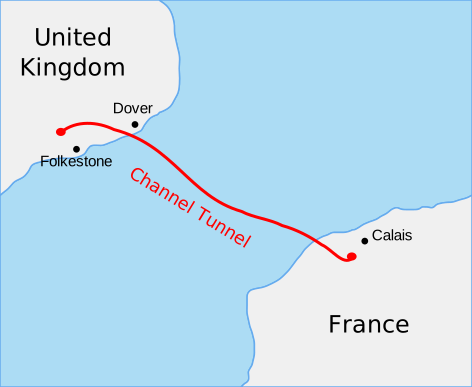
The Channel Tunnel, or Chunnel (map), linking the United Kingdom and France under the English Channel, takes the second (completed) spot at 31 miles long. While it’s a few miles shorter than the Seikan Tunnel, the Chunnel’s underwater segment is longer than that of the Seikan, making it the world’s longest underwater tunnel. The construction took 13 7 years, from 1987 to 1994, with over 13,000 workers involved in construction. Eleven tunnel boring machines were used — 6 on the English side, and 5 on the French side — and the sides met on December 1, 1990. 8.2-million passengers traveled the Chunnel via Eurostar in 2005, and numbers are expected to grow even larger when the Channel Tunnel Rail Link extends to London later this year. When the link is completed, a train trip from London to Paris will take 2 hours and 15 minutes.

The Lötschberg Base Tunnel in Switzerland runs 21.5 miles from Frutigen, Berne to Raron, Valais. When it opens in December of 2007, it will be the longest land tunnel in the world until the Gotthard Base Tunnel opens in 2015. “To dig the Loetschberg, some 16 tons of explosives were used and enough rock was excavated to pack a freight train 2,500 miles long – stretching across Europe from Lisbon, Portugal, to Helsinki, Finland,” according to this report from MSNBC.

A Canadian in Beijing: Lost in the Market and Laughing

With a rickety gate marking one of the main entrances, the market spills out on both sides. There are stalls of all shapes and sizes featuring all kinds of items whose colours cascade down tiered bins and flowing displays. All of the visual action splashes into my senses. The different smells from each stall curl into each other in comfort as we pass through and into the heart of the market.

I am taking it all in.

We are caught in the current of the Sunday shopping crowd and we move slowly through the stalls examining the wide variety of items for sale. I have a moment of feeling like we blend in well (despite the fact that I’m obviously a “waiguoren” or foreigner.) Well, perhaps we don’t exactly blend in considering I look so different and we’re speaking English together, but shopping with David, my Chinese-Canadian friend, makes it a little easier than shopping with a bunch of other non-Chinese folks. People are curious about us but kind and open. Before long, we are having lots of conversations about where we’re from and why we’re here. I don’t see any other foreigners in this market except for us.

Perfect.

Maybe it’s because the market is tucked away in a western Haidian area where tourists rarely go. This is the kind of market that I love the most. It’s slightly dirty with rinds and pits and lychee skins all over the sidewalks from snacking shoppers. There are stalls that look like hovels and/or temporary residences. Kids with dirty faces, bare bottoms and round open eyes are playing with dried nuts from a dried food stand. Vendors are taking naps everywhere in the thirty-two degree heat. (In fact, is there something about garlic that makes people sleepy?!)

Strung everywhere are tarps for shade. Because they are strung up by the individual stalls, they are all different colours as though we’re at a summer campsite where space is extremely limited forcing all the tents to intertwine. Some of these tarps hang a bit low and graze the tops of our heads as we pass. Sometimes we even need to duck.

David complained about the dangling ropes from the tarps reminding him of dangling spiders and I stopped to consider such an image before photographing the offending twine. These ties sometimes catch your head as you pass and if you haven’t noticed them, then it is a slightly creepy feeling, I agreed. Although I’m not arachnophobic, I probably wouldn’t appreciate a bunch of spiders in my hair! We steered around them after that, laughing each time.

Dave and I first discovered this market on the way to The Summer Palace a few weeks ago. At that time, we glanced in at the entrance but couldn’t tell what kind of market it was but agreed to return and investigate. Besides, we were headed for history. Today, we were on a market mission.

Mission successful. This is my favourite marketplace so far.

In this market (whose name I still don’t know), there are fruits and vegetables, breads, steamed buns, oils and nut butters, meat, fish, household supplies, clothing, tea, dried foods of all kinds, antiques, you name it. In fact, I couldn’t quite identify this market as anything but a “general market” if I tried. I could buy lingerie, hoses, brooms, tea, jewelry, fruit and fresh bread while also stocking up on my plumbing supplies if I so desired! It’s amazing.

Row after row of stalls kept making our bags heavier as we purchased dried foods to send home, mangosteens, lychees, and this nut butter that is sort of a combination between peanut butter and tahini. The one cloth shopping bag I brought wasn’t enough for our spontaneous purchases that were now spilling out of additional plastic bags.

Then, we found ourselves at a teashop.

I have been into tea this week, as you know, and I had already bought some chrysanthemum flowers for tea at a different stall – a flavour I truly love here and haven’t seen back home in its raw state. But, the woman at this tea stall was extremely warm and gracious. She spoke Chinese clearly and slowly and we soon found ourselves seated on stools inside the shop and accepting her offer to let us sample various kinds of teas.

She started with a type of tea that looks like a ball. When put into the water, it opened up into the flower that it is and is extremely beautiful. She said that one cup of this tea in a local downtown restaurant or tea house (like the one I went to this week) is about 160 kuai (very expensive by Chinese standards) and Dave confirmed her story. She made one cup of this tea for us and it was a beautiful flavour to top off the beautiful presentation. I watched it opening like a little kid staring into an aquarium. After tasting it too, I knew I had to have a few of these incredible bulbs to bring home for a special (tea) occasion! 40 kuai got me about 8 of them… and that’s pricey but sure beats the cost of tea in the tourist districts.

Of course, that was not all. She began to make us another pot of tea and each time heated the water perfectly, warmed the cups, measured the tea with precision and handled all of the tea tools like the pro that she was. A cup of “pu-er” tea was next on the list and we sipped and exclaimed as she described the properties and why this tea was good for you and when to drink it, etc.

An hour later, we were still in this little tea stall and we had sampled about ten different flavours of tea and had become quite chummy with the shopkeeper and several other customers. She would have kept pouring, too, had I not felt suddenly that we should buy our many items and get heading back home. In fact, I’m not sure the tea would have stopped flowing had we not stood up to leave, protesting yet another flavour she was pulling from the shelf. I laughed out loud at the feeling like I was going to float away!

We all laughed.

Dave bought a lot. In fact, he is the perfect guy to shop with because he is easily convinced to buy more when it’s cheaper to do so and vendors love him! He came away with several different flavours of tea as well as some “feng mi” or honey. (The honey here has a different flavour – it’s sweeter!) I also bought two metal travel mugs for a mere twenty-five kuai each (around $3 Canadian) that come with a built-in infuser. Those will be a welcome addition to our travelling supplies.

We left the stall in great spirits and with bellies sloshing, filled with tea of all kinds. I wondered if all of those medicinal properties combined together would cancel each other out, but if our moods were any indication of tea’s effects then I’d say that it’s all positive!

Losing oneself in a tea stall nestled deep in an authentic Chinese market in an outer district of Beijing feels like a luxurious weekend pastime. I smiled at my life. “Look at me!” I thought, “I’ve tucked myself into this corner of Beijing and it is just my size.”

Then, I popped a lychee into my mouth and let the sweetness roll around in my smile.