Inside the Olympics stadium in Beijing

It is no secret that the Olympics in China this year are designed to make a splash and let the world know that China is “back in the game.”

The Guardian writer, Jonathan Clancey, has been inside the main building and declares it “quite simply stunning.” The Chinese have named it Bird’s Nest when its creators–Swiss architects Herzog & de Meuron, working with Arup and the China Architectural Design and Research Group–unveiled their design five years ago. “Its mesmeric steel frame, 41,875 tonnes in all, loops, swoops and swirls over and around the great, red, concrete 91,000-seat arena. What had seemed to be a solid structure from a distance proves to be a filigree Chinese puzzle close up.”

The structure is almost complete, while the fit-out, with its shops, restaurants, cafes, bars and meeting places, is racing ahead. At times, there have been as many as 7,000 construction workers on site.

Say what you will about the Olympic-size megalomania, but there is no denying this is a gorgeous building..

British Olympians prohibited from criticizing Chinese government

The British Olympic Association (BOA) has inserted a controversial clause into their athletes’ contracts preventing them from criticizing the Chinese government while participating in the ’08 Beijing Games.

The clause states only that athletes “are not to comment on any politically sensitive issues,” which would include China’s dismal human rights record and its occupation of Tibet. The move has been widely condemned as an infringement on the athletes’ rights of free speech.

Those who do not sign the contract will not be permitted to travel to the Olympics, and those that violate it while in China will be sent home, according to the BOA.

The move has already been compared to the British soccer team’s forced Nazi salute before a match in Germany in 1938, which they were told to give to come across as “gracious guests.”

UPDATE: Because of all the outrage this contract provision has caused, it looks as if British Olympic officials may reconsider the clause after all.

Once in a lifetime: How to track pandas in the wild

What you see in the shot here is a panda turd. And not just any panda turd, it’s a fresh panda turd. (Don’t worry. They smell like fresh bamboo.)

If you want the chance to find your own panda turds, there’s perhaps no better place than to trek to Wanglang Panda Reserve. That’s what I did last March, where I stopped as part of a big story for Science about the booming panda population. Unfortunately, the story is behind a subscription firewall, so here’s a shorter one I wrote about my trip for The Scientist.

Wanglang Panda Reserve can’t match its more famous big brothers, such as Wolong Panda Reserve, which NBC Nightly News, Animal Planet, etc love to cover. But that’s a great thing for you. Wanglang is very peaceful–chances are you’ll have the whole place to yourself. Their eco-tourism only recently kicked off, and even then, they rarely if ever receive any travelers from outside China.

To arrange your tour, you can try contacting the park directly, though I don’t believe any of the rangers or staffers speak English. Or you can go on one of the arranged tours, which will be more expensive of course. But it’s definitely an adventure to brag about once you get back. Worth every dollar!

%Gallery-15205%

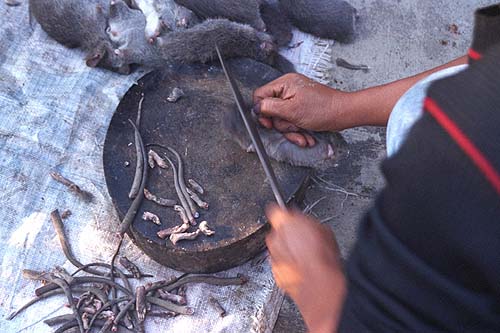
Prefer your lucky rat deep-fried or grilled?

To welcome the Year of the Rat, some people in rural Taiwan and China have increased their rat consumption accordingly. Reuters reports that a rural eatery at Taiwan’s Chiayi county, serves 10 rat-themed dishes, including rat soup, black pepper-dipped and deep-fried rat. The diner goes through around 18 kg (40 lb) of rat meat per day.

Here is the “Rat-at-Chewy” video by Reuters, depicting the way rats are prepared and eaten. I wouldn’t suggest watching it before lunch.

Rat meat apparently became popular in rural Taiwan in the 1940s and 1950s among people who could not afford chicken or pork. At least we know that if the sub-prime mortgage crisis gets any worse, there are enough rats in New York to fill every American man, woman and child.

How the Chinese celebrate the New Year

Chinese New Year parades are taking place in many North American cities this month, but like the fortune cookie and the Cheesy Gordita Crunch, the parades are US inventions that reveal little about their ostensible home countries. So if there are no outlandish parades in China to celebrate the New Year, what really goes on?

“For most urban families, celebrating is limited to eating dumplings, setting off fireworks, and watching the national TV program (this year’s theme, “Thriving China, Harmonious Society“),” says a new Slate article.

Throughout the 20th Century, according to the article, the Chinese government has been attempting to eradicate the traditions associated with celebrating the New Year, like burning the Kitchen God and kowtowing (prostrating oneself) to one’s elders. In the past, they’ve even gone so far as to ban fireworks, re-name the holiday the “Spring Festival,” and to try to change its date. Some of the government’s efforts have been successful– few burn the Kitchen God anymore– but others, like the fireworks ban, have been ignored or overturned.

Read Slate’s article for an interesting history of the Chinese New Year (which I assume is, in China, called just “the New Year,” in the same way they call “Chinese food” simply “food.”)

Here’s more from Gadling about Chinese travelers trying to make it home for the New Year amidst the country’s largest snow storm in 50 years.