“No Reservations” season 4, episode 16: Tokyo

Location: it’s Tokyo time! Bourdain finally makes his pilgrimage to every food host’s favorite culinary destination, the capital of Japan and one of the world’s largest cities.

Episode Rating: Three bloody meat cleavers out of five. Bourdain made a concerted effort not to do the traditional “this is Japan” food show. It made for interesting subject matter, but the episode also seemed a bit disjointed as well.

Summary: In Anthony Bourdain’s mind, Japan is all about the relentless pursuit of perfection. No matter if it’s food, art or sport, the Japanese are almost religious in their attention to quality and detail. It is through this lens that Bourdain takes us on a tour of Tokyo, one of the most famous but also most confusing places to visit on earth (after visiting earlier this year, I would have to agree). After an earlier No Reservations visit to Osaka, where Tony proclaimed he was not going to “do the traditional” Japan visit to Tokyo, it was interesting to get an entirely different Bourdain perspective on the country, one which was noticeably more subdued than his previous visit.
There’s no better insight into Japanese culinary culture than noodles, and Tony starts his visit by meeting up with famous Japanese chef Masaharu Morimoto for some soba. Made mostly from buckwheat, soba noodles are “one of the most fundamental foods” in Japanese cooking. The noodle shop they visit has been perfecting the art of making the perfect noodle since 1789. Each noodle is cut to the exact width of 1.6mm to ensure proper cooking time and consistency. It was clear Tony was loving his noodles, and the camera work here confirms this – we see some serious “noodle porn” with plenty of close-ups and slow-mo effects for good measure.

Not to be outdone by Japanese noodle-making is the Japanese fanaticism for quality cocktails. To better experience the phenomenon, Tony visits Bar IshinoHana, world-famous for its exquisitely-crafted cocktails. According to Tony, the bartender spends an “agonizingly” long time making Tony’s drink – relax man, it’s going to be one-of-a-kind! In the pursuit of his hypothesis that the Japanese are obsessed with perfection, Tony asks the bartender what inspired him to become a bartender. Amusingly enough, the bartender answers his idol is Tom Cruise in Cocktail. How’s that for an odd source of inspiration?

In order to work off his designer-cocktail hangover the next day, Tony visits a sports complex to learn more about Kendo. The sport, involving the ancient martial arts techniques of sword fighting, is as much a mental exercise as it is a physical one. Participants use their shinai, or bamboo sword, to try and outmaneuver and out-think their opponent, aiming to strike body hits.

Back in Tokyo’s Roppongi district, Tony reunites with chef Morimoto after-hours at his restaurant, XEX. Morimoto prepares Bourdain a surprisingly delicious multi-course dinner using a whole Monkfish. Not a single organ is wasted – Tony gets to sample the liver (tastes like foie gras), fried monkfish with seaweed and bamboo shoots, and a “Nabe” (NAH-bay) made with Monkfish cartilage and skin. All unexpectedly prepared and unexpectedly delicious.

Tony seems to be tired of Tokyo, so he hops on a Shinkansen bullet train to take in some of the other nearby sites. I think Bourdain must be getting up there in years, because the next 5-10 minutes of the show take an unexpected turn into HGTV territory while Tony learns about the art of Ikebana, or Japanese flower arrangement. Really? Look, I don’t doubt that it’s a cool art form, but it really did seem out of place in your typical No Reservations episode that centers on gluttony, shooting firearms and killing animals. Perhaps Tony is becoming more mellow as he ages?

All the arts and crafts have made Tony hungry, so he heads to a famous Yakitori joint known for their top-notch chicken skewers. Let me tell you – there is not a single fingernail of that chicken which Tony did not eat in this scene, where he devours rare chicken breast, spleen, chicken sashimi, the chicken tissue connecting the liver and heart, chicken skin, and chicken tataki. I swear, I will not make any “tastes like chicken” jokes here. Tony makes a point of commenting on the raw chicken, which he finds surprisingly delicious. Apparently illness is not an issue, as the chicken is killed immediately before preparation.

Tony ends his adventure outside Tokyo with a visit to a knife-making shop in Sakai City, and with a traditional Kaiseki meal with chef Morimoto, prepared using fresh seasonal, regional ingredients. Tony samples some Cod sperm during his meal, but this kind of weird food indulgence almost seems routine at this point.

Appropriately, Bourdain ends his Tokyo visit with a trip to one of the city’s most famous sushi establishments. The sushi is simply made, amazingly fresh and accompanied by perfectly-made rice. Tony can’t help but hide his glee, proclaiming it the best sushi he’s ever had. Another reminder that when it comes to anything in Japan, the “devil is in the details.” Anthony Bourdain’s Japan is much of the same – an idealized vision of perfectly crafted foods, supreme attention to the little things and an overarching philosophy of minimalism. In modern Japan, that’s perhaps only half the picture – there are plenty of elements of Japanese culture, technology and bizarreness that Tony intentionally leaves out here. But for a show with a singular focus on food and spinning us a pretty narrative, it makes for a nicely packaged hour of television.
Pursuing the American Dream in China

Because the Olympics are in China, you’ve probably noticed an increase of stories and news segments with a China focus occupying the airways. For example, The Today Show on NBC is looking at China from a variety of angles.

One story, presented Monday, illustrated just how fluid the world’s economy can be and how there is an interchange between cultures as a result. For example, if you head to China, you can find an Auntie Anne’s, an American franchise that specializes in soft pretzels.

The Auntie Anne’s in Beijing was started by a Chinese American couple whose parents had immigrated to the United States as a way to make a better life for themselves and their children. This couple moved to China to open China’s first Auntie Ann’s after researching what would work in China and realizing that the enterprise was a way to seize a profitable opportunity. They discovered that one way to make money in another country is to export a popular, established brand.

As the segment illustrated, some Chinese Americans are returning to China as a way to make a better life for themselves. One motivation, in addition to making money, is to learn Chinese and also to learn more about the culture of their heritage-something they often pooh-poohed as they were growing up.

As the segment noted, most plan to return to the United States once the money has been made. It’s not that they have an issue with life in the U.S., they are going after financial opportunity in the country where their parents were born.

If you look at the history of the Silk Road, and how goods and services moved from Asia to Europe and from Europe to China centuries ago, the pattern in similar. Now, though, soft pretzels are part of the scenery.

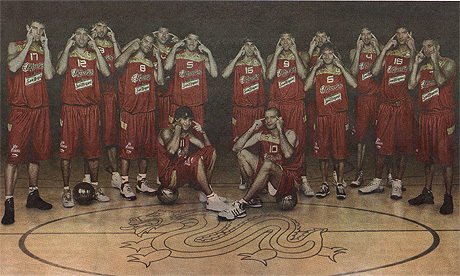
Olympics: Spain and the height of cultural insensitivity

This is a full page advertisement that has been running here in Spain. It’s an advert for the courier company that has sponsored the Spanish Basketball Federation to the Olympics. The photo is the Spanish basketball team, in full Olympic kit, pulling their eyes back.

Of course it has created an uproar in the international media for being offensive to the Chinese. However, people involved in the making of the ad as well as the national team, don’t see what the fuss is about as it was done with good intention; ask any Spaniard how they feel about this and they will chuckle.

Having lived in Spain for over two years now, nor the advert nor the Spanish reaction to this is surprising to me. It is common in Spain to hear people call Africans and African/Americans “negros” (blacks); if you behave badly, you could be told that you are behaving like a “morro” (Moroccan). Although these comments are of racist origin, I have to say that I don’t find the country racist at all. In fact, I find Spain is most welcoming and accepting when it comes to people of different race and culture. Things like this are not taken seriously here but the Spanish don’t understand the consequences of such acts outside their own country.

All that said, I do think that this advert is unacceptable and embarrassing for Spain to project on an international scale. When the Spaniards say they didn’t mean to offend or that it was just an “affectionate wink”, as much as I truly believe them, it was a colossal mistake.

Official report encourages drunken British traveler stereotype

While staying with a friend’s family in Barcelona last year I was shocked when they told me about the stereotypical British traveler often talked about in Spanish media.

“They [British travelers] come down on cheap flights and they don’t even make hotel reservations,” said my friend’s father.
“You mean they sleep on the street?”
“No, they just stay out drinking all night and once morning comes they just take a nap on a bench. No need to pay for a hotel I guess.”

He pointed out that obviously not every British traveler behaved in this manner, yet it was unfortunate, because it gave all of them — even those with hotel reservations — a bad name. But apparently he wasn’t all that wrong. According to the annual “British Behaviour Abroad” report by the Foreign Office, excessive drinking has led to the increase in arrests of Brits traveling abroad. In Spain for example, arrests have gone up by 32% to 2,032 in the period reported.

With a powerful British pound, drinking in other countries doesn’t make a huge impact on the average Brit’s wallet, so holidays can easily turn into drinking days. In response to the report, the British tabloid the Daily Mail pointed out that “drunken and loutish holidaymakers have sent Britain’s reputation abroad plunging to new depths.” Again, we should not stereotype — I have met many Brits while traveling that don’t behave in such a manner — but maybe it’s time to consider whether or not to down that last pint. You don’t want to get arrested…

Photo of the Day (08.12.08)

Istanbul’s Blue Mosque — one of my favorite places in the world in one of my favorite cities in the world. Walking into The Sultan Ahmed Mosque is one of those jaw dropping experiences that you remember for the rest of your life, its vaulted ceilings and Ottoman and Christian influences gently meeting far above the silent crowd. Today’s photo of the day comes from smallscreen, who does an excellent job capturing the detail of the central and satellite domes. A truly exceptional shot.

Have any cool photos you’d like to share with the world? Add them to the Gadling Pool on Flickr, and it might be chosen as our Photo of the Day.