Budget Guide 2013: Washington, DC

All eyes have been on Washington, D.C., over the past year, and it’s not just because the historic city happens to be our nation’s capital. From the 57th presidential inauguration to fiscal cliff drama, much of the media attention has focused on the city’s overspending and excess.

What most don’t see is the vibrant mix of neighborhoods and ever-expanding web of restaurants, hotels and cultural attractions that make Washington a budget capital – not just a power broker’s destination. From new extended-stay hotel options to recently unveiled monuments and more than a dozen free museums, Washington, D.C., has more than its fair share of budget-friendly reasons to visit.

While Washington may still, in some ways, live up to its wonky, politically-savvy-yet-fashionably-challenged reputation, the city has spent the past decade and, most notably, its past few years coming into its own, forging a path that quickly puts this East Coast gem on par or ahead of Chicago, Boston or Atlanta for your next vacation destination.


Hotels

Before we venture into specifics, it’s worth noting that for the true budget seekers, staying just outside the city, but inside the Beltway, is often much more affordable than D.C. proper, and still accessible via Metro and just a 10- to 15-minute ride away from downtown. Neighborhoods like Arlington (Virginia) or Bethesda (Maryland) can be much more reasonably priced. But if a Washington, D.C., address is your priority, consider the following.

Avenue Suites: Part of a small group of boutique properties in the Washington area, this new extended-stay property offers the advantages of apartment-like living in the heart of the city’s Foggy Bottom neighborhood. Simple and clean lines give the property a timeless appeal, while photographs of Hollywood elite lend a touch of glam. Walkable to Georgetown shopping and dining, and yet still metro-accessible, this property is an ideal choice for those looking to stay more than a night or two.

An extra perk? Generously sized suites (600-650 square feet) have separate bedrooms and living areas, full kitchens and gratis Wi-Fi. They’ll even stock your fridge if you request it! Of course, it doesn’t hurt that the attached A Bar + Kitchen is one of the city’s more popular new spots for happy hour.
Avenuesuites.com 2500 Pennsylvania Ave.

Kimpton Hotels: If you’re going to attempt a budget-friendly trip, choose a hotel with a wide variety of value-added amenities. From complimentary in-room pet visitors in the form of goldfish to “Wine Down Hour” or a morning cold pizza and Bloody Mary bar, Kimpton’s dozen-plus D.C.-area properties are some of the city’s best budget accommodations. This boutique brand offers more than 50 hotels nationwide, but features a strong concentration in Washington, with many offering weekend rates starting at around $100.

These properties are as well-loved by locals as they are by guests, due in part to their affiliated restaurants that make up some of the city’s most popular tables, including Urbana in Dupont Circle’s Hotel Palomar, Poste in the Hotel Monaco D.C. or Jackson 20 in the Monaco Alexandria. Of course, cheeky in-room add-ons like leopard- and zebra-print robes don’t hurt the brand’s lighthearted but upscale rep either.
Kimptonhotels.com


Eat and Drink

Food Trucks: As in many cities, the food truck boom has hit it big in Washington. Locals spend lunch hour tracking trucks as they stop in popular downtown destinations like Farragut Square and George Washington University and get their fill of lobster rolls from Red Hook Lobster Pound, Cuban sandwiches from celebrity chef Jose Andres’ Pepe truck or enjoy more than 40 types of sauce add-ons to the fusion cuisine at the ever-popular Sauca. Of course, the varieties don’t stop there; trucks offer everything from cupcakes and banh mi to peanut butter and jelly as their specialties.
foodtruckfiesta.com is the easiest way to track where your favorite will stop today.

Union Market: Most D.C. guidebooks advise visitors to take a swing through Capitol Hill’s Eastern Market, a collection of food and flea market-style vendors that gather each weekend to display their wares. We’re not discouraging a visit, but food lovers should now seek out the city’s new market-style experience in the NoMa neighborhood. From oysters to ice cream and artisan olive oil to freshly-baked goods, the market is not only open Wednesday to Sunday, but it also offers an ever-changing array of pop-up artisans.
unionmarketdc.com

Charles Steak & Ice: For years, Washingtonians bemoaned the lack of quality delis downtown. That was until the duo behind Taylor Gourmet began a Philadelphia-style sandwich shop on H Street in late 2007. Offering up hoagies galore, this shop quickly became a cult favorite and now has six area locations with more scheduled for early 2013. But their newest venture, Charles Steak & Ice, riffs on another Philadelphia tradition that D.C. sorely lacks – the cheesesteak. Done up in artsy graffiti and reclaimed metal picnic tables, guests line up all day to order subs “wit wiz” or “wit out.” We’d suggest that you don’t miss the sloppy fries.
Steakandice.com 1320 H St. NE


Budget Activities

Martin Luther King, Jr. Memorial: The city’s newest monument is the recently-opened tribute to the nation’s most famous civil rights leader, located within walking distance of the presidential monuments.
www.nps.gov/mlkm

D.C. by Foot: Learning the ins and outs of any city is usually left to those visiting with a local. But not anymore – from the city’s “Secrets and Scandals” to the inside story of Lincoln’s assassination, these free (tip-based) tours are great ways to learn the city like a local.
freetoursbyfoot.com/dc/


Get Around

The easiest way to get from point A to B in Washington, D.C., is via the Metro rail system. Use Wmata.com for a simple trip planner, calculating distances via foot, bus or Metro.

Just be sure to stand on the right and walk on the left of Metro escalators – it’s the city’s cardinal rule of transportation.

If the weather permits, visitors can also test Capital Bikeshare. Rent by the day or three-day period, simply dropping your bicycle at locations around the metro area when you’re finished. With nearly 2,000 bicycles at your disposal, you’ll always have wheels when you want them. capitalbikeshare.com

Budget Tip

If you’re visiting the city for just a day, consider buying a daylong pass ($14), which allows for unlimited access to the system. When spending more than a day riding the rails, opt for a credit card-style “SmarTrip” card, which can be refilled again and again as well as used for parking at metro stations.

[Photo credit: Leigh Vogel/Getty Images for Edens]

Damage To Timbuktu’s Antiquities Not As Bad As Originally Thought


Earlier this week we reported on the possible destruction of Timbuktu’s collection of medieval manuscripts. Now it turns out those initial reports were exaggerated.

Timbuktu in Mali is a UNESCO World Heritage Site thanks to its many shrines to Muslim saints and its collection of some 300,000 manuscripts dating as far back as the beginning of the 13th century. They’re in several languages and cover everything from the history of the Songhai Empire to medical texts. They’re the biggest collection of texts from west Africa and are immeasurably important in our understanding of the continent’s past.

Sadly, the city got captured by the Islamist group Ansar Dine (Defenders of Faith) last April as part of a war against the government. The Islamists enforced a harsh version of Sharia law and destroyed many of the shrines. It was also feared that they had destroyed all the manuscripts.

Now that Timbuktu has been liberated by French and Malian forces, it turns out the damage isn’t as bad as previously reported. Reuters reports that most of the manuscripts were hidden in private homes and secret caches. The people of Timbuktu have had to do this many times in the face of invaders, and so they got together to protect their heritage.

The two libraries that housed tens of thousands of the manuscripts were not significantly damaged. About 2,000 manuscripts are missing. Some were burned and others may have been stolen to be sold on the international antiquities market. Also, it appears that only “dozens” of the more than 300 shrines were destroyed or significantly damaged.

An Agence France-Presse report today states that some manuscripts were smuggled all the way to the capital Bamako in the south, where they were out of reach of the rebels. The furniture in one of the main libraries was looted and there’s a pile of ash on the floor from where the Islamists burnt some of the manuscripts, but the library and collection as a whole are fine.

So it looks like the ancient heritage of Timbuktu has survived another war. Hopefully soon the situation will stabilize and the famous city will once again become a destination for scholars and adventure travelers.

[Photo courtesy Gina Gleeson]

New Orleans Prepares For ‘Super Gras’ 2013

Visiting New Orleans during Mardi Gras has never been for the faint of heart. But with the city set to host the Super Bowl just nine days before Fat Tuesday, locals believe that this year’s “Super Gras” celebration might be the city’s biggest party ever. New Orleans has spent $1.3 billion on infrastructure improvements in the run up to the Super Bowl according to CNN, and USA Today estimates that the city will see a $1 billion spike in economic activity as a result of the Super Bowl and Mardi Gras.
%Gallery-177572%
The pre-Lent partying culminates on Fat Tuesday, which falls on February 12 this year, but there are dozens of parades, organized by carnival krewes, balls and parties in the weeks leading up to Ash Wednesday. We spoke to Laura Martone, a New Orleans native and author of the recently released “Moon Handbook to New Orleans,” to get a flavor of what New Orleans is like during Mardi Gras.


For some, Mardi Gras is synonymous with debauchery – beads, flashing and binge drinking, among other things. Has all of that been going on for decades?

I’m 36 and all of that has been happening since I was a little kid. My mom tells me that it used to be more family friendly. People throw beads down to women and men who are flashing. I have never done that. My dignity is worth more than some plastic beads. But a lot of the parades are more family friendly and you don’t see much flashing at those events.

I assume 99% of the women who are flashing are tourists?

Probably. The thing that used to fascinate me as a kid was seeing the cops taking pictures of the women flashing. No one was getting ticketed for indecent exposure because the cops were too busy taking pictures.

The cops don’t still take photos of women flashing, do they?

I don’t know. I wouldn’t put it past them.

You live in the French Quarter. Do New Orleans natives dread Mardi Gras because the city is invaded by tourists?

A lot of my friends are leaving town, and when I was growing up, my mom would take me to some of the parades but even she didn’t love it. As an adult, you kind of dread the mayhem. You get so many drunken crowds; people are here to party more than for the culture. This year is the perfect storm because we have the Super Bowl and Mardi Gras at the same time. It’s total mayhem.

But, while I know plenty of people that flee the city during one of the busiest times of the year, there are many, many more that embrace the occasion. People host Mardi Gras parties, flock to as many parades as possible, and, sometimes even spring for tickets to one of the big balls. Most New Orleanians don’t need a reason to let the good times roll.

What’s it like to live in the French Quarter during Mardi Gras? Are people vomiting and peeing in the streets?

Oh yeah, but sadly you see that here throughout the year. It’s just a bit more during Mardi Gras. Sometimes I just do not want to be on Bourbon Street. I’d rather walk on Royal Street, where you can still get the French Quarter atmosphere without being inundated by hawkers and drunks. But sometimes it is fun to walk down Bourbon Street and just feel the energy. Most people are having a really good time.

Do most of the tourists just turn up around Fat Tuesday or well before then?

The big crowds come for the last weekend because that’s when all the major super krewes run. Endymion is on Saturday night and Bacchus is Sunday night, and Monday is Orpheus. Orpheus is the one started by Harry Connick, Jr. and it has a music theme. And then on Mardi Gras Day, you have a ton of parades. The major ones are Rex, which is the king of Mardi Gras, and Zulu, that’s the African-American one that’s been around since the early 1900s. They pass out coconuts and it’s a little crazy.


When does the Mardi Gras season start?

Technically, it starts on January 6, Epiphany. But the parade season is usually the two weeks before Mardi Gras Day. The dates change every year, depending on when Easter is. Usually right after Christmas, we take down our Christmas decorations and put up our Mardi Gras decorations.

What advice do you have for first-time Mardi Gras visitors?

If they’ve never been before, coming on Mardi Gras weekend is a big deal because that’s when the super krewes roll. You get the celebrity grand marshals and the big floats and endless marching bands and that kind of stuff. But for people who just want to get a taste of the season, there are parades going on all the time. On Sunday, for example, there’s the Krewe of Barkus – it’s the dog parade and it’s really crazy.

It’s tough to get a room in the French Quarter for Mardi Gras. What other neighborhoods should people look into?

I don’t always encourage people to stay in the French Quarter. The French Quarter hotels tend to be a lot pricier and it’s harder to get rooms. The two neighborhoods on either side of the French Quarter – the Central Business District (CBD) and the Faubourg Marigny – are really good. CBD has a lot of chains so those places will be more reasonably priced. Faubourg Marigny has more intimate bed-and-breakfasts and it’s a little funkier, so it’s kind of a good New Orleans experience. It’s cheaper than the French Quarter but it’s still within walking distance.


And the Garden District?

That’s another good choice and it’s accessible via the St. Charles streetcar but because of the Super Bowl, everything is in disarray because they were repairing that line. But it’s still pretty easy to get from the Garden District to the heart of the city. Uptown is also a good choice. It has a combination of chain hotels and bed-and-breakfasts.

What other tips do you have for first-time visitors?

New Orleans isn’t dangerous in the same way Rio is. But still, with the crowds and alcohol, you want to be careful. Travel in pairs. Watch out for pickpockets. People worry about the crime situation in New Orleans but just be careful where you go. The Quarter itself is relatively safe because there’s a big police presence. But right across Rampart Street, which borders one side of the quarter, you’re in Tremé, which is not very safe. Tourists wander off the beaten path when they’re drunk and that’s when they get mugged. Try to stay in places where you see plenty of people, and when in doubt about an area, just ask someone. Natives are very friendly here.

Tourists come here and they leave their inhibitions behind. People think that anything that happens here, stays here but it can be safe if you have your wits about you.

For those who want to experience Mardi Gras but are a little intimidated by the crowds and craziness in New Orleans, are there alternatives nearby?

There are parades in Metairie, which is a suburb of New Orleans, Slidell, which is another suburb that is much more family friendly. And beyond here, Lafayette has a big Mardi Gras celebration of its own. It’s about 2-1/2 to 3 hours away and it has a more Cajun vibe. And outside Louisiana, Mobile has a great Mardi Gras and it’s also pretty family friendly.

People do crazy things to get beads at Mardi Gras but these things are made in China. Why not just buy them?

Right, you can buy them wholesale. They are dirt-cheap, so it doesn’t make that much sense to me to expose myself to get them.

[Photo credits: Laura Martone, Infrogmation, Toast to Life, Mark Gstohl, Derek Bridges, and Tulane Public Relations on Flickr]

The Best Of The West: Classic Ski Lodges

Despite deceptively balmy temperatures in parts of the U.S., there’s still plenty of ski season left. Why not spend it staying at a classic ski lodge or chalet out West? These regal or groovy remnants from the early-to-mid-20th century are a dying breed, although some have been refurbished to good effect, while still retaining their original style. They also tend to offer friendly, personalized service, so you feel like a welcome guest, not just a number.

Classic places are often more affordable, and just as stylish and comfortable than their boutique or generic high-end chain counterparts. Even when they’re pricey, they’re a bit of living history that can give your ski trip a fun retro feel. Think racy Piz Buin and Lange boots ads, fondue, tight, color-blocked sweaters, Bicentennial Ray-Bans, and all things Bavarian.

Below, some favorite vintage ski accommodations across the West. Don’t forget your Glockenspiel.

Tyrolean Lodge, Aspen, CO
It may come as a shock that Aspen has a classic ski lodge that’s remained little-changed in atmosphere or ski-town spirit since its opening in 1970, but the Tyrolean is just that place. Located several minutes’ walk from the slopes, this no-frills, family-owned chalet is one of the best deals in town, with rooms starting at $155/night; some with kitchenettes. The rooms have been upgraded to be more modern, but the decor and vibe is still vintage Tyrol ski culture. Love.

Tamarack Lodge
, Mammoth Mountain, CA
This small, mid-century property overlooking Twin Lakes is on the California Register of Historic Places, and caters to the cross-country crowd. It has both European guesthouse style rooms, historic, refurbished cabins (see photo above), and from December through April, ski-in/out access. If the town of Mammoth is too hectic and soulless for you, consider this a peaceful alternative to the mainstream.
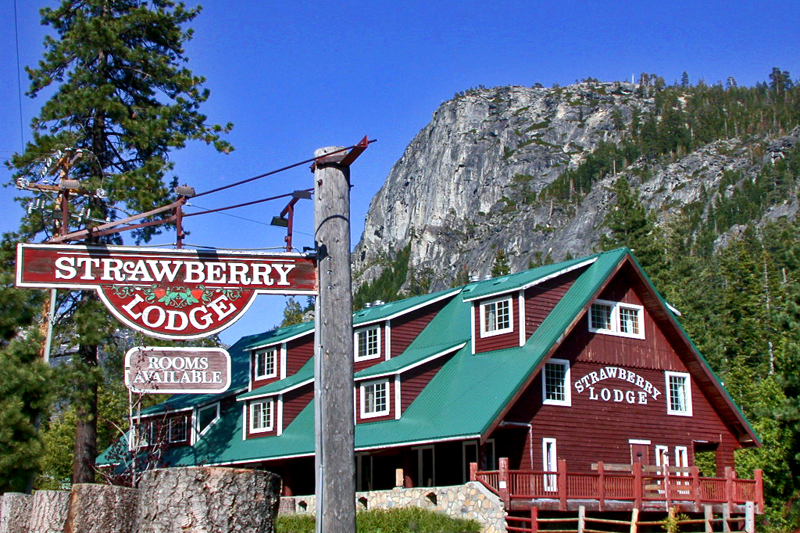
Strawberry Lodge, Kyburz, CA
Highway 50 Tahoe road-trip regulars will be familiar with this former Pony Express stop (right). Located off the side of the road in the nano-community of Kyburz, Strawberry is 20 minutes from South Shore. It’s seriously old-school, in that musty, funky way, with bad taxidermy, historical oddities, and is a much-loved Lake Tahoe institution.

With 31 rooms starting at just $49 a night (some are European style, with a shared bath), it’s hard to pass up, especially when you consider the proximity to all manner of vices, ranging from drinking (please don’t attempt to drive back) and gambling, to outdoor recreation. I love it because it’s one of the last remnants of old Tahoe, in a pastoral mountain setting. Strawberry also offers cross-country skiing, and the restaurant and bar can get hopping, sometimes with live music.

Sun Valley Lodge, Idaho
Built in 1936 at America’s first destination ski resort (with the world’s first chairlifts), the SVL was considered cutting-edge. It offered “every amenity a skier could possibly imagine.” Today, the 148-room property has been completely refurbished into a luxury hotel, complete with glass-encased swimming pool, yet it retains its majestic timber-and-stone facade and stately atmosphere.
P.S. Hemingway slept here.

Timberline Lodge, Mt. Hood, OR
Celebrating its 76th year, this National Historic Landmark (lobby, right) was built at a time when American heritage and the spirit of adventure crashed head-on with the Great Depression. FDR heralded the lodge as a “testament to the workers on the rolls of the Works Progress Administration,” which funded most of the property’s construction. The lodge shut down twice, once during WWII, and again in 1955, as it had fallen into disrepair. Under a new lessee, it was restored to grandeur and reopened later that year.

Located less than 90 minutes from Portland, Mt. Hood is a favorite local’s ski area. Timberline is built in the classic Pacific Northwestern lodge style, constructed primarily by hand of native timber and rock. The bright rooms are upscale rustic, with wood paneling, thick comforters, and stone fireplaces: all the trappings for a cozy getaway.

Alta Peruvian Lodge
, UT
Located at one of Utah’s premier ski resorts, this three-story wooden lodge had an unlikely start as a pair of barracks buildings in Brigham. They were relocated to Alta in eight pieces, and reconstructed into a 50-room lodge that opened in 1948. In 1979, an architect was hired to gussy up the property, although by today’s standards, it retains a retro Alpine charm (the kelly-green shutters decorated with Edelweiss, for example).

Rooms are straightforward and more motel than mountain lodge, but a fantastic deal, starting at $129 for a dorm bed. Prices include all meals, served family style in the lodge dining room, and free shuttle service to Alta Mountain and Snowbird. There are also twin and queen rooms with a shared or private bath, as well as bedroom suites. As for why the property is called the Peruvian? No one knows, although possibly it’s for a nearby landmark, Peruvian Creek.

Nordic Inn, Crested Butte, CO
Reopened on December 15, 2012, under new ownership, this beloved, 28-room Alpine lodge (right) opened over 50 years ago. Located just 500 yards from the slopes, the Nordic has refurbished half of its spacious rooms, which are now kitted out with hardwood floors, down comforters and pillows, and gorgeous Colorado beetle kill pine woodwork. The remaining rooms (which are a colorful ode to the ’80s, and a screaming deal for ski-in lodging) will be redone by June 1.

P.S. Ski lodges aren’t just for winter! Many are open year-round, and summer is also peak season for outdoor recreation.

[Photo credits: Tamarack, Mammoth Mountain Ski Area; Strawberry, 50Cabins.COM; Sun Valley, Sun Valley Resorts; Nordic Inn, Ken Stone]

Budget Guide 2013: Las Vegas

If the thought of Las Vegas conjures up images of flashy clubs, glitzy shows, an endless parade of limousines and eye-wateringly high table limits – you’re not entirely mistaken. This is a city where high rollers come to play and $3000-a-glass cocktails or $40,000-a-night hotel rooms are on offer for those with cash to burn.

However, the good news is you don’t need to have deep pockets to enjoy Las Vegas. The city has experienced a recent surge in hotel room capacity because of a series of new properties that opened during the depths of the recession. That timing means they’ve had to discount rates in order to keep occupancy up and other hotels have followed suit.

Downtown Las Vegas – which has traditionally offered better prices than the Strip – is also drawing more visitors thanks to its ongoing renewal. Trendy bars like The Downtown Cocktail Room, The Griffin and recently opened prohibition-style lounge Commonwealth have been growing in numbers much to the delight of hipsters. Decent bang for the buck also makes them a great draw card for the budget traveler.

Hotels

When choosing a cost effective hotel, be sure to factor in the amenities and entertainment as well as the price, and remember that even upscale hotels offer excellent deals from time to time, making them a great value for the money.

A few more points to keep in mind when booking accommodation:

Hotel rates in Vegas vary dramatically depending on when you’ll be staying and when you book. Mid-week stays will be markedly cheaper than weekends, as long as there are no major conventions or events going on.

For the uber budget conscious, note that while Vegas does boast a handful of hostels, they tend to be in out of the way or in somewhat unsavory areas. So rather than paying $10-15/night for a dorm bed, share a room with friends at one of the hotels below for not much more.

To get the best rates, do a thorough search on online booking sites like Expedia and Kayak and then call the hotel to check current rates. Most will match a cheaper deal you find for their establishment online, and some will even knock off 10 percent of that price.

Beware that many hotels in the city charge a daily resort fee – it’s not always clear when booking but it can add a significant amount to your final bill, so always ask.

Here are a few options:

Main Street Station. Located just two blocks from Fremont Street in Downtown Las Vegas, this train-themed hotel is heaven for the history buff. Packed to the brim with antiques, the hotel even has a piece of the Berlin Wall – although ladies will have to enter the men’s restroom to see it. The hotel’s microbrewery and restaurant, Triple 7, serves up award-winning brews and a free shuttle service whisks guests to and from the Strip. The hotel doesn’t have a pool, although guests are welcome to use the facilities at the neighboring California Hotel. From $38. No resort fee but a $9.99 charge for Wi-Fi. mainstreetcasino.com 200 North Main Street, Las Vegas, NV. 89101.

The Stratosphere. This 1149-foot tower situated past the north end of the Strip just spent $20 million revamping its décor, restaurants and sky-high bar. The hotel is a bit out of the way of the action, but what it lacks in location, it makes up for in price. Guests still have relatively easy access to the rest of the Strip via bus, which stops outside the hotel; monorail, which is a short walk away near the Sahara Hotel; or by driving and making use of the free valet parking. Hotel guests are allowed free visits to the observation tower, which provides great views of the Strip. They also have access to two pools and a fitness center, but will have to pay for Wi-Fi. From $31 plus $7.50 daily resort fee. stratospherehotel.com 2000 Las Vegas Boulevard South, Las Vegas, NV. 89104.

Luxor. This three-star hotel in the shape of a sleek black pyramid is located at the southern end of the Strip and offers a great value for the money. Guests at the Egyptian-themed resort receive free pool and gym access, two free drinks per stay, Internet access and free parking. The hotel also boasts a newly revamped food court and a new interactive center for sports fans. Rooms are located in either the pyramid itself (complete with slanted elevators that provide access to the higher rooms) or the adjacent towers, which are newer. From $38 plus $18 daily resort fee. luxor.com 3900 Las Vegas Boulevard South, Las Vegas, NV. 89119.

Eat and Drink

Tacos El Gordo. This chain, which started in Tijuana, Mexico, is known for their authentic street-style tacos. Fillings include spicy pork, carne asada and carnitas, as well as tripe, tongue and brains for the more adventurous foodie. Tacos are small but cheap at $2 each and are topped with onions, cilantro, guacamole and various sauces. You can also grab a quesadilla, tostada, or fries loaded with guacamole, sour cream and your pick of meat. Bottomless soft drinks are also on offer. Don’t expect table service here – you’ll be ordering food at various meat “stations” and then paying at the cashier. The restaurant has a location downtown as well as one on Las Vegas Boulevard in a strip mall just north of the Wynn Hotel. The Strip location is open until 3 a.m. on weekdays and 5 a.m. on Fridays and Saturdays, making it an ideal spot to grab some late-night munchies.

Secret Pizza. Inside the swanky Cosmopolitan Hotel you’ll find a cheap and unassuming pizza place sure to satisfy late night cravings. Hidden away down an alley on the third floor of the hotel, the signless restaurant serves up New York-style, thin-crust pizza to hungry clubbers. The hidden pizza joint serves up pies and slices with a range of toppings, including white pizza, homemade meatballs, cheese and pepperoni. A slice will set you back around $5.

Buffets. We couldn’t talk about eating in Las Vegas without mentioning the buffets. There are more all-you-can-eat dining options in this city than you could possibly work your way through, with just about every hotel offering at least one buffet. As a general rule, buffets are cheapest earlier in the day (so breakfast or lunch will be a better deal than dinner). If you’re eating downtown, you’ll find plenty of lunch buffets around the $7 mark, and dinner buffets for about twice that price. One notable option on the Strip is the Buffet of Buffets. This is a day pass offered by Harrah’s that gives you access to buffets across their various properties (which include Paris, The Rio, and Planet Hollywood among others). For $50 you can eat as much as you like over 24 hours. Just beware that some of the premium buffets like the over-the-top one at Caesar’s Palace will add a $15 surcharge on top of the pass.

Activities

Pool Partying. Without a doubt, gambling is the number one activity in Las Vegas, but if you’re looking for other ways to have fun, hit up one of the city’s many pool parties. These daylong parties feature sizzling beats, bronzed bodies and typically, very pricey booze; however, the good news is you can often get into the parties for free. Some of the bigger venues include Rehab, located at the Hard Rock Hotel, and Wet Republic, at the MGM Grand. A more budget-friendly (and relaxed) option is the Venus Pool Club at Caesar’s where you can throw back a beer for around $8. Admission costs $10-30 depending on the night, but ladies will almost always get in free and men are often handed free passes too.

See a half-price show. Vegas has countless shows taking place every night, including comedy shows, concerts, dance performances, magic shows and acrobatics. Popular shows include The Jabbawockeez, Absinthe and various Cirque du Soleil performances, but there’s really something for everyone. You can buy tickets for half the box office price by visiting tix4tonight, which has a number of locations along the Strip.

Free entertainment on the Strip. There’s no shortage of things to see on the Strip, and wandering through the various themed hotels is an activity in itself. Experience the canals of Venice, see the Sphinx, or take your photo in front of the Eiffel Tower. Nature lovers can enjoy the Conservatory and Botanical Gardens at the Bellagio – the horticultural displays are constantly changed to suit the season. You can also see flamingos, along with a variety of other birds in the Flamingo Hotel’s wildlife habitat. Vegas hotels also put on a number of free performances to draw in the crowds. At Circus Circus, the world’s largest permanent circus comes alive at 11 a.m. daily, where you can see new world class acts like the Ethiopian foot juggler or the aerial silk artist from Italy. In front of The Mirage, a giant volcano erupts every hour from 5-11 p.m. The Sirens of TI is a 20-minute show featuring hip-swinging sirens and swash-buckling pirates that’s somewhat risqué. It takes place nightly in front of Treasure Island. For something tamer, take in the fountains at the Bellagio, which dance to music every 15 minutes from 7 p.m. onwards, and every 30 minutes during the afternoons. The Bellagio has begun adding new “dances” to the fountains’ repertoire.

Take a Stroll Downtown. If you venture downtown, check out the Fremont Street Experience. The historic street is home to the largest LED screen in the world in the form of a giant canopy over a pedestrian walkway. Visitors can watch a dazzling display every night on the hour, and the light show is usually accompanied by music and other live performances. While you’re downtown, don’t forget to check out the Neon Museum featuring original neon signs that once glittered across the city’s casinos. The museum is made up of several components: the Downtown Gallery at Fremont Street and Las Vegas Boulevard displays restored, illuminated signs; while the Neon Boneyard is an outdoor museum home to donated and rescued signs. The Neon Museum is just the start of a grand plan to revitalize the downtown area (after Zappos relocated to the city, it set up the Downtown Project, which aims to completely transform Vegas’ urban core) so keep an eye out for more arts, music and cultural developments in the months and years to come.

Get Around

To get to and from the airport, you can take bus routes 108, 109, or the Westcliff Airport Express. A single ride costs $2 – buy your ticket at the bus stop vending machine before boarding. Alternatively, a number of shuttle services ferry passengers between the airport and hotels on either the Strip or downtown. Most cost $7 for Strip hotels and $8.50 for downtown destinations. A taxi from the airport will cost around $15 depending on the route.

Las Vegas is well served by public transport and most visitors will be able to get around sufficiently on the double decker bus known as The Deuce. The bus runs between downtown and the Strip, making stops at most major hotels. The Strip and Downtown Express Bus (also known as the SDX) runs along a similar route but is much faster due to the limited stops. The Deuce runs 24 hours a day, while the SDX starts operating after 9 a.m. Both run every 15-20 minutes. Passes can be purchased at the vending machines located at bus stops. They’ll set you back $6 for two hours, $8 for a one-day pass, or $20 for three days.

A pricier option is the monorail, which runs from the MGM Grand on the south end of the Strip to the Sahara at the north end. The line runs behind the hotels and casinos (rather than along Las Vegas Boulevard) and takes 15 minutes to complete the route. Tickets cost $5/single, $12/one day, $28/three days, or $43/five days.

Budget Tips

Free Wi-Fi. If your hotel charges an extravagant fee for wireless Internet access, it’s worth knowing that the various MGM properties provide free Wi-Fi to the public. The hotel group offers complimentary service in its casinos, pools, lobbies and restaurants – and you don’t need a password or room key to access the network. At the time of writing, Wi-Fi is already available at the Bellagio, Mirage, Mandalay Bay and MGM Grand and is being added to the Monte Carlo, Luxor, New York New York and the Excalibur.

Day passes to hotel pools. You don’t have to be a guest at one of the upscale resorts to use their amenities. For as little as $10 per day you can gain access to the pools of many of the hotels along the Strip. It’s great if you’re trying to save on accommodation costs but still want to be able to enjoy some of the luxe facilities the city has to offer. You can see a list of pools open to the public here. A particularly notable pool is The Tank at the Golden Nugget, which boasts a 200,000-gallon shark tank with a water slide that runs through it before dumping you in the pool. Cover charge for non-hotel guests is $20.

Drinking on the cheap. One of the cheapest places to drink in Vegas is in a casino, since most of them serve free alcohol to gamblers whether they’re high rollers or only playing 1-cent slot machines. Just remember to tip the server $1 per drink or the service will quickly dry up. Many bars and vendors along the Strip also sell cheap frozen daiquiris by the yard glass – since you’ll rarely be prevented from taking a drink from one casino or bar to the next, it can be a cheap way to have a big night.

Room upgrades. Want to score a better hotel room than the one you paid for? Try the $20 trick. Simply slip the hotel receptionist $20 when handing over your credit card and ask if any upgrades are available. If you’re staying at a budget hotel, you may get away with tipping significantly less. You can read more about the success rate of this strategy at various Vegas hotels here.


[Photo credit: Flickr user David Stanley]