Global rise in food costs: The real effects

The dollar has hit a new low against the euro, America is on the verge of recession and global food prices are on an upward spiral. In fact, global food prices have risen by 40% in the last nine months. Add to that the fact that food reserves are at their lowest in 30 years and the global economic situation looks grim. But beyond percentages and figures what does this really mean?

To showcase the real effects of the global rise in food costs the BBC has put together an interesting piece featuring six families from around the world, their shopping lists and exactly how their shopping habits have changed because of the rise in prices.

The six families are from Guatemala, India, Kenya, China, Egypt and the UK. In Guatemala the Rodas family has gone from eating meat five times a week to two. In Egypt the Abdulwahab family speculates a household used to be able to eat for one Egyptian pound; today it costs more than five.

The article also itemizes each family’s shopping list, which provides for some eye-opening figures. The Classik family from the UK spends 10% of its monthly income on food, while in Egypt, the Abdulwahab family spends about 80%. Makes you think twice about complaining about how expensive everything is going to be on your next trip to Europe; travel is still a luxury.

Read the whole BBC article here.

Binging in the UK: Part of culture or culture itself?

Last week in London, I noticed pubs still closed at 11, despite having had the option of applying for a 24-hour drinking license for almost three years now. It just so happens, that the UK released a report last week claiming that the prolonged opening hours didn’t really help curb the “binge-drinking problem” in Britain.

In her column, Sorry I binge responsibly, The Guardian’s Zoe Williams writes about the complicated British culture of binge-drinking, asking herself whether to blame the 60s for destroying a shared understanding of morality, or the 80s for creating the financial disparities that make society functionally meaningless to people anywhere near the bottom, or–her best bet–she offers leftist fiscal explanations.

Whatever causes the Britons to binge-drink, one thing is clear. Liberal licensing laws have not helped much. The average pub in the UK stays open only 21 minutes longer than before (pubs are not interested to apply for licenses). Although crime has gone down slightly, alcohol-related crime, in city centers, has gone up, especially after midnight. Williams writes: “If the relaxation of licensing laws has had any beneficial impact on crime, then perhaps it is to keep burglars in the pub, giving them less time to burgle.”

Oktoberfest in Munich: Read about it…in March?

Anyone who has experienced Munich’s famed Oktoberfest knows one truth about the world’s biggest beer binge above all else: It’s damn hard to get into one of those tents on the Theresienwiese.

My brother and I tried a few years ago, standing in the rain in several endless lines for nearly two hours, thirsty, with my brother turning to me and finally asking a question probably not often uttered in late September in Munich: “What do you have to do to get a beer at Oktoberfest?”

Ah, memories. They came rushing back as I clicked into a Der Spiegel story on Oktoberfest Inc. that was pimped on the World page of the New York Times online. The Times for a while now has had a content sharing agreement with Spiegel, Germany’s most respected news magazine (which is trying to make inroads in the U.S. by publishing a very solid online edition in English).

The story recounts what a big, billion dollar business Oktoberfest has become, with more than 6.5 million visitors a year getting sloshed and doing stupid things (my brother stole a bike). It’s a really interesting, behind the scene look at what it takes to put the event on (one tent owner pays €2 million a year just to set up and take down his 9,400 seat venue, to say nothing of the €400,000 or so in other costs he absorbs for insurance, musicians, etc.).

But I still have a question, which I’ll direct to the Times: Why are you telling us all this now? The article is dated from last October, despite being hyped as “News from Der Spiegel” on the World page right now…in March. So it’s really late to be reading about last year’s Oktoberfest, and a little early to be reading set-up pieces for Fest ’08.

Timing is everything with newspapers. I wonder what editor made the call to re-print this piece now.

Alternatives for ice-chewers traveling to Spain

Alert for travel-industry: the next lucrative market niche you must target is that of ice-chewers — people addicted to chewing ice who, alongside price, look at the availability of ice-chewing options when they travel. Yes, the cult of ice-chewers is on the brink of a revolution as more and more of them come out of the closet and share their fetish for ice-chewing.

The underground world of ice-chewers was exposed recently by the Wall Street Journal that reveals how these people spend their time fascinating over the feeling of different ice-forms in their mouth while ice-machine makers are competing over how to make the best chewable ice.

There is an online forum of ice-chewers (that currently has 3334 registered members) where “ice restaurants” are a topic of discussion. The Wall Street Journal article quotes Amy Grant’s ice-chewer husband saying: “Europe is a drag…I ask for ice, and they give me one or two cubes. They’re stingy with their ice. I’d never survive there.”

That’s true, I have lived in Europe for over 18-months and never have I been served ice in any other form but cubes. However, here are a few suggestions to get your dose of crushed ice to chew on — but you can’t be fussy about it being flavored: (does it make a difference?)

  • Ice-popsicles: Available everywhere in every imaginable flavor. In the various brands and shapes available, you will probably find a form of compact ice that will match the type you like to chew on.
  • “Flashes”: Well, that’s what they are called here. They are long bags of plastic filled with flavored ice, mainly made for kids to chew on.
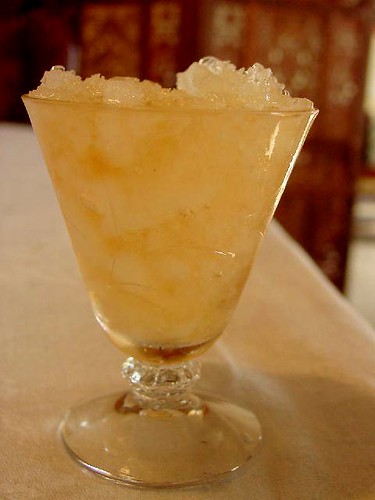
  • “Granizados”: In Spain people are big on a slush called “granizado” — which translates to something “grained”, in this case, it’s ice. Lemon and coffee flavor are available almost everywhere; the density and crunch-ability of the ice varies so I’m sure you’ll be able to find something similar to the type of ice you like to chew on. If you drink the flavor out quickly, what you are left with is plain chewable ice. Since these places serve these slushes year-round, they are probably your best shot, but you’d have to ask for it and try your luck.

So, ice-chewers, if these alternatives work for you, you can add Spain to your list of countries to visit :)

Big in Japan: Zen and the art of ramen appreciation

I love ramen…

For some, it’s the marbled fat and delicate color of farm-raised Kobe beef. For others, it’s the delicate flesh and buttery taste of wild salmon.

For me however, it’s got to be ramen, Nature’s most perfect food.

Although I’ve spent several years living in Tokyo, for some strange reason I never had the privilege of dining at Ippudo (?????), a world famous chain of ramen noodle shops.

Originating in the city of Hakata (????) on the island of Kyushu, Ippudo pays homage to its roots by serving up some of the best damn Hakata-style ramen on the planet.

Hakata ramen is distinguished by its rich and milky pork-bone broth, thin noodles and unique toppings such as pickled ginger, crushed sesame and pickled greens.

So how good is Ippudo you ask?

Put it this way – one doesn’t merely jump right into a bowl of Ippudo’s signature Hakata ramen.

On the contrary, it must first appreciated and respected before even a single slurp of soup and noodle can be savored.

So, without further adieu, I present to you today Zen and the art of ramen appreciation.

Upon arriving at the table, don’t lose face in front of the chef by diving into the bowl like an uncouth barbarian.

Instead, take a moment to appreciate the immaculate presentation, the intoxicating aroma and the beauty of the meal before you.

Ippudo ramen is best served up with a dollop of fiery red miso paste and a squirt of black sesame oil.

However, don’t let these culinary flourishes distract you from the heart and soul of the meal, namely the honorable pig that gave up its life for your dining pleasure.

Indeed, the fat from the humble pig comprises much of the bulk of the broth, while cuts of tenderloin float delicately on the surface like sakura petals on a still pond.

Next, use your chopsticks in a precise and exacting manner to explore the delicate coil of noodles that lie in waiting beneath the surface of the broth.

At Ippudo, these handmade noodles are thin yet resilient, and are expertly crafted to capture globules of rich fat and flavorful broth.

By this point, your mouth is salivating and your stomach is growling, so give a polite bow to the chef and say a small prayer for the pig.

Now that the appropriate amount of respect has been given, dive right into what will most likely be the most heavenly bowl of ramen you’ve ever tasted.

And of course, don’t forget to slurp your noodles – not only is it polite, but it also enhances the flavor!

Ippudo has several locations in Tokyo, though I tend to frequent the one on Meiji-dori in Hiroo-go-chome. If you happen to see a fellow gaijin noodle lover there, be sure to say hi.

** Special thanks to my fellow diner and all-around partner in crime, Will-san, who understands whole-heartedly that no two bowls of ramen are ever created equal **