Carnival Magic completes sea trials on way to May 1 launch

On track to debut in Venice, Italy May 1st, new Carnival Magic has completed sea trials in the Adriatic Sea.

Currently under construction at the Fincantieri shipyard in Monfalcone, Italy, the 3,690-passenger vessel had a full contingent of officers, technicians and engineers on board who thoroughly tested the Carnival Magic’s sophisticated navigation and mechanical systems.

A sea trial is the testing phase of a watercraft (including boats, ships, and submarines). It is also referred as a “shakedown cruise” by many naval personnel. It is usually the last phase of construction and takes place on open water, and can last from a few hours to many days.

Following sea trials, Carnival Magic returned to Monfalcone, where it is undergoing final interior outfitting prior to its delivery late next month.

Carnival Magic will introduce a number of new features, including the Caribbean-inspired RedFrog Pub with its own micro-brewed draft beer, Thirsty Frog Red, and a menu that includes conch salad, spicy chicken wings and other bar food favorites; Cucina del Capitano, a family-style Italian restaurant that taps Carnival’s Italian heritage to the table; and SportSquare, a top-deck recreation area featuring cruising’s first ropes course and outdoor fitness area.

Carnival Magic is set to debut in Europe with a series of seven- to 12-day Mediterranean cruises operating May 1 – Oct. 16, 2011. Following a 16-day trans-Atlantic crossing, Carnival Magic will launch seven-day Caribbean service from Galveston, Texas, Nov. 14, 2011, becoming the port’s largest year-round cruise ship.

Photo courtesy Carnival Cruise Lines

Useful foreign phrases, Part 1: how to say, “I’m just looking” in 10 languages

I’ve frequently pimped Lonely Planet’s Phrasebooks on this site, but I swear I don’t get kickbacks from the company. It’s just that I’m a big believer in not being a). A Tourist (although, let’s face it, if I’m not at home, I am indeed A Tourist) and b). helpless.

Even if you’re the biggest xenophobe on earth–which would make foreign travel a really weird and pointless pastime you might want to reconsider– it’s hard to dispute the importance of knowing how ask “Where’s the bathroom?” in certain urgent circumstances.

It’s with such experiences in mind that I came up with this fun little series. There are a handful of phrases I’ve cultivated in various languages that have served me well, in situations both good and bad. Not only are they inscribed on the dog-eared inner covers of my trusty Phrasebooks; they’re etched into my mind, so I can summon them at will. Whether you need to ward off annoying vendors, personal humiliation, potential suitors, or would-be attackers, it pays to be prepared and know what to say, when. Since things like “Yes, No, Thank you, Please, Hello,” etc. are generally not too challenging, for the purposes of this series, I’ll leave them out. That doesn’t mean they’re not very important to learn, however.

This week’s lesson: “I’m just looking.” Invaluable for politely but firmly stating your desire to see with your eyes, not your wallet. It may not stop persistent hawkers from trying to close a deal, but at least you’re showing respect by speaking in their native tongue (or an approximation thereof). And who knows? If you change your mind, that alone may help you score a better bargain.

P.S. I don’t claim to be polylingual: I’m compiling phrases based on past experience or research. If I offend anyone’s native tongue, please provide a correction in the “Comments” section. Be nice!

1. Spanish: Solo estoy mirando.

2. Italian: Sto solo guardando.

3. French: Je regarde.

[Photo credit: Flickr user Gerry Balding]4. German: Nur schauen.

5. Czech: Jen se dívám.

6. Portuguese: Estou só a olhar.

Many languages, especially those spoken in Asia and the Middle East, use written characters. Transliteration will vary, depending upon the guidebook/translator, which is why the spelling or phonetics below may be different from other sources. Since these languages are largely tonal (and may require accents or characters not available on a Western computer), look at this way: odds are you’re going to mangle the pronunciation anyway, so just do your best! It’s the thought that counts.

7. Chinese (Cantonese): Tái haa.

8. Japanese: Watashi ga mite iru dakedesu (here’s to Japan getting back on its feet and attracting travelers soon!) To make a Red Cross donation, click here.

9. Vietnamese: Tôi chỉ xem thôi.

14. Moroccan Arabic: Ghir kanshuf.

What’s the most useful phrase you’ve ever learned in a foreign language? How has it helped your travels? We want to hear from you!

[Photo credit: Flickr user wanderer_by_trade]


Top 20 countries for life expectancy

“Old people” – we all hope to live long enough to earn this distinction. In some countries, the probability of living well into your eighties is much better than in others. The worldwide average for life expectancy is just a smidge over 67, with the highest and lowest countries fluctuating by over 20 years in each direction. 39 of the bottom 40 countries are located on the African continent, and 3 of the top 5 are European micro-states. The United States ranks in at number 50, boasting a life expectancy of 78 years old.

At the bottom of the list is Angola, a country in southwestern Africa with a machete on its flag. The average life expectancy in Angola is almost 39 years old. At the other end of the spectrum is Monaco (pictured above). Monaco is a micro-state in Europe with an extremely high standard of living. The average person there lives to be 89 years old. The 50 year gap between these two countries represents the difference between yacht ownership and subsistence farming, and every other country falls somewhere in between. For the full list, check out the world fact book at cia.gov.

20. Bermuda – 80.71
19. Anguilla – 80.87 (at right)
18. Iceland80.90
17. Israel – 80.96
16. Switzerland – 81.07
15. Sweden – 81.07
14. Spain – 81.17
13. France – 81.19
12. Jersey81.38
11. Canada – 81.38
10. Italy81.779. Australia – 81.81
8. Hong Kong82.04
7. Singapore – 82.14
6. Guernsey82.16
5. Japan – 82.25
4. Andorra82.43
3. San Marino83.01
2. Macau – 84.41
1. Monaco – 89.73 (at top)

flickr images via needoptic and adomass

Celebrate Italy’s 150th birthday in Torino

150 years ago, Italy became a country. Well, sort of. Venice and Rome didn’t join for another 9 years, so many Italians will be waiting until 2020 for the big celebration of the Risorgimento, as the unification is called in Italian. Nevertheless, as Italy’s first capital city in 1861, Torino (aka Turin, home of the famed Shroud) is celebrating all year, including the reopening today of the Risorgimento Museum, with free admission for the rest of March. This weekend also marks the reopening of the Automobile Museum, with a huge expansion and total concept overhaul, fitting for a country that gave birth to the Ferrari, the Lamborghini, the Alfa Romeo, and Torino’s own Fiat.

Beginning this summer, the history and evolution of Italian fashion will be celebrated just outside Turin at La Venaria Reale. La Venaria Reale will also host a Leonardo da Vinci exhibition starting in October 2011. Not to leave out food, visitors can attend “royal dinners” all spring through fall, sample traditional regional dishes, and learn about their history as part of the unification. Buon compleanno, Italia!

Learn more about Italy’s birthday events at eng.italia150.it and

www.dreamofitaly.com

Rome – 3 days in Italy

With the bustle of a large European metropolis and the detritus of a monumental past, Rome delights with a frenetic pace and antiquities lurking innocuously around each bend in the road. Here, history has been built on top of history for thousands of years. Seeing bankers in candy red Alfa Romeos zipping by millenia old ruins frames the endurance of this old city. Each sediment in time is visible and speaks to the ancient tale of decaying empire and modern function. The past is everywhere. You may be taking a stroll to sample some Trippa for a late lunch and accidentally stumble upon the Pantheon. There is a certain beauty to this unplanned chaos, and the overlapping of ages is historical mayhem at its most charming.

Rome is estimated to have been settled over ten thousand years ago. It has been a destination for a very long time. It is said that all roads once lead to this settlement on the Tiber. Thankfully, getting to Rome is inexpensive care of European budget air lines. Easyjet flies to Rome from several European cities such as Paris, London, Berlin, and Amsterdam for under $200 round-trip. Three days is plenty of time to see the highlights of Rome, but budget more time to truly understand this storied destination.

%Gallery-119063%

Day 1 – Roam the streets of Old Rome

One of the most amazing qualities of Rome is the integration of the ancient city into the modern metropolis. Most ancient sites beautifully disturb the modern order of things. On an old square, a McDonald’s faces the Pantheon in a worthy example of the strange compromises the present has made with the past. Due to this integration of the historical and the proximity of many Roman landmarks to each other, Rome is a great city for wanderers.

Start at the Colosseum, and take in the crumbling feat of ancient engineering. The queue at the Colosseum can be rather daunting, but booking tickets in advance or purchasing a Roma pass bypasses the line. Here is a great online resource for line skippers. Around the Colosseum, also seek out the Arch of Constantine. It is hard to miss.

From the Colosseum, start heading northwest towards Foro Romano, or the Roman Forum – the ancient seat of Roman government. It is a ruined old structure, and its considerate ambitions can be ascertained by the remnants. The Foro Romano is just east of Palatine Hill – one of the seven hills of Rome. The Circus Maximus, or old chariot racing ground, is just on the other side of the hill.

Continue northwest along Fori Imperiali road and slowly make your way to the heart of Rome. You will pass Foro Traiano, Piazza Campidoglio, and several other breathtaking landmarks. Eventually, if you stay the course, you will arrive at the doorstep of the Pantheon. The Pantheon is such a feat of engineering that it is still the world’s largest unreinforced concrete dome. During the renaissance, master architects such as Brunelleschi studied the Pantheon’s construction to reverse engineer advancements in the architectural field. This was 1300 years after the Pantheon’s construction. To call the Pantheon a marvel would be an insult. It stands as a testament to conquering impossibility.

Next the Pantheon, duck into Tazza D’Oro for some caffeine rejuvenation. Tazza is accused of making the best cappuccino in Rome. The place is busy and confusing. Follow someone who looks like they know the lay of the land.

Head north and east to the Trevi fountain, where well wishers toss away an estimated 3000 Euros per day. It is said that if you toss a coin into the Trevi fountain, then you will be guaranteed a return trip to Rome. North of the Trevi fountain is the Spanish Steps – the longest and widest staircase in Europe. Climb from the Piazza di Spagna to the top and cherish the view out over Rome.

For dinner, find a busy restaurant and order a lot of food. Rome is a mecca for food and has multitudes of delicious options. It is difficult to find a bad meal in Rome, so be adventurous. Hostaria Antica Roma on Appian Way is highly recommended.

Day 2 – Vatican City and Sistine Glory

Vatican City is a sovereign city state ruled by the Pope. With a population of less than a thousand, and only 110 acres in total size, the Vatican is considered the smallest country in the world, edging out the micro-state of Monaco. This center of the Catholic world boasts immaculate gardens, a heavenly basilica, and one of the top museums in the world.

The best way to reach the Vatican is on foot by crossing Ponte Sant’Angelo over the Tiber River. Castel Sant’Angelo is framed gloriously between winged angels on both sides of the bridge. The castle is a great first stop of the day, and houses a museum and Hadrian’s tomb. Castel Sant’Angelo has been a tomb, a castle for the popes, a prison, and also figures prominently int the novel Angels and Demons by Dan Brown.

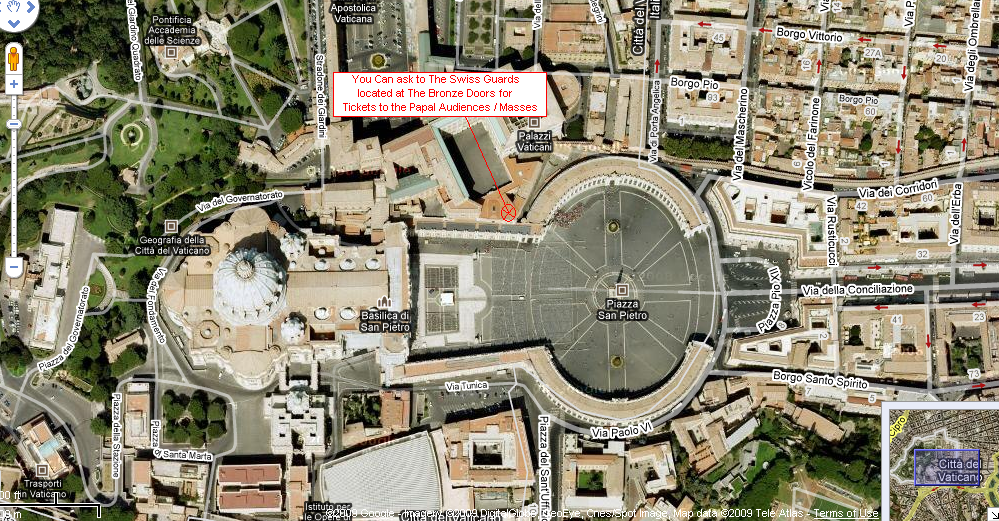
West of Sant’Angelo is Vatican City. Entering on Via della Conciliazione is probably the most dramatic way to approach the holy place. Once in Vatican City, take in the breathtakingly large Piazza di San Pietro (St. Peter’s square) before entering the basilica. The square boasts an obelisk that was relocated from Egypt almost two-thousand years ago.

The height of the Michelangelo designed dome in St. Peter’s Basilica is so lofty that you could fit the entire statue of liberty within the dome with room to spare. The interior of St. Peter’s is a heavenly place, festooned with gold finery and artistic masterpieces. You can climb to the top of the dome for a stunning view out across Rome, or take to the crypts beneath the marbled interior to check on some papal tombs.

If you happen to be in Rome on a Wednesday, then you can be blessed by the Pope himself. He hands out blessings at 10:30am on Wednesdays. Check with your hotel or guesthouse to arrange tickets for the event. The Swiss guard also hands out tickets on Tuesdays from their post near the bronze door. Be sure to check the Pope’s schedule before getting too excited about being blessed. He is a busy man and routinely leaves his Vatican home.

The Vatican Museum is my favorite museum in the world. From entire rooms filled with the works of masters to hallways covered with brightly painted maps of an uncertain world, this place is an unbelievable experience. Budget plenty of time to take it in. The museum is laid out to move you through several gorgeous rooms and immaculate hallways before climaxing at the Sistine Chapel. The museum is free the last Sunday of each month, and is not open any other Sundays. The rest of the week is fair game.

Finish your day with a stroll down the Tiber river just as dusk blankets Rome.

Day 3 – Trastevere and personal interests

With so many options around Rome, pick something personally interesting to do on your last day. Take a cooking class, check out the art at Galleria Borghese, go to a wine tasting, explore catacombs and crypts, check out Florence (only an hour and a half away by fast train), go to a football game, or perhaps just take to some serious shopping.

On your third night in Rome, spend some time in Trastevere. Trastevere is a cool neighborhood on the west bank of the Tiber filled with locals, expats, artists, and college students. It is a great place to sample authentic Roman food, explore, and get inexpensive lodging. The area feels less like a museum than ancient Rome and is a great place to get in touch with the city’s less touristy side.

All photography by Justin Delaney