Inca Trail? Not this summer.

World travelers just can’t get enough of Peru’s famous Inca Trail. But has the Inca Trail had enough of them? It may come as surprise to anyone still planning summer travel to Peru, but the world-famous path to Machu Picchu is completely sold out for the 2008 summer travel season, with the next available opening in September 2008.

As veteran Peru trekkers might know, the Peruvian government began imposing restrictions in 2005 on the number of hikers who could take the path each day to no more than 500. Couple this with the insane popularity of Machu Picchu on globetrotter “must-see” lists and increasingly affordable airfare deals and you have a serious supply and demand problem on your hands. While this quota is helping to preserve the impact of human visitors on this priceless cultural artifact, it’s certainly frustrating news for anyone planning their trip to Peru around a stopover at the site.

If it turns out the big, bad Peruvian government has thwarted your travel plans this summer, don’t despair just yet. As this article article points out, there are a few alternative routes to the famed Inca Trail including the Salkantay Trail, which also climaxes at Machu Picchu, along with the scenic Lares Valley and the spectacular Colca Canyon.

And if you’re still dead set on that Inca Trail trek? Give it another try in the off-season. You might even have that million-dollar view at the top all to yourself.

Murder on the Inca Trail

A divorced British banker died after a blow to the head on the Inca Trail and was found in a nearby river–and it’s raising more than a few eyebrows across the pond. Colin Murphy, 44, disappeared on News Year’s day during a Christmas holiday to Peru from the town of Aguas Calientes in the Andes, not far from the Machu Picchu.

The last hours of his life were spent with 14 other holidayers, who left their campsite on New Year’s Eve to grab a drink at the nearest watering hole. The next day, Mr. Murphy was not in his tent. It’s believed the last person to see him alive was fellow tourist Harvey Layton, a construction worker he had befriend on the trip.

Called “the life and soul of any gathering.”, Mr. Murphy’s body has since been flown back to England, and while investigators are looking into his suspicious death, they’re hesitant to speculate on what happened.

I guess I can stop complaining about how awful my New Year’s Eve was …

How to hike the Inca trail

Every time I took a step, my wet sneakers made the same sound as when I’m slurping spaghetti. I just crossed Dead Woman’s Pass (which won’t seem as derogatory once you hear the full backstory) at 13,700 feet and all I wanted was to sit down, get out of my soaking clothes, and take a hot shower. But I couldn’t, because I was on a four day trek on the Inca trail to the lost city of Machu Picchu.

Besides the rain (the rainy season is December to February), you’ll have to deal with the cold (Under Armour helps), the sun (bring lots of sunscreen, trust me), the snow (one porter died a couple years ago at Dead Woman’s Pass), the endless steps (both up and down), the wake-up times (4 am on the last day to get to Machu Picchu by sun-rise), and the traffic (thousands of tourists crowd the trail during the popular season, June to August).

Oh, and there’s also the $300 or so you’ll spend on mandatory porters and a guide.

Even with these hassles and expenses, I guarantee you won’t regret hiking the Inca trail. In fact, it’s a classic favorite on any traveler’s life-list. These days, though, many guides like Lonely Planet will try to convince you to take an alternative hike, citing the crowds on the trail and a rushed itinerary.

But it’s not just any old trail. Taking an alternative route will mean missing out on seeing the 10+ amazing ruins scattered throughout the 33-kilometer trail. And you can avoid most of the crowds by going outside of June to August, like I did. If you can afford it, hiring a private tour will help you feel less claustrophobic, since you can just zip right past other groups-or slow down and enjoy the ruins. Having said that, the standard 3-night / 4-day itinerary really gives you plenty of time to soak it all in.
What to expect


You’ll be hiking on a 500-year-old+ trail that’s wide enough for foot traffic in both directions. Granted, going down the steps can be treacherous sometimes, especially after it rains when the trail can turn into just another mountain stream. The first day is very relaxing as the terrain is level. The second day is grueling, as you’ll climb two passes, starting from inside a cloud forest up to snowy peaks; expect to hike more than ten miles. The third day is again fairly easy-I got to our camping site by lunchtime. And the fourth day, you’ll wake up when it’s still night and hike to the Sun Gate, where you’ll see the sun rise over Machu Picchu. Simply spectacular.

Picking a tour

You can’t hike the Inca trail by yourself. Government regulations require you to pick a tour company, which will supply a guide, the tent, plenty of porters, and all the food you can eat. It’s a very good deal if you think about it, but expect to pay around $300 for a good tour. I’ve heard of one company that does it for $175, but you get what you paid for, which is a giant group of 25 hikers and little personal attention (and they treat the porters poorly). Recommended:

  • Llama Path (telephone: 50-0822)- I went with Llama Path, which was an amazing company that’s quite affordable. Ask for Dimas to be your guide-he knows everything about Peru and the Incas, and he comes with good stories.
  • Peru Treks (50-5863)-Locally owned
  • Aventours (22-4050)-Expensive, but good quality equipment and service
  • Andean Trek (617-924-1974)-Run by an American, with great guides

Not recommended:

  • SAS (25-5205)-Their group camped next to ours. They had something like 20 hikers with only a few more porters than in our group of 7. This is the most popular agency, but don’t fall for it!

How to get there

Fly or bus in to Cusco. Make sure you stay in Cusco for at least two or three days to get acclimated. Or get acclimated in neighboring Arequipa, which is what I recommend. Your tour company will arrange all transportation to and from Cusco.

See my gallery of the Inca trail and Machu Picchu here. I have galleries of Lake Titicaca, Lime and the Peruvian coast, the Sacred Valley, and canyon country up too.

%Gallery-14287%
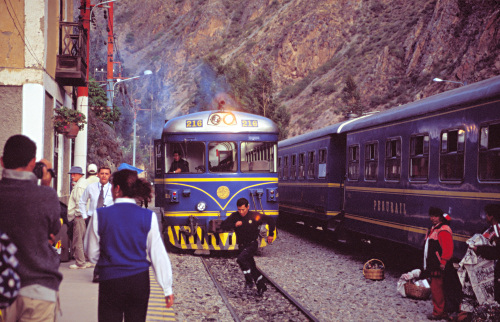
Train to Machu Picchu reopens

Peruvians ended two days of protests against new laws allowing more development near historic sites. Rail service to the Inca ruins at Machu Picchu reopened and the nearest regional airport at Cuzco also reopened. The airport had been closed since Thursday when protestors stormed the facility and piled rocks and trees onto roads, according to AP.

Local leaders protested two laws, originally approved late last year, that permit the construction of new hotels and restaurants near historic sites. Last week, lawmakers ratified the disputed laws, and then modified them three days later to let regional governments decide whether to apply them.

I can’t believe they want to develop the area more. I hope developers are not planning to replace the old train with some sort of highly efficient high-speed train. Hmmm. what would the Incas do?

Yellow Fever: Vaccine Deaths and Outbreaks in South America

Most travelers to Africa and South America have heard of Yellow Fever, even if only because there are countries within that have mandatory vaccinization requirements. People that live in these “Yellow Fever Zones” (an estimated 508 million in Africa alone) know this disease as a killer. This is also what is happening in Brazil.

ProMED mail, from the International Society of Infectious Disease, recently reported a third case and second fatality from YF since the new year. The latest case involved a 24-year-old man from the region of Goianesa. In 2008, there are 26 suspected cases, three confirmed, and 17 pending results of labwork. Six of the suspected cases have been excluded. Brazil also reported to the World Health Organization (WHO) that monkeys were dying of YF, in December 2007.

The Center for Disease Control (CDC) in Atlanta has also released an outbreak notice and stresses the importance of the vaccine for travelers heading to yellow fever areas.

Immunization is the traditional preventative measure against Yellow Fever, and the in Congonhas airport in Sao Paulo — a major travel hub for the region — 1000 people a day are receiving the free vaccine. Savvy travelers may have heard news of a few vaccine associated deaths recently, in Peru. The vaccines in question were manufactured in Brazil, by Bio-Manguinos. All deaths are still under investigation and believed to be associated with the same lot numbers. The vaccines used in North America are from a seperate manufacturer, Sanofi-pasteur. All vaccines from the batch in question, and several from related lots, have been removed.

The Yellow Fever vaccine is considered relatively safe and effective by the CDC. Administered as a single dose under the skin, the vaccine is a live virus. Contraindications to the vaccine are people who are pregnant, immunocompromised or less than 9 months old. Interestingly, the vaccine is grown in chicken eggs and is also to be avoided by those with egg allergies. WHO advises the vaccine be given routinely to children in endemic areas, around the age of 9 months to one year of age. For travelers who are not candidates for the vaccine, a waiver is possible.

Why do you need the vaccine? Besides the country requirements for entry, the disease can be fatal.

Here is some basic information on the disease:

Basics: An Arbovirus spread via arthropods (mosquitos) in the genus Flavivirus. Symptoms include fever, head and backaches, fatigue and nausea. May progress to hemorrhagic complications and/or liver failure. Jaundice is also common. This is a vaccine preventable disease and proof of vaccinization is often required at customs.

Location: Only in Africa and South America. No reported cases in Asia, although the required mosquito species is present to carry the disease.

Transmission/Incubation: Bites from infected Aedes species mosquitoes in cities or Haemagogus species in jungles. The main vector is Aedes Aegypti in urban areas and an incubation of 3-6 days.

Prevention: Vaccination lasts for 10 years and is a live virus. Contraindicated with egg allergy, immunocompromised, pregnancy or less that 9 months old individuals. Mosquito awareness/ bite prevention is the other key.

Diagnosis: Antibodies to YF through a blood draw.

Treatment: This is a vaccine preventable disease, treatment once infected is supportive.

Resources:

CDC Yellow Fever Page

WHO Yellow Fever Vaccine

Interactive Health Map of South America