Veterinarian reaches into shark’s throat to remove hook it swallowed

It’s good to know people don’t always torture sharks and sharks don’t always torture people. Sometimes, we even help each other out.

David Blyde, a veterinarian in Australia, was willing to plunge his arm up to his shoulder into the throat of a 10-foot nurse shark to save the animal after it swallowed a large hook. It was stuck in the animal’s digestive tract, leaving a long metal handle sticking from its mouth, AP reports.

The gray nurse shark is apparently one of Australia’s most endangered marine species because it was fished to near-extinction, with some estimates running as low a fewer than 300 animals left in the wild in waters off Australia’s east coast.

I wrote about nurse sharks just last week. In Belize, you can swim with them and pet them. The Australian grey nurse shark is a little different than the kind they have in Belize. Still, it is generally much smaller than the more aggressive great white. It is also not considered a threat to humans, but its bite could still do serious damage.

The “hooked shark” was spotted by divers on Monday as it swam with a group of others near Byron Bay, 500 miles north of Sydney. After the animal was captured and placed in a holding tank, rescuers pushed a stiff plastic pipe into the shark’s throat. Blyde then reach down through the pipe to free the hook.

Blyde told reporters that “as a veterinarian you often end up putting your hands in places that people find somewhat unattractive.”

I think I could think of several different professions with the same problem.

Belize it or not: Diving the Blue Hole

Greetings from Belize.

Yesterday, I made one of my life-long dreams come true. I dove the Great Blue Hole, a submarine cave about 45 miles off the coast of Belize. They say after diving it, divers are usually either utterly disappointed or absolutely blown away. I found it absolutely amazing.

The Great Blue Hole is circular, over 1,000 feet (330 meters) across and 400 feet (120 meters) deep. It was formed as a limestone cave system during the last ice age. As the ocean began to rise again, the caves flooded, and the roof collapsed.

The trip

To get to the Blue Hole, we booked a diving with the operator Aqua Dives Belize. They offer a $199 per person special now, which was the cheapest deal going, from what I could see. It includes the boat trip out there, breakfast, lunch (on a tiny caye on the same atoll) plus yummy rum punch (after diving), purified drinking water, 3 tanks and weight belts.

(We’d tried Ambergris Divers earlier, and found their staff friendly and competent, but we preferred Aqua Dives and their newer equipment.)

You start out at 5:30am, and make a 3-hour boat ride from Ambergris Caye to Lighthouse Reef. After a total of three dives, they get you back at 5:30pm.

The trip to the Lighthouse Reef, which the Blue Hole is a part of, goes through some rough waters. People were getting sick on the boat, which is always the “fun” part about diving. Isn’t that funny that there is always that one girl who throws up on the way to the reef. (That girl is typically me, but it wasn’t yesterday. I took half a Dramamine, which is not a great idea before diving since it makes you drowsy, but I survived!)

[Here is a question for you. Why is it always girls who get seasick? You never see guys throwing up from fishing boats.]

The diving

We parked the boat right in the middle of the Blue Hole. Eight divers with two instructors (one in the front, one in the back) descended with us to the depths of 140 ft (45 meters). As you descend, you see great stalactites which cover the cave. You don’t see a lot of fish. In fact, we only had couple of solitary bull sharks swimming with us, which was way cool.

The sheer drama of swimming among the stalactites makes it almost a religious experience. I caught myself forgetting I was under water. Some people might see the “lack of fish” as boring, but I found it incredible. Never saw anything like that in my life.

This was the deepest dive I have ever done. I, naturally, found the breathing much harder than breathing at, say, 80 feet. The air is denser and you feel like you have to breathe harder.

Since it is a pretty deep dive, I’d heard some people experience nitrogen narcosis, which–using the dive master’s term–means they get a “little crazy.” They have had people taking their masks off at that depths, taking their regulator out of their mouths, wanting to go deeper and deeper, and cut themselves from hugging the stalactites. Obviously, going to the full depth of 400 ft is not possible, but that apparently doesn’t prevent some people from trying. Several people have died diving the Blue Hole (I knew of one of them).

You’re only in the water for about 25 minutes, and down at 130-140 feet for about 8 minutes (due to the depth), but every second was worth it. A sandy ledge slopes down from near the surface, down to about 50 ft. Then, it’s straight down a vertical wall to about 110 ft. Then, you’re in the cave. You swim in and around stalactites that are easily 3 ft or more in diameter, and underneath the old cave’s “ceiling.”

Below you, at about 170 ft, you can see another sandy ledge. It looks so close that you could reach out with your leg and touch it. It’s like you’re swimming in a cathedral, with the stalactites forming statues hanging from the arched ceiling.

It’s magic how you can watch the bubbles ascend the walls, and see the light and wall above you. You can see tiny creatures living on the walls and stalactites. A diving light is not necessary due to the clarity and complete lack of current.

Recommendations

I thought the dive masters did a great job preparing everyone for the dive, repeating all the underwater hand gestures, safety instructions, etc. I was surprised that me and my buddy were the most experienced divers on board, having been certified for only 6 years. The rest of the divers all had less than two years of diving experience. Those are some gutsy people. I don’t think I would have gone down 140 ft with that little experience.

I actually would not recommend the dive to beginners. Not because it’s that difficult (although the depth makes it more technical), but because I don’t think as a beginner, you quite appreciate how special the Blue Hole is. As a beginner, all you want to see is big and colorful stuff – fish and corals. Plus, you should be very relaxed in order to really get the most of it. As an experienced diver, you have seen all those things that beginners want to see– sharks, turtles, eel, lobsters — and seeing something as stark as the Blue Hole is actually quite powerful.

Belize it or not: The shark petting zoo

Hello from Belize! What a beautiful little country this is.

I have wanted to come here forever, being a diver and all. As you probably know, the Belize Barrier Reef (stretching from Yucatan all the way to the coast of Guatemala) is the second largest reef in the world, after the Great Barrier Reef.

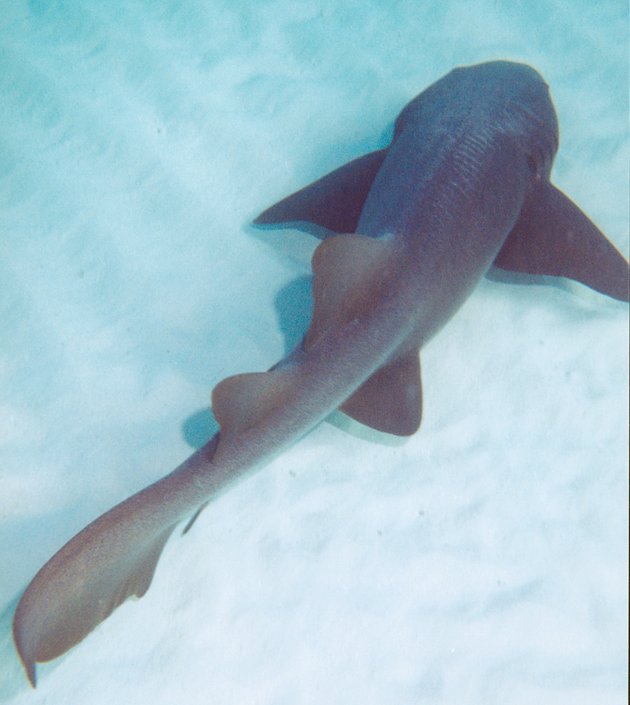
We took our first dive trip today, right off the Ambergris Caye island. It was just a shallow dive with a bunch of snorkelers who desperately wanted to “see some sharks.” This part of the reef is know for its abundance of nurse sharks, pretty harmless types of sharks who eat by suction (hence the name). Still, they are sharks, aka beautiful creatures.

The dive instructor threw in some bait (an enormous fish head) and a few minutes later, a bunch of sharks (I saw five, the largest at least two meters long) and sting rays (the largest was over a meter across) came by for the feast. It was an incredible sight.

I don’t know how I feel about the whole “petting the shark and sting ray” aspect of the whole thing. The instructors caught a couple of the sharks by the fin and let everyone in the group touch them. Same with the sting rays. I felt a little bad for them. I can’t be good for them to have a hundred people a day touch them, right?

Whale sharks and stingrays in the Gulf of Mexico

Check out this amazing photo. Two times a year in the late spring and late autumn, up to 10,000 Cownose stingrays make their way between their feeding grounds in western Florida and the Yucatan Peninsula in the Gulf of Mexico. This amazing shot of the migration was taken by amateur photographer Sandra Critelli.

As soon as I saw Sandra’s image, I immediately wanted to know where it was taken. According to some quick research, she apparently encountered this awesome phenomenon while on a Whale Shark expedition off the coast of a small Mexican island in the Yucatan called Holbox. As intrigued as I am by her photo, my interest was instantly piqued by the mention of whale sharks – huge, plankton-feeding fish that can grow up to 40 feet in length. Holbox is apparently whale shark paradise, hosting numerous opportunities to dive with huge creatures.

Between huge schools of stingrays, giant whale sharks and plenty of other sea life at diving hotspots like Cozumel, the Yucatan peninsula is a diver’s dream.

US diver accused of drowning his wife on honeymoon in Australia

They had been married for exactly 11 days and the husband already wanted to kill his wife? When they say everything happens faster nowadays, they are not kidding.

Yesterday, four and a half years after the Gabe and Gina Watson incident, a warrant was issued for Gabe. Australia has asked for his extradition from the US to stand trial for killing his young wife while diving in an apparent attempt to secure her life insurance payout, The Guardian reports.

The US newlyweds were on their honeymoon. Gabe Watson, an experienced rescue diver, was exploring a submerged wreck with his wife when she died. It was her first big diving trip, after she had been persuaded by her husband to explore the deep, turquoise waters of the Great Barrier Reef.

One witness said the couple appeared to be locked in an unnatural embrace at a depth of about 50ft before they separated, with Watson heading to the surface while his wife sank to the ocean floor. A leader of the dive spotted the stricken woman and brought her to the surface, but she could not be revived.

Gabe, however, severely underestimated the prevalence of underwater cameras these days. A couple people in their group just happened to take some revealing pictures (and videos) of the scene…

One for the scrapbook.