The lottery obsession in Madrid

I would never pass up the opportunity to spend a few days in Madrid. On my way from Portugal, I couldn´t be so close and not come here for some tapas and paella. When asked if I prefer Barcelona over Madrid (and I have been asked this question more than once) Madrid would get my vote. I can´t really explain why.

There is only so much one can write about Madrid that hasn´t been written already. What surprised me the most is the Spanish obsession with playing the lottery. It took me a few hours to figure out why there has been a consistent, long line (and I mean long, hundreds of people–see picture) at the Puerta del Sol. Then a friend told me that people regularly line up here to buy lottery tickets. ¨The Spanish people are very superstitious,¨ she explained. Apparently, no other country on Earth has such religious lottery-following, even though other countries´s top prizes are much higher than here. The Spanish state-run National Lottery dates back nearly 250 years.

The most eagerly-anticipated draws of the National Lottery are those which take place over the Christmas period, El Sorteo Extraordinario de Navidad or El Gordo (The Fat One), and El Niño (The Boy). The purse in El Niño is held on January 6th (hence the line yesterday and today) and the top prize in each series is 2 million euro. You can still buy a ticket, folks!

Some people say that in order to win, you have to buy your ticket at the Dona Manolita, a lottery vending shop which opened in 1931 and has become a Spanish institution. They apparently sell all the winning tickets. Now, that is what I call superstition!
Spain celebrates April Fool’s Day today

If you live in Spain or any South American country, watch your back today as, other than getting a paper cut out of what looks like the shadow of the gingerbread man stuck on your back (see image), you might be the victim of many other pranks as these countries celebrate the Dia De Los Santos Innocentes (literally Day of the Innocent Saints).

Even news channels are known to give false information that will only be revealed as a joke tomorrow, but apparently they are pretty obvious: UFO lands in the Royal Palace, President runs off with daughter of the opposition, are some examples rumored to have been announced on television. I’m going to try to watch every news bulletin today :)

On this day in history, Christians believe that when King Herod found out that Jesus was born, he ordered all children under the age of two in Bethlehem to be slain in order to protect his authority as King. How did such a sad day become one of jokes and laughter?

A bit of probing and there seem to be two possible explanations:1) kids play innocent pranks all the time, so playing pranks today is actually an ode to the children that were killed, or 2) jokes on this day have a pagan origin from the Middle Ages when the day was a joyous carnival and no one was held responsible for his actions; one thing blended into another and voila, prank day in Spain and Latin America was born.

I’m going with the second explanation. Joke away!

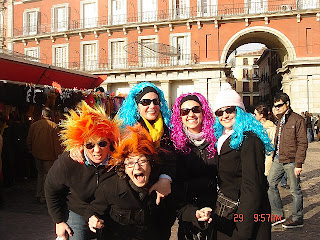
Christmas in Madrid, where’s your wig?

One of the strangest things people do in Madrid for Christmas is wear crazy wigs around the city. What’s stranger is that nobody really knows why!

For the last 30 years or more, Plaza Mayor has been home to a Christmas market with over a 100 stalls that sell all sorts of things: miniature statues of Jesus and the Virgin Mary; novelty gift-wrapping material; carnival accessories like tinsel wigs, rainbow wigs, Afro wigs, assorted head-boppers, mad glasses with flashing lights or with eyes springing out — the list is endless. I think the carnival stuff, although sold pre-Christmas and worn throughout the festival, is mainly for New Year’s Eve.

Go there after 6pm pre or post Christmas and Plaza Mayor is a jolly circus of people of all sexualities and walks of life frolicking around the area being merry, encompassing and radiating the joy of Christmas in the capital. There is a great video that captures this spirit, you can check it out here.

Needless to say, there is Christmas activity all over the city, but Paseo Castellana, which is the business high-street of Madrid is one of special interest. It’s decorated with lights and huge sparkling Christmas trees, all so magnificent that there is a special bus that takes you along the route just to see them all. Also this year, 60 international artists have sculpted structures from ice that represent Madrid like the Puerta de Alcala, or the Santiago Bernabeu football stadium.

It’s cold here but not excruciating so everyone’s on the streets in holiday mode — it’s a great time to be in Madrid.

Merry Christmas!

Spanish ham, sweet Spanish ham

For those of you pork-eaters in the US who have never tried made-in-Spain Jamon (ham) Ibérico, now that you can avail of it in again locally, jump on the opportunity because you don’t know what you have been missing.

Although produced in the US since 2005, it’s import from Spain had been prohibited by the USDA because Spain’s slaughter houses did not adhere to it’s safety regulations, and presumably because of the pig-borne viral swine virus that was prominent in Europe years ago. Last week, the ban was lifted and now authentic Ibérico can be bought in the US at a cost of US$50-$100 a pound, depending on the type.

This ham is the Spanish delicacy I can’t get enough of. A general fan of sausages, cold ham and bacon, since I have been introduced to cured Spanish ham, it has happily replaced my desire for any other pork production. I will eat it anytime, anyhow, anywhere — sometimes even preferring it to dessert (*gasp*). I am a regular customer at Madrid’s Ham Museums where you can nip in for a cold beer and a plate of ham that fits your budget.
Jamon Ibérico is made from the Iberian pig that is bred in Southwestern Spain and Southeastern Portugal, for a period of 14-36 months. Good ham in general is also called “Jamon de Pata Negra” (ham of the pig with black feet), the most expensive is the acorn fed Jamon de Bellota that in Spain costs atleast US$720 for an entire leg.

Yes, extremely expensive, so most of the time I have to resort to a ham of lesser quality and appreciate its remote similarity to Jamon Ibérico, but now and again it is something I generously pay for.

I would say eating ham in Spain is like eating noodles in China, households rarely go without it. Also, eating and gifting high-quality ham is a sign of status in Spain; for Christmas (for example), it is not uncommon for the Spanish to gift each other legs of ham.

Knowing how to buy ham and then how to cut it is an art in itself that I am still clueless about, but am determined to understand at some point very soon.

Diving for treasure

This may sound like something straight out of a movie, but this year, a US treasure-hunting company (yes there is such a thing) found and excavated 500,000 silver coins off the coast of Spain. The trouble is Spain’s also eyeing the loot.

That’s why this week the Spanish government got together a team of experts to help plan their strategy against further looting. But the company, Odyssey Marine Exploration, it was fair game because they claim the site was in international waters. The trouble is they won’t release the site location. I guess that’s why they’re going to court next month in Tampa, of all places.

Anyways, I talked with an Odyssey spokeswoman a couple weeks ago. Though she was generally nice, and even sent me some promotional material, I was surprised at just how paranoid she was about who I was, why I was calling, and why I needed to know anything. Perhaps it just goes with treasure-hunting, after all, location is everything in this game.