Dead body exhibition in Barcelona


An exhibition of dead bodies opened today in Barcelona, allowing visitors to see the complexity of the human anatomy like never before.

You can get a close look inside the skeletal, muscular, reproductive, respiratory and circulatory systems of your body. Many of the bodies are dissected in different ways so as to see what happens under our skin when performing daily activities.

The 17 corpses that display over 200 human organs are said to be of Chinese people, and have been donated for the exhibition by a medical school. The bodies have undergone a chemical treatment called ‘plastination’ that prevents them from decomposition and gives them a fibrous aseptic texture.

They even have displays comparing healthy and unhealthy bodies/organs; for e.g. you can see a real healthy lung, and a lung destroyed by smoking.

Not surprisingly, the exhibition has raised many eyebrows because it is not clear if the bodies were donated for a commercial exhibition like this, or if consent was given to do the same; rumors even say that they are bodies of executed Chinese prisoners. For these reasons, many have been calling it a shameless commercial display of death.

I personally think it’s great. Unless you are a doctor or say a homicide detective, there is no way you can see what’s really under your own skin, so I think it’s incredible that you can now go to an exhibition to have a glimpse at your own body structure (that is not artificial). There is no better way to educate yourself about your body; isn’t this how doctors study the human anatomy anyway?

The exhibition is being held at the Maritime Museum in Barcelona, and will run until January 13, 2008.
One for the Road: Frommer’s Barcelona Day by Day

Catalan bread, paella and copious amounts of Spanish wine — food is what first comes to mind when I think of my past visits to Barcelona. (Tip: I had several scrumptious meals at vegetarian gem Venus.) Then there is the inviting Mediterranean breeze, the winding stone alleyways and the entertaining Las Ramblas street performers. And of course, best of all (in my opinion) there is the art! My very favorites are the Gothic architectural masterpiece, Santa Maria del Mar and Picasso’s stunning Las Meninas series. But I’ve hardly scratched the surface…

Barcelona offers up an endless array of activities, sights and culinary delights. Which is why a book like Frommer’s brand new Barcelona Day by Day can be a traveler’s best friend. This about-to-be-released pocket guide is structured around “19 smart ways to see the city”, which includes suggested neighborhood walks, special-interest themed tours, practical day-trip options and the best lodging, dining and shopping around. And it’s packaged quite efficiently in a compact glossy 180-pager. The book contains 39 easy-to-read maps and includes a larger regional Catalonia map tucked in a rear-cover plastic pocket.

Let this handy travel partner help plan your stay in Barcelona, whether it’s for 24-hours or a week — just be sure to get there, eventually, one of these days!

Big in Spain: Viagra becomes recreational drug of choice

Spain used to be the home of leisurely afternoon siestas and conservative, Catholic mentalities.

Apparently, that has all changed.

Nowhere is this more apparent than in the recreational drug scene where, according to the New York Times, Viagra has become one of the most popular recreational drugs of choice. It’s mixed with cocktails, consumed at bars, and experimented with in the bedroom. Most of all, it’s used to fuel the concept of machismo held so dearly in this part of the world–which helps explain why users of all ages are snatching up the little blue pill. In fact, the New York Times revealed that Pfizer “sold nearly one million boxes of Viagra in Spain last year, the equivalent of one box for every 17 men 18 and older.” Wow. That’s a lot of blood flow being directed to the nether regions.

Critics blame not just a post-Franco sexual revolution for this boom, but also the globalization of Spain where the famously laidback citizens are now caught up in the mad-dash world of dog-eat-dog consumerism peppered with an increasingly fast food mentality. This leaves little time, and far too much stress, for the legendary Latin lover to work his magic.

And thus, viva el sexo azul!

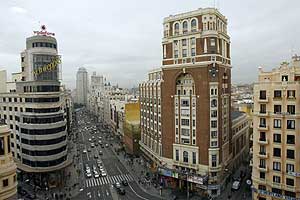
Bragging about Gran Via on its centennial


Around August last year, I was living in Valencia and went to Madrid for the weekend. As I was aimlessly walking down Gran Via — the main commercial street in Madrid’s city center — I distinctly remember thinking “I could live here”. A few months later I moved and it was one of the best decisions I made.

Being someone who lately has been repelling anything big and mercantile, it’s funny I had that thought on Gran Via, of all other places in the city.

There’s this inanely rare charm that street eludes.
It’s high-street-big-city-for-tourists bustling, but it also radiates something that pins it down as being traditionally Spanish.

Often referred to as the ‘Spanish Broadway’, perhaps it’s early 20th century buildings, no skyscrapers, and nonchalant nature dampens it’s commercial side, making it an unexpected representation of Madrid as Spain’s traditional capital.

I can’t put my finger on what exactly allures me about this street, but it’s the reason I moved here.

On the 100th anniversary of Gran Via’s conception, the newspapers splattered the history and development of the street over the last century.

Haven’t seen it in the international press, but for those interested who don’t speak Spanish, you can check out this “Madrid in Black and White” gallery of the Gran Via that takes you through its historical significance.

[Via El Mundo]

Spain almost has lyrics for its national anthem

Spain is one of the very few countries that doesn’t have lyrics to its national anthem; Bosnia-Herzegovina, Kuwait and San Marino are others. When I first found out, I wasn’t surprised and it made me laugh.

Few locals seem to have strong sentiments about this. When I asked my Spanish friends, reactions were mixed — some laughed about it, others were embarrassed but didn’t really dwell on it. Spain is quite ‘whatever’ when it comes to things like this — I suppose there are more important national issues at stake.

Set to a tune from the 18th Century, its words were unanimously abandoned when Spanish dictator Franco died (1978). Since then, all Spaniards manage to muster is a ‘la la la la’ when they win a national or international championship/trophy. Quite embarrassing when you have to hum from a podium because your national song doesn’t have any words.

So three months ago the government along with the Spanish Olympic Committee (SOC) launched a competition for the lyrics and they have received about 5,000 entries. The decision will be announced on December 19 — I can’t wait to see the country react to the decision. Madrid is bidding for the 2016 Olympics, which is a good excuse to sort itself out as soon as possible,

These random eccentricities of Spain is what makes me love the country.

[Via CNN]