Hey London, where are the trans cans?


On my way through St. Pancras international station in London this past weekend, I grabbed a smoothie at Marks and Spencer while I was waiting for my train. Tired and dehydrated from travel, I made pretty short business of the drink then proceeded to seek out a waste receptacle to drop my bottle in. Turns out though, there are none. I must have walked around in circles, in and out of the station for twenty minutes looking for a place to drop the bottle before I gave up, walked into a restaurant and dropped it off there. I was curious why a public place wouldn’t have any trash cans.

Apparently, this is for a reason. As I’m told, the British had issues with the Irish Republican Army putting bombs in the receptacles and the bins turning into shrapnel. So as a safety precaution, they were removed.

Preventative measures like this make me leery. On one hand I suppose it’s best to remove as many opportunities to place a bomb in a public place as possible, but is it really necessary to take out all the trash cans? Can’t the Brits just use thin, translucent bags like the French do?

How well can we prepare ourselves for another bombing? Will we next pad all of our buildings with foam, require everyone to wear helmets and walk in our socks? How far is too far?

At some point, we as Westerners are going to have to accept that there is some inherent risk in traveling. Be this a bee sting, malaria or a terrorist bombing we have to come to terms with the fact that going out into the world is not as safe as staying at home and in bed. Until we and our governments can accept that, we’re doomed to paranoia, inconvenience and countless tax dollars for overprotective measures.
First A380 flight in Europe: March 18

Singapore Airlines currently flies both of the only two operating Airbus A380 airplanes in the world on the Sydney-Singapore route. The third plane, also purchased by Singapore Airlines, will operate on the London – Singapore route, starting March 18. This will be the first commercial flight with the world’s biggest plane in Europe.

Tickets for this flight are already on sale, starting at 550GBP (approx. $1100). First class tickets have not been priced yet. The Singapore Airlines A380 has 471 seats available in three classes: 12 seats in their ultra-luxury suites (see picture), 60 seats in business class and 399 in economy.

Those luxury suites don’t look too bad. I don’t think I want to know how much they go for.

%Gallery-9672%

Walking from the UK to India with no money

You think walking from Bristol to Gandhi’s birthplace in India–through the war-torn Afghanistan–is bad enough? Try doing it with no money in your pocket. A 28-year-old British man, Mark Boyle, started his 9000-mile journey on Wednesday with just a few T-shirts, a bandage, sunscreen, a knife and spare pair of sandals.

Boyle is an ex-dotcom businessman who is planning to walk 15-45 miles a day and not touch any money, credit cards or travelers’ cheques the entire time. Why, you ask? To show his faith in humanity and get back to a more communal way of living.

You can follow his journey here.

Will fingerprinting replace need for a passport?

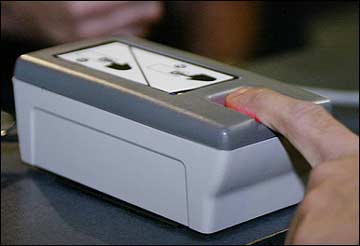
Scandinavian airline SAS has introduced finger-print check-in on a domestic flight from Stockholm to Gotenburg in Sweden. Its purpose at the moment is to make sure that the person who checks-in luggage is the same as the person boarding the flight, a sure advantage for airport /on-flight security.

On a domestic level, this makes sense as check-in procedures are relatively lax when traveling within the country, and even within the EU for that matter; but they plan to eventually make it an international check-in system.

Fingerprinting at airports is not new. The US introduced it a while ago as an added security check for visitors to the country; the UK has a similar system, but not restricted to visitors; and Dubai has had a retina scan system for a while now. This makes it impossible for people to travel with fraudulent documents.

Dubai went beyond finger-printing for security purposes when they introduced the eGate card — a check-in option for Dubai-based frequent travelers who don’t want to stand in line to get their passport stamped. If you have this card, you swipe it to enter/exit the airport, match your finger-print on a screen and you are through.

So the question is: will we eventually be able to travel without any printed form of identification? If you are finger-printing and retina-scanning anyway, other than to have a stamp, what do we need passports for?

Mission impossible: Scotland in a weekend

So is it possible to see an entire country in a weekend? And not even a long weekend. My college roommate and I had just Saturday and most of Sunday to see Scotland, and we did!

First, we took an overnight bus from London to Edinburgh, leaving at 11 pm and arriving at 7 am on Saturday. Then we hopped on one of the countless day-trip bus tours around the highlands. Except the one we took bussed us all the way from Edinburgh to the northernmost city in Scotland, Inverness. Along the way, we saw Loch Ness, and plenty of other lochs along the “Great Glen,” and great views of the famous Scottish highlands, including a stop at Glencoe, the site of the 1692 massacre.

The next day, we saw most of Edinburgh, including Edinburgh Castle and the Queen’s Scottish royal palace. Of course, we didn’t have time to visit any of Scotland’s legendary islands: Shetland, Orkney, Hebrides (divided into the Inner Hebrides and the Outer Hebrides). And I definitely plan on going back and enjoying the scenic landscapes of the highlands more thoroughly. But all in all, if you only have a weekend, and you want to desperately see Scotland, it’s doable (just make sure to book a day-trip like we did).

%Gallery-15100%