Reactions to World’s Biggest Smoking Ban: Londoners Fired Up

London–the alleged smoking and drinking capital of the world by sheer volume of alcohol and cigarettes consumed–put its smoking ban into effect, kicking and screaming, on July 1st. Although other cities, such as New York or Paris, have gone through similar labor pains, London’s is the biggest smoking ban yet: it affects 3.7 million businesses, including 200,000 pubs, bars and restaurants.

So far in the last two weeks, smokers have reluctantly gone outside to smoke, but the government is not stopping there. It is planning to change the law so that, among other things, employers can be fined if they fail to stop workers dropping cigarette butts on the street.

The Independent offers a glimpse into the London smokers’ sentiments by quoting a few “influential” ones:

  • ‘I am appalled at it. They are treating us like children. I’m not a schoolboy. Mr Brown thinks he’s a prefect’. David Hockney, Artist
  • ‘We’re suppressing everyone these days, not allowing adults to make their own minds up’. Antony Worrall Thompson, Chef
  • ‘The alleged danger of so-called second-hand smoke is so phoney it stinks to high heaven’. Joe Jackson, Musician
  • ‘You would have to search the world very hard to find a single government that would say it was abolitionist’. Paul Adams, British American Tobacco
  • ‘Smokers should not be discriminated against simply because they smoke’. Chris Ogden, Tobacco Manufacturers’ Association
  • ‘I’m inventing bike sheds to attach to buildings so it’s somewhere people can go to smoke’. Joanna Lumley, Actress

Hmmm, I am a semi-militant non-smoker myself but I realize that smoking bans do raise important questions about personal liberty in civilized societies. Makes you wonder, what’s next?
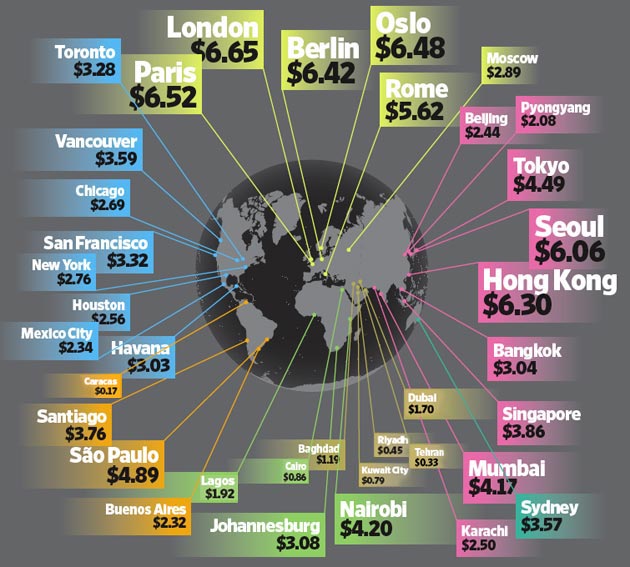
The Price of Gas Around the World

The next time you pull into the station for a fill-up, keep this in mind before you curse the prices: People elsewhere have it a lot worse than we do in America (and we tend to gripe about it the most, it seems!). Take Asia for instance — Hong Kong averages a whopping $6.30 per gallon, with Seoul, South Korea, not too far behind. Europe also pays well above what we do in America. London, Berlin, Oslo, and Paris are all well above $6 a gallon. On the low end of the spectrum, places in the Middle East like Kuwait City and Tehran, Iran, pay under 79 cents for their gas. Big surprise there!

The lowest, however, is reserved for Caracas, Venezuela. 17 cents per gallon! [via]

Related:

The World’s Most Expensive Cities

Mercer, a human resource consulting company, has compiled a list of the most expensive cities in the world based on a cost of living survey which “measures the comparative cost of over 200 items” in each city. Two years in a row Moscow has topped the list, followed by London, Seoul, and Tokyo. Here’s the top 10:

  1. Moscow
  2. London
  3. Seoul
  4. Tokyo
  5. Hong Kong
  6. Copenhagen
  7. Geneva
  8. Osaka
  9. Zürich
  10. Oslo

Most of the locations on the list were in Europe, taking thirty of the fifty spots, with six in the top 10. New York and L.A. are the only two from the United States in the top fifty. For the full list, head to Mercerhr.com. [via]

Related:

The World’s Longest Tunnels

The Gotthard Base Tunnel (map), a railway tunnel in Switzerland, isn’t complete yet, but in 2015 — after 22 years of construction — it will be the longest transportation tunnel in the world, running 35 miles through the Swiss Alps. It will eventually cut the travel time between Zürich and Milan from 3.5 hours to 2.5. Four tunnel boring machines are working the job: “2 southbound from Amsteg to Sedrun, 2 northbound from Bodio to Faido and Sedrun,” according to Wikipedia. The machines cut away at the rock at a rate of 100 feet per day in optimal conditions. That explains the 22 years of construction!

The Seikan Tunnel in Japan is the current world record holder, clocking in at 33.49 miles. Almost half of the length runs under the Tsugaru Strait, which connects the island of Honshū to Hokkaidō in northern Japan, and bridges the Sea of Japan with the Pacific Ocean. The tunnel opened on March 13, 1988, after 17 years of construction. Two stations are located in the tunnel: Tappi-Kaitei Station and Yoshioka-Kaitei Station, both of which were the first train stations in the world built under the sea. Yoshioka-Kaitei has since been demolished to make way for the Hokkaido Shinkansen project, which will eventually facilitate high-speed trains in the Seikan.

The Channel Tunnel, or Chunnel (map), linking the United Kingdom and France under the English Channel, takes the second (completed) spot at 31 miles long. While it’s a few miles shorter than the Seikan Tunnel, the Chunnel’s underwater segment is longer than that of the Seikan, making it the world’s longest underwater tunnel. The construction took 13 7 years, from 1987 to 1994, with over 13,000 workers involved in construction. Eleven tunnel boring machines were used — 6 on the English side, and 5 on the French side — and the sides met on December 1, 1990. 8.2-million passengers traveled the Chunnel via Eurostar in 2005, and numbers are expected to grow even larger when the Channel Tunnel Rail Link extends to London later this year. When the link is completed, a train trip from London to Paris will take 2 hours and 15 minutes.

The Lötschberg Base Tunnel in Switzerland runs 21.5 miles from Frutigen, Berne to Raron, Valais. When it opens in December of 2007, it will be the longest land tunnel in the world until the Gotthard Base Tunnel opens in 2015. “To dig the Loetschberg, some 16 tons of explosives were used and enough rock was excavated to pack a freight train 2,500 miles long – stretching across Europe from Lisbon, Portugal, to Helsinki, Finland,” according to this report from MSNBC.

One for the Road: Celebrate Literary London

The Southbank Centre in London is gearing up for a summer full of exciting events that celebrate the city. At the forefront of the festivities that focus on Literature and the Spoken Word is the brand new London Literature Festival, a two-week collection of literature, writing and performance activities that will take place throughout the Southbank complex beginning June 29.

One of the main themes of the festival is Metropolitan Lines, which honors London as muse with readings and performances inspired by the city. A headliner event of this series will celebrate the re-opening of The Poetry Library, which has been closed during the Royal Hall renovations. The library will be showcasing an exhibition of books on the theme of London and on July 4, three poets (Sean Borodale, Tobias Hill and Iain Sinclair) will pay tribute to the city.