Spain’s new high speed train connects Madrid and Barcelona

Spain’s high speed link between Madrid and Barcelona is finally open, after more than two decades of construction and administrative delay. Transporting passengers at 300 kilometers per hour (186 miles per hour), and at a price of 180 euros round-trip, the train is expected to compete with air travel.

Madrid and Seville have been connected by high speed bullet train since 1992. Motivated by the addition of the new Madrid-Barcelona line, the Spanish government says that it will have more high speed train lines than anywhere else in the world by 2010, as reported by the BBC. France recently unveiled its latest contribution to the industry of high speed trains, meaning that we can probably look forward to an even better, and certainly faster, train-connected Europe.

[Thanks, Moody75!]
Want to get around the Prado Museum line?

I promise I will stop writing about the painfully long lines everywhere you look in Madrid, starting with the lottery lines to the King’s cake line, but seriously…look at this line at the Museo Nacional del Prado. People as far as the eye can see! I haven’t seen a line of art lovers this long even at the Louvre.

Granted, Prado is an amazing museum featuring one of the finest art collections in the world and I understand people want to see it. What I cannot understand is why everyone is waiting in line (for up to 8 hours, I hear) to purchase tickets if you can get tickets online and bypass the line entirely.

Please, do Velazquez a favor, and do not give up on him. Next time you are in Madrid, go to an internet cafe, buy a ticket in advance and get around the people who clearly enjoy queuing up.

The lottery obsession in Madrid

I would never pass up the opportunity to spend a few days in Madrid. On my way from Portugal, I couldn´t be so close and not come here for some tapas and paella. When asked if I prefer Barcelona over Madrid (and I have been asked this question more than once) Madrid would get my vote. I can´t really explain why.

There is only so much one can write about Madrid that hasn´t been written already. What surprised me the most is the Spanish obsession with playing the lottery. It took me a few hours to figure out why there has been a consistent, long line (and I mean long, hundreds of people–see picture) at the Puerta del Sol. Then a friend told me that people regularly line up here to buy lottery tickets. ¨The Spanish people are very superstitious,¨ she explained. Apparently, no other country on Earth has such religious lottery-following, even though other countries´s top prizes are much higher than here. The Spanish state-run National Lottery dates back nearly 250 years.

The most eagerly-anticipated draws of the National Lottery are those which take place over the Christmas period, El Sorteo Extraordinario de Navidad or El Gordo (The Fat One), and El Niño (The Boy). The purse in El Niño is held on January 6th (hence the line yesterday and today) and the top prize in each series is 2 million euro. You can still buy a ticket, folks!

Some people say that in order to win, you have to buy your ticket at the Dona Manolita, a lottery vending shop which opened in 1931 and has become a Spanish institution. They apparently sell all the winning tickets. Now, that is what I call superstition!

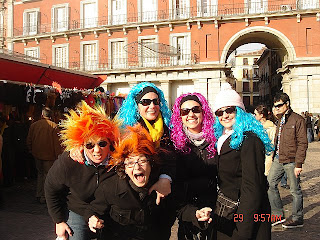
Christmas in Madrid, where’s your wig?

One of the strangest things people do in Madrid for Christmas is wear crazy wigs around the city. What’s stranger is that nobody really knows why!

For the last 30 years or more, Plaza Mayor has been home to a Christmas market with over a 100 stalls that sell all sorts of things: miniature statues of Jesus and the Virgin Mary; novelty gift-wrapping material; carnival accessories like tinsel wigs, rainbow wigs, Afro wigs, assorted head-boppers, mad glasses with flashing lights or with eyes springing out — the list is endless. I think the carnival stuff, although sold pre-Christmas and worn throughout the festival, is mainly for New Year’s Eve.

Go there after 6pm pre or post Christmas and Plaza Mayor is a jolly circus of people of all sexualities and walks of life frolicking around the area being merry, encompassing and radiating the joy of Christmas in the capital. There is a great video that captures this spirit, you can check it out here.

Needless to say, there is Christmas activity all over the city, but Paseo Castellana, which is the business high-street of Madrid is one of special interest. It’s decorated with lights and huge sparkling Christmas trees, all so magnificent that there is a special bus that takes you along the route just to see them all. Also this year, 60 international artists have sculpted structures from ice that represent Madrid like the Puerta de Alcala, or the Santiago Bernabeu football stadium.

It’s cold here but not excruciating so everyone’s on the streets in holiday mode — it’s a great time to be in Madrid.

Merry Christmas!

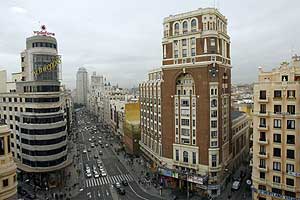
Bragging about Gran Via on its centennial


Around August last year, I was living in Valencia and went to Madrid for the weekend. As I was aimlessly walking down Gran Via — the main commercial street in Madrid’s city center — I distinctly remember thinking “I could live here”. A few months later I moved and it was one of the best decisions I made.

Being someone who lately has been repelling anything big and mercantile, it’s funny I had that thought on Gran Via, of all other places in the city.

There’s this inanely rare charm that street eludes.
It’s high-street-big-city-for-tourists bustling, but it also radiates something that pins it down as being traditionally Spanish.

Often referred to as the ‘Spanish Broadway’, perhaps it’s early 20th century buildings, no skyscrapers, and nonchalant nature dampens it’s commercial side, making it an unexpected representation of Madrid as Spain’s traditional capital.

I can’t put my finger on what exactly allures me about this street, but it’s the reason I moved here.

On the 100th anniversary of Gran Via’s conception, the newspapers splattered the history and development of the street over the last century.

Haven’t seen it in the international press, but for those interested who don’t speak Spanish, you can check out this “Madrid in Black and White” gallery of the Gran Via that takes you through its historical significance.

[Via El Mundo]