The World’s Longest Tunnels

The Gotthard Base Tunnel (map), a railway tunnel in Switzerland, isn’t complete yet, but in 2015 — after 22 years of construction — it will be the longest transportation tunnel in the world, running 35 miles through the Swiss Alps. It will eventually cut the travel time between Zürich and Milan from 3.5 hours to 2.5. Four tunnel boring machines are working the job: “2 southbound from Amsteg to Sedrun, 2 northbound from Bodio to Faido and Sedrun,” according to Wikipedia. The machines cut away at the rock at a rate of 100 feet per day in optimal conditions. That explains the 22 years of construction!

The Seikan Tunnel in Japan is the current world record holder, clocking in at 33.49 miles. Almost half of the length runs under the Tsugaru Strait, which connects the island of Honshū to Hokkaidō in northern Japan, and bridges the Sea of Japan with the Pacific Ocean. The tunnel opened on March 13, 1988, after 17 years of construction. Two stations are located in the tunnel: Tappi-Kaitei Station and Yoshioka-Kaitei Station, both of which were the first train stations in the world built under the sea. Yoshioka-Kaitei has since been demolished to make way for the Hokkaido Shinkansen project, which will eventually facilitate high-speed trains in the Seikan.

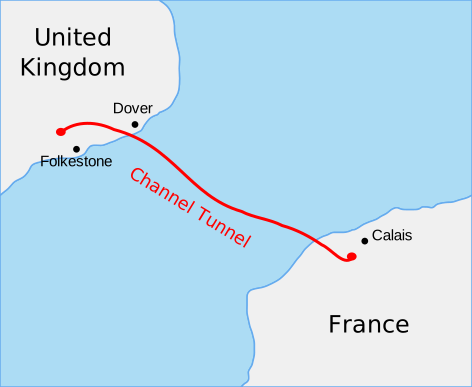
The Channel Tunnel, or Chunnel (map), linking the United Kingdom and France under the English Channel, takes the second (completed) spot at 31 miles long. While it’s a few miles shorter than the Seikan Tunnel, the Chunnel’s underwater segment is longer than that of the Seikan, making it the world’s longest underwater tunnel. The construction took 13 7 years, from 1987 to 1994, with over 13,000 workers involved in construction. Eleven tunnel boring machines were used — 6 on the English side, and 5 on the French side — and the sides met on December 1, 1990. 8.2-million passengers traveled the Chunnel via Eurostar in 2005, and numbers are expected to grow even larger when the Channel Tunnel Rail Link extends to London later this year. When the link is completed, a train trip from London to Paris will take 2 hours and 15 minutes.
The Lötschberg Base Tunnel in Switzerland runs 21.5 miles from Frutigen, Berne to Raron, Valais. When it opens in December of 2007, it will be the longest land tunnel in the world until the Gotthard Base Tunnel opens in 2015. “To dig the Loetschberg, some 16 tons of explosives were used and enough rock was excavated to pack a freight train 2,500 miles long – stretching across Europe from Lisbon, Portugal, to Helsinki, Finland,” according to this report from MSNBC.

How to Visit Marché d’Intérêt National de Rungis

Just outside of Paris sits the Marché d’Intérêt National de Rungis (or International market of Rungis), the largest wholesale food market in the world. Each day the 573 acre complex is flooded with 26,000 trucks worth of fresh vegetables, fish, meats, and cheeses; 13,000 market workers, restaurateurs, and distributors unite to purchase the freshest of the fresh for the lowest price. €7-billion worth of food is sold within the gates every year.

Visiting this colossal market as a tourist, however, can be challenging. Buses, passenger trains, and most taxis won’t go there, and subway lines stop well before reaching the southern commune of Rungis. Doors open at midnight, and by 7 AM, most of the days goods have been pillaged to leave only the rotten and runt. Even when you do make it, the locals want you out of their way, and they’re not afraid to tell you.

While the Rungis market may not be completely accessible to tourists, it’s still possible for the persistent traveler to pay a visit. A writer with FXCuisine.com recently went, and reported back on the best way to make a stop. You can either:

  1. Join a group tour
  2. Hire an official guide
  3. Go with a registered Rungis buyer/seller
  4. Sneak in with chutzpah
  5. Become a registered buyer

For a full trip report, including details on how you can take in the sights and smells of Rungis the next time you’re in Paris, visit FXCuisine.com. [via]

Paris Writing Workshop, July 2-27

Let’s see…live for a month in Paris, write, learn how to be a better writer from Rolf Potts, drink French wine, and generally enjoy the most beautiful city on earth. Sounds awesome. If, like me, you want to pretend you’re Hemingway during his Paris phase, you’ll be interested in the Paris Writing Workshop, to be held July 2-27 of this year.

In addition to building your writing portfolio and taking “nonfiction storytelling classes” (that’d be travel writing, to you and me), attendees will participate in one-on-one critiques with professional writers, give readings in Parisian bookshops, and receive “survival” French lessons. Mon Dieu!

However, much like college, it isn’t all about class time. Happily, there will be ample opportunity to experience the city, attend cultural events, visit museums, take day-trips to the countryside, read books, hang out in cafes, and even go on a chocolate tour — all of which you can write about during your free time.

Free time?

[Via Written Road]

Let There Be Darkness

This evening between 7:55-8pm CET in Europe, some European cities–Paris and Athens among them–went dark for five minutes. Not by accident, either.

Tomorrow, the Intergovernmental Panel on Climate Change will unveil a long-awaited report on global warming. And, apparently, nobody (aside from global warming deniers and skeptical environmentalists) expects it to be pretty.

Pressure is building on U.N. Secretary-General Ban Ki-moon to call an emergency summit of world leaders to break the deadlock over cutting greenhouse gases.

I wonder how much money would be saved by keeping the Eiffel Tower dark indefinitely. The 20,000 flashing lights sure make it look more visible to air traffic though. Oh, but wait, air travel is bad for the environment, too. This is where I might stop being an environmentalist. I guess you have to pick your battles.

What Does the Inside of the Louvre Look Like?

I’ve had the honor of spending, oh, about 10 hours in Paris. During a lengthy layover, I rode the train into town, stood outside Notre Dame, ate lunch at an outdoor cafe, hopped a bus to the Eiffel Tower, trudged to the Louvre, returned to the train station, and then headed back to the airport. It was an exhausting day — man, I sure coulda used one of those free bikes! — but it was fun.

Unfortunately, although I got to see a lot of stuff from the outside, I didn’t get to see much from the inside. I never entered Notre Dame. I didn’t ride to the top of the Eiffel Tower. I only marveled at the architecture of the Louvre’s front door. Frankly, I was afraid to invest too heavily in any single activity for fear I’d miss out on something more fun — or miss my flight. On one hand, I’m glad I got to see so much of Paris, whirlwind though it was. On the other hand, if I could do it over, I might’ve chosen one activity, spent the whole day doing it right, and forsaken the others. Dunno. Nevertheless, I stumbled on this 9-minute clip shot (no doubt clandestinely) inside the Louvre. Now I see what I missed.

Did I make a mistake tackling Paris this way? Or was I wise to do what I did, given my time constraints?