Brits on traveling to the US: more hassle than it’s worth

Despite the weak dollar, the number of Brits visiting America is down 11% since 9/11. As this blog by The Guardian suggests, traveling to the US is just too much hassle these days.

The author, Ed Vulliamy, who travels frequently between London and the US, sounds quite angry about the whole thing: “And now here comes a new bag of tricks from Washington’s Department of Homeland Security: demanding to be informed of everything about you – by yourself and your government – before you try and buy a ticket, even if you are merely flying over America,” he writes. “Who the hell wants to apply online for permission to visit the US before even buying a ticket? Why should information on a friend or relative pushing a passenger in a wheelchair to the gate at Prestwick be dispatched to the CIA?”

One of his points especially struck me. He says that “the paranoia and war on terror, of which the new travel measures are part – have robbed and abused the emotional power and dignity of New York’s response to al-Qaeda’s murderous visit that morning: the carpets of flowers, the tributes, the missing posters and peace signs. This kind of language, this paranoia and manipulation of what happened has nothing to do with the real best of America. And godammit, that’s why it is still worth braving.”

It is hard to argue with that.

Watch out for middle-aged British binge-drinkers

Here is the question. Why do British people like to binge-drink so much? Just when you think American college students are bad, go to any British pub at about 10pm and you will probably see more drunks than at an average American fraternity house.

In addition to all the young people in Britain drinking too much, there are the middle-aged folks to worry about. A record number of middle-aged people are drinking themselves to death, according to latest figures published in The Independent. A report shows that 8,758 people died from excessive alcohol intake in 2006, twice the number in 1991. The biggest increase was among people aged 35 to 54 and among women than men.

Binge-drinking was one of the reasons why Britain decided to change their “must-drink-fast” 11pm closing time for pubs and introduced 24-hour licenses for pubs and clubs in 2005. There is no hard evidence whether binge-drinkers have transformed to 24-hour drinkers, although streets of London are still rowdier than normal after the 11pm spill-out-on-the-street tradition.

Bill Bryson Takes on Rubbish

The Times Online published a lengthy piece about Bill Bryson’s crusade against fly-tipping (what the Brits call littering) now that he is officially the new president of the Campaign to Protect Rural England (CPRE). The longtime UK resident has decided to do his part to raise awareness about rubbish issues in his adopted homeland, although he didn’t exactly set out to take on this position.

Bryson’s still under contract to write two more travel books, but that won’t stop him from rising to the challenge that seemed unavoidable after he asked his readers to email him if they were concerned about litter. He got about 1,000 responses and made a conscious decision to get involved with CPRE as a result. Does this mean future travel writing from Mr. Bryson will be green and litter-free? We shall have to wait and see…

As he explains in the interview: “I’m not doing this because I’m American and think I can tell you how to run your country,” he says. “I’m doing this because I’m a long-term resident and I’ve seen all this happening over a very long time. I would rather not be doing this at all; I’d much rather be at home gardening.”

The World’s Longest Tunnels

The Gotthard Base Tunnel (map), a railway tunnel in Switzerland, isn’t complete yet, but in 2015 — after 22 years of construction — it will be the longest transportation tunnel in the world, running 35 miles through the Swiss Alps. It will eventually cut the travel time between Zürich and Milan from 3.5 hours to 2.5. Four tunnel boring machines are working the job: “2 southbound from Amsteg to Sedrun, 2 northbound from Bodio to Faido and Sedrun,” according to Wikipedia. The machines cut away at the rock at a rate of 100 feet per day in optimal conditions. That explains the 22 years of construction!

The Seikan Tunnel in Japan is the current world record holder, clocking in at 33.49 miles. Almost half of the length runs under the Tsugaru Strait, which connects the island of Honshū to Hokkaidō in northern Japan, and bridges the Sea of Japan with the Pacific Ocean. The tunnel opened on March 13, 1988, after 17 years of construction. Two stations are located in the tunnel: Tappi-Kaitei Station and Yoshioka-Kaitei Station, both of which were the first train stations in the world built under the sea. Yoshioka-Kaitei has since been demolished to make way for the Hokkaido Shinkansen project, which will eventually facilitate high-speed trains in the Seikan.

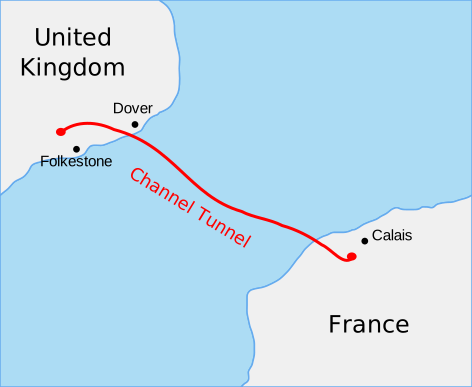
The Channel Tunnel, or Chunnel (map), linking the United Kingdom and France under the English Channel, takes the second (completed) spot at 31 miles long. While it’s a few miles shorter than the Seikan Tunnel, the Chunnel’s underwater segment is longer than that of the Seikan, making it the world’s longest underwater tunnel. The construction took 13 7 years, from 1987 to 1994, with over 13,000 workers involved in construction. Eleven tunnel boring machines were used — 6 on the English side, and 5 on the French side — and the sides met on December 1, 1990. 8.2-million passengers traveled the Chunnel via Eurostar in 2005, and numbers are expected to grow even larger when the Channel Tunnel Rail Link extends to London later this year. When the link is completed, a train trip from London to Paris will take 2 hours and 15 minutes.

The Lötschberg Base Tunnel in Switzerland runs 21.5 miles from Frutigen, Berne to Raron, Valais. When it opens in December of 2007, it will be the longest land tunnel in the world until the Gotthard Base Tunnel opens in 2015. “To dig the Loetschberg, some 16 tons of explosives were used and enough rock was excavated to pack a freight train 2,500 miles long – stretching across Europe from Lisbon, Portugal, to Helsinki, Finland,” according to this report from MSNBC.

The UK Gets a Little Dimmer

The UK’s Highways Agency may be installing dimmer switches on new street lights. In a move to reduce carbon emissions, cut down on the waste of electricity, and lower light pollution, lamps that dim when street traffic is lower might be installed around that country in the future.

But they’re not rushing into it: they’ll be starting, later this year, the research on exactly where and when the dimmer switches will be installed. And, don’t be completely afraid of dark roads: they plan to dim the lamps, rather than completely turn them off.

Who knows, maybe the UK will become a star-gazer’s travel destination?