Articles tagged “adventure travel”

Filter the Adventure Travel category by popular activities:

Biking, Camping, Climbing, Hiking, Paddling, Scuba diving, Skiing, Surfing


Woman sets new speed record on Appalachian Trail

Long distance hiker Jennifer Pharr Davis completed an end-to-end hike of the Appalachian Trail on Sunday, setting a new speed record in the process. The 28-year old endured long days on the trail, plenty of insects, record heat, and nagging injuries along the way to the finish.

Pharr Davis began her trek at the AT’s northern trail head, located on Mount Katahdin in Maine. Hiking for 15+ hours a day, she managed to cover the entire 2200-mile length of the AT in just 46 days, 11 hours, and 20 minutes, reaching the end on Springer Mountain in Georgia this past Sunday. That’s a full day faster than previous record holder Andrew Thompson’s time (47:13:31) and more than ten days faster than Jennifer’s previous record for a female hiker, which stood at 57 days, 8 hours, and 13 minutes.

Between Maine and Georgia, the trail passes through 14 states and offers hundreds of access points along the way. On an annual basis, the AT sees 2-3 million hikers, although most are content to walk just a small section of the full route. There are a few however who take it upon themselves to thru-hike the entire length, with most taking months to complete the journey.

To put into perspective Jennifer’s accomplishment; she managed to walk more than 47 miles per day for 46 days. That’s a very impressive stat considering the terrain that she had to cross through often involved rugged climbs and descents and was usually through dense forests as well. The daily grind of walking that many miles is enough to take its toll on anyone and is a true test of stamina and determination.

[Photo courtesy Mike Dirks/Times-News]

Five things (most) women should pack when traveling to a foreign country

I’m not one to whine about the hardships faced by solo female travelers. Sure, some things are frustrating, but in general, I much prefer to travel alone, and the more challenging the destination, the better. I don’t go out of my way to attract trouble or visit sketchy places, but I’ve had my share of close calls and situations that set off alarm bells.

For the most part, however, I’ve been treated with generosity and kindness while traveling alone, and had my most rewarding travel experiences. That said, there’s a few things most women should bring on trips to foreign lands, solo or no. Guys, you got it easy.

1. Appropriate attire
More than just practicality, wearing the right clothes is important from both a cultural/religious respect and personal safety standpoint. Showing too much skin or your hair is definitely not cool in much of the Middle East or Muslim world, and skimpy attire or sunbathing topless is just plain disrespectful, not to mention dangerous, in many countries.

Remember that we’re incredibly liberal here in the U.S. (too much, in my opinion) when it comes to public dress code…or lack thereof. Don’t make yourself a target for crime or unwanted solicitation. You don’t have to go all Victorian, but use good judgement.

2. Tampons
It may come as a shock, but to most of the world–including much of Europe–tampons are a foreign concept or a luxury/exorbitantly expensive. If you’ve ever tried to find tampons in Latin America, you know what I mean. Whether the reasons are cultural, religious, or geographical doesn’t matter. If you’re not down with wearing the equivalent of a diaper, BYOT.

[Photo credit: Flickr user fisserman]

3. Prescriptions for UTI’s, yeast infections, morning-after pill, etc.
There’s no better teacher than life. Let’s just say that enduring 14 hours of rutted highway on a janky Mexican bus while suffering a raging bladder infection is not an experience I care to repeat. These days, I travel with a full-on portable pharmacy, but at the very least, bring these basic Rx’s.

As for the morning-after pill, better safe than sorry. Don’t assume you can get an Rx filled overseas, so bring the actual dosage in its original packaging, and scan and email yourself copies of all prescriptions. And speaking of the morning after…

4. Condoms
You never know when you might need them, and purchasing them from a vending machine in a bar in a developing nation (not that this happened to me) because they’re not available elsewhere is just asking for trouble. Don’t trust foreign condoms–they’re not subjected to the same FDA testing and safety standards as American brands manufactured domestically. And please: if you’re having a foreign (or any other) fling, no glove, no love.

5. Hard and email copies of important documents and contact information
Email yourself, family members, and a close friend your itinerary, contact numbers (if applicable), emergency contact numbers (including bank and credit card companies), and copies of your passport and medical (and travel, if applicable) insurance card. If you’re going somewhere prone to natural disasters, civil unrest, or general sketchiness, it’s not a bad idea to register with the U.S. Department of State’s Smart Traveler Enrollment Program (STEP).

Oh, and one more thing you should always bring with you:Common sense.
Don’t be lulled into complacency: always walk with a sense of purpose, and keep your wits about you. Same goes for partying: the only one responsible for your personal safety is you, so go easy on the beer or local libation. If you’re going to hook up, better to go back to your accommodation, and make sure an employee sees the two of you together or openly text a friend of your whereabouts and who you’re with. And please, don’t be tempted to use or buy illegal drugs: besides the stiff penalties for getting caught (life in a Thai prison or death isn’t a good way to end a holiday), you may also find yourself the unwitting victim of a set-up. Just say no.

[Photo credits: pills, Flickr user michaelll; luau, Laurel Miller]
Explorers rowing to the Magnetic North Pole

A few days back, a crew of six adventurers set out in a specially designed rowboat on a 450-mile journey to the Magnetic North Pole. The six-week long journey began in Resolute Bay, Canada and will end when the team becomes the first to row to the Pole, which is located in a remote area of the Arctic Ocean.

Not to be confused with the Geographic North Pole, the Magnetic North Pole is actually the location on the surface of the Earth that a compass points to in the Northern Hemisphere. Over the years, that point has been known to change and move, but it is currently located at the coordinates of 78°35.7N 104°11.9W. The Geographic NP is, of course, found at the top of the world, at exactly 90°N.

This expedition is led by Jock Wishart, a veteran polar explorer and ocean rower. He is joined by a crew of experienced sailors and adventurers that includes Mark Delstanche, Billy Gammon, Rob Sleep, David Mans, and Mark Beaumont. The plan is for the team to row in three hour shifts, as they make slow, but steady, progress toward their goal.

According to the expedition’s website, the crew launched amidst good weather on Saturday, with low winds and temperatures hovering around 55°F. That is quite warm for the Arctic, and those conditions aren’t expected to last, as even in the summer, the temperatures can fall well below freezing and high winds can make travel extremely challenging.

If all goes as planned, the team should reach their goal sometime around the middle of September. You’ll be able to follow their progress at RowToThePole.com, which includes blog updates from the water, live GPS tracking, and plenty of information about the boat and her crew.

[Photo credit: RowToThePole.com]

Israel, Chile, Slovak Republic among countries with highest adventure travel potential

A new study conducted by George Washington University, Vital Wave Consulting, and the Adventure Travel Trade Association (ATTA) shows that Israel, Chile, and the Slovak Republic led the way in adventure tourism in 2010. The study, which resulted in the third annual Adventure Tourism Development Index, uses a mix of quantitative data and expert surveys to rank nations from around the globe on their approach and commitment to sustainable adventure travel.

The study examines what researchers call the “ten pillars” of adventure tourism. Those pillars include such things as infrastructure, cultural resources, adventure activities, entrepreneurship, and more. When those factors were all examined and ranked accordingly, for each country, a score was calculated that resulted in rankings for both developed and developing nations.

So exactly which countries earned high marks in the latest Adventure Tourism Development Index? The top ten developing countries included the following: Israel, Slovak Republic, Chile, Estonia, Czech Republic, Bulgaria, Slovenia, Jordan, Romania and Latvia.Conversely, the top ten developed nations included: Switzerland, Iceland, New Zealand, Canada, Germany, Sweden, Ireland, Norway, Finland and Austria.

The ATTA is quick to point out that these lists are not an indication of how well visited these countries currently are as adventure travel destinations, although some are already popular amongst travelers. Instead, it is a general rating on the climate that exists in these places that make it possible to support sustainable tourism now and into the future.

Judging from the list, it appears that Europe is well ahead of the game in terms of promoting sustainable travel. Both lists are dominated by countries from that continent, which could come as a surprise to many travelers.

To read the entire report click here.

Antarctica updates, July 2011

The fact that today’s high was -67 degrees at the South Pole is not news. Especially for the 49 hardy souls overwintering; they knew what they signed on for. Nor is it a shock that it was -97 at Vostok one day last week, since the Russian base holds the record for the coldest temperature ever recorded (-128).

But there are some surprises being reported from the deep-deep south during the continent’s long, cold winter (which lasts eight months, roughly March through October). Like that alien species are invading and that declining penguin numbers may have less to do with warming temps than previously thought. And that the ozone hole over the continent increasingly influences the southern hemisphere’s weather and that the ice around the continent’s edges is melting faster than predicted. And that for the first time in a decade tourist visits to Antarctica are expected to dip dramatically in the coming summer season.

1. The aliens worrying Antarctic observers are not of the cellophane-skin and pumpkin-head variety, but rather more garden variety: Insects, slugs, worms, plant seeds and fungi that sneak in with the fruits and vegetables consumed by the 4,000 scientists who call Antarctica home during the summer season. Tourists are contributing too, carrying plant seeds in on their shoes and clothing. The invasion is encouraging calls for new levels of “biosecurity” to protect the otherwise pristine continent from being further infiltrated. For the moment, simple fungi and mold are the greatest concern because they often carry plant diseases: On the 11,250 fruit and vegetables sent to nine research stations researchers found soil on 12 percent of the food as well as 56 alien invertebrates and 19 different species of mold. On Antarctica’s near islands, rats, mice and cats are already devastating bird populations, a risk the mainland doesn’t have to worry about … for now … since warm-blooded creatures have a hard time surviving sub-sub freezing temps. For now.

2. Everything from burning fossil fuels and rain forests to cow farts are blamed for the planet’s changing climate. Now a team from Columbia University suggests the ozone hole growing over Antarctica is linked to warmer, wetter weather reaching all the way north to the equator. Initially discovered in the 1980s and blamed on the use of chlorofluorocarbons (CFCs) in refrigerators and aerosols, since their banning it’s expected the hole will largely close up by the middle of the century. In 2000, NASA satellites measured it at 11.5 million square miles; a decade later it had been reduced to 8.5 million square miles. Despite the shrinkage, the study blames the high-altitude ozone hole for contributing to higher wind speeds, leading to more intense storms and for heavy summer rains across eastern Australia, the southwestern Indian Ocean and the South Pacific.

3. It has been widely reported (including by me) that the Adelie penguin population in Antarctica has dropped by as much as 50 percent in recent years. The blame has been placed largely on the fast-disappearing ice along the edge of the Antarctic Peninsula, which had long been home to thriving penguin populations. The reasoning has been that as the average winter temperatures along the Peninsula have risen by 9 to 11 degrees since the mid-20th century, compared to 2 degrees everywhere else on the planet, the habitat change was chasing the ice-loving Adelie’s further south, or killing them off. But new studies by NOAA and the Scripps Institute of Oceanography suggest that might not be their numbers are declining, but rather because their main food source – krill – is diminishing thanks to warming seas, a recovering whale populations and overfishing. The two-inch long, shrimp-like crustaceans are the basis of Antarctica’s food chain but along the Peninsula it’s estimated krill density has declined by 80 percent. Warming temps, of both air and sea, will continue to take a toll as will man’s growing demand for krill: In 2009-2010 more than 202,000 tons of krill were taken, a four-fold increase over 2002-2003.

4. It looks like penguins and krill alike will have to adapt to even warmer temps and less ice far sooner than expected. A new report out of the California Institute for Technology and NASA’s Jet Propulsion Laboratory suggests that the big ice sheets in Antarctica and Greenland are melting faster than previously predicted. If nothing changes – i.e. dramatically less-burning of fossil fuels and far fewer cow farts – that will make melting ice the biggest contributor to sea level rise, outstripping the melting of mountain glaciers and polar ice caps. The report suggests a 6 inch rise in sea levels around the world by 2050, sounding even more worrying alarm bells than the 2007 study by the International Panel on Climate Change, the last international body to fully assess the future of the ice sheets. The new numbers are based on a new technique that combines satellite radar readings of ice movement and soundings of ice thickness with new satellite information that measures differences in gravity planet-wide. Between Antarctica and Greenland, the two ice sheets dump 475 gigatonnes of ice (one gigatonne is one billion metric tons) into the ocean each year. They report estimates that the melting of polar ice caps and glaciers is about three times slower.

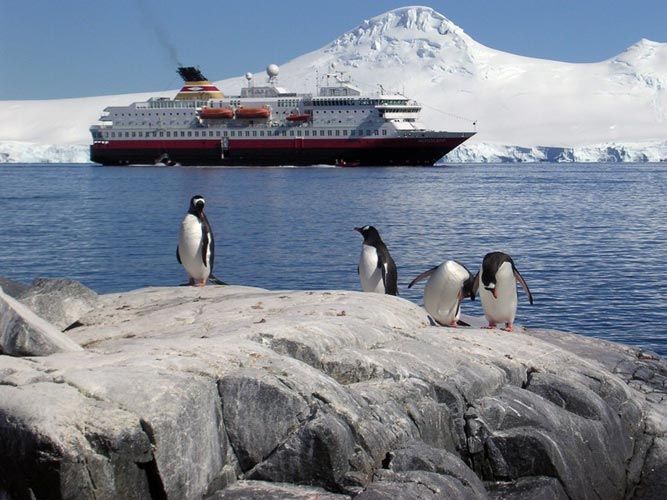
5. According to the International Association of Antarctic Tour Operators (IAATO) the numbers of people visiting the 7th continent during the most recent summer season has dropped way off its high of 46,265 people in 2007-2008. Last season – 2010-2011 – the number was less than 34,000. This coming summer, thanks largely to a new ban on heavy fuels which will prohibit most big cruise ships from visiting the Peninsula, the industry monitoring group anticipates a 25 percent drop, to just over 25,000 visitors. The ban on heavy fuels, imposed by the International Maritime Organization (IMO), goes into effect next month; it is purposely aimed at reducing the number of big ships visiting the Peninsula, the kind that carry thousands of passengers. Big ships + heavy fuel = big trouble in case of an accident, which could be disastrous on many fronts in this most-remote, most-pristine region. Visitor numbers are also down simply due to a still-sour global economy. Even the smaller ships that carry fewer than 500 passengers and make a dozen or more trips to the Peninsula each season are expecting fewer customers in the season, which begins in November.


[Flickr image via Christian Revival Network]