Undiscovered New York: Up the Hudson River Valley

Welcome to this week’s installment of Undiscovered New York. This week we’re going to be heading north, following the path of the Hudson River, one of the great waterways of the Northeastern United States. Many New Yorkers will tell your our city is “the center of the world,” and in some ways, they have a good case. But the land bordering the Hudson River up to the capital in Albany has been just as important in shaping New York as the city itself in matters historical, political and cultural.

Along the shores of this picturesque valley lie all sorts of fascinating destinations which have shaped New York City, the United States and arguably the world. The Hudson River Valley is home to the mansions of former Presidents and wealthy industrialists, famous enclaves of artists and culinary experts and birthplace of one of our nation’s great military schools.

Are you ready to leave the confines of New York City? Come along with Undiscovered New York as we “head up the Hudson.”Stop One: West Point Military Academy
Just fifty miles up the Hudson from New York is West Point, site of the oldest continuously occupied military post in the United States and home to around 4,000 cadets. Though the academy was first established by President Thomas Jefferson in 1802, the site was founded as a military installation in 1778, when it helped deter British troop movements along the river during the Revolutionary War. Visitors who are interested in checking out the grounds can stop by the Visitor’s Center where they can arrange guided tours. There’s also one of the world’s biggest military museums on site, providing a interesting look at the history of U.S. military.

Stop Two: Storm King Art Center
Next on our tour of the Hudson, is Storm King, an outdoor sculpture gallery set against the backdrop of scenic Mountainville, NY. Nestled among over 500 acres of gorgeous rolling hills are enormous sculptures crafted from famous artists like Alexander Calder and Richard Serra. It’s a peaceful place to spend the day strolling the grounds or to bring along a picnic and enjoy the outdoors (OK, yes winter is coming, but you never know with global warming these days).

Stop Three: Hyde Park
As we move further up the Hudson, we arrive at Hyde Park, a historic New York town that dates back to the 18th Century. It’s famous for several great attractions, all within close proximity. Perhaps most renowned is the former home of Franklin D. Roosevelt, who was born in Hyde Park and spent many years living there during his time as President. In addition to tours inside Roosevelt’s home, visitors can also take a look at FDR’s Presidential Library with many artifacts from the momentous years of the Great Depression and World War II. Also nearby is the Vanderbilt Mansion, one of the family’s many opulent retreats and a monument to Gilded Age excess. Foodies should also make a stop at the Culinary Institute of America, where they can sample world class cuisine from the school’s chefs in training.

Stop Four: Woodstock and the Catskills
What trip up the Hudson would be complete without a stop in Woodstock, notorious home of the world’s best known music festival and long time hippie enclave? If schlocky tie-dyed t-shirts are not your thing, don’t despair – there are plenty of awesome attractions nearby that will make the trip more than worth it. Nature lovers will be pleased to find the Catskills are just minutes away. It’s a gorgeous unspoiled wilderness where you can take in the scenery and perhaps check out the Buddhist Monastery that sits at the top of one of the area’s many hills. Make sure to finish your day at The Bear Cafe – the food is absolutely outstanding.

Ten annoying First Class passenger habits

I’ve been lucky enough to sit up front on the plane more than I deserve, and in those flights I have come across some pretty bad behavior from my fellow passengers.

Don’t think the worst offenders are the ones in the back of the plane, because it’s the ones up front that really can’t behave themselves!

“Do you know who I am”

Surprisingly, there are still quite a lot of passengers that equate first class tickets with royalty. They’ll make outrageous demands from the ground or cabin crew, and fully expect their needs to be met. The “do you know who I am” line is the best in the book, as I’m convinced it is an instant directive to the crew to ignore this passenger for the rest of the flight.

And just so you know; yes, the cabin crew does know who you are, and they also know your status and whether you are on a mileage ticket or an upgrade. So behave yourself!

The mobile phone screamer

Yeah, I’m on the plane now, yeah, I’m getting in my seat, yeah, lemme put my bag away, yeah, I’ll be there around noon, yeah yeah yeah…

The part the follows this usually involves me grabbing their phone and beating them with it. At least that is what is going through my mind. For some reason, passengers traveling in premium cabins tend to have louder and less interesting conversations than those in the back. I have absolutely nothing against someone making a last minute phone call saying goodbye to the folks at home, but the people who feel the need to document every single move they make, or walk on board pretending they are closing an important deal really push my buttons.The “my luggage is more expensive than yours” passenger

I have actually run into this kind of creep several times. They are the ones that stroll aboard the plane with $2500 luggage, and will remove any bags that get in their way. On a British Airways flight, I actually sat in my seat watching a lady remove all the other bags from the luggage closet, just so she could store her bag without any of the “cheap” luggage touching it.

When she was done, I got up and placed my rolling bag right back where it was. Needless to say that did not go down too well.

Step aside please – I am an elite member of this airline

Ugh. Nothing annoys me more during check in, than when someone tries to cut in front of me waving their elite status card from a lanyard.

My best experience with this was at LAX when someone actually pushed me aside claiming “she was a top level elite”. Of course, it turned out that she was not a top level elite, and the check in agent made it very clear that she was to head down to the regular check in desk. Chuckles all down the queue.

The bathroom is mine mine mine

Travel up front is usually quite peaceful, and with just 12 passengers on average, most of the cabin tends to sleep during the flight.

Sadly, as soon as the cabin lights are turned on towards the end of the flight, there are always some passengers who feel they are entitled to use the bathroom for the next 45 minutes. I’ve witnessed passengers carrying their beauty case into the bathroom and stay there for an hour.

The flight attendant hassling passenger

Let it be clear – I love flight attendants. And no, not in the way that begins with “Dear Penthouse”.

I’ve been on enough flights to know that they have a tough job, and I’ve seen them harassed by enough passengers to forgive them if they spill something or forget a drink order. But it’s the harassing passengers that really grind my gears. Spending $4000 on a plane ticket does not entitle you to annoy the flight attendant, nor does it give you the right to make unreasonable demands for 14 hours.

Some of the silliest things I’ve heard these passengers demand are “french fries” and yelling at a poor flight attendant to clean up the vomit mess they just made in the bathroom (really!).

I do not need to see you in your underwear

One of the perks of flying an international first class flight, is a set of fluffy PJ’s. Sadly, most US based airlines don’t believe in this amenity, but any top class foreign airline still provides them in almost any size requested.

Common courtesy would expect you to be discreet and pop into the bathroom for a quick wash and change. However, every now and then I still run into someone standing in the middle of the aisle, stripping down to their underwear and changing into their PJ’s. Of course, it’s also never a supermodel performing this strip tease…

Smelly feet on the bulkhead

You have to wonder what is going through someones mind when they get on board, take off their shoes, and rest their smelly sweaty feet on the bulkhead. Perhaps they think nobody in the cabin cares, or perhaps they are convinced their expensive ticket entitles them to being obnoxious.

I’ll never know, but it is one of the most disgusting things I see when I fly.

Bring the kids, but stick them in the back (and keep them there)

There is nothing wrong with bringing your kids on a trip with you. I’ll even forgive you if you got yourself into the first class cabin, but stuck the kids in the back of the plane. But please do not let that give you the idea that it’s fine to let your kids join you up front for dinner and a movie.

If the larger seat of first class means so much to you that you are willing to dump the kids in steerage, then you’d better be prepared to be separated from them for the rest of the flight. The first class cabin is not a social club.

I’ve had several flights where I was trying to sleep, only to be disturbed by a family having their usual Sunday dinner right next to me when they dragged their kids (and their meals) from the back of the plane.

I’ll sit here thank you very much!

I’m by no means an elitist, but sometimes I’ve arrived in the cabin and come across someone who I just know does not belong there. They are often pretty nervous, and are constantly looking around every time another passenger boards.

These are the seat stealing passengers. There are 2 kinds of seat stealers; those that know exactly how the system works, and those that are just plain stupid. The stupid ones don’t realize how the seat assignment system works, and figure the plane is like a bus; grab the first and best seat you can.

The other kind knows exactly how things work; they’ll grab any seat in the cabin, and when the real occupant of the seat arrives, they’ll simply grab another one. They’ll rinse and repeat until all the seats are taken (and they go to their real seat), or till the doors close and they relax in their new first class seat.

Thankfully, most airlines have a flight attendant directing people to their correct cabin, or doing a seat count, but the smart seat stealers will always try. After all, with a little effort they could be sitting in comfort instead of in the back.

TSA friendly laptop bags popping up everywhere – an overview

Back in September, when the TSA announced their new relaxed rules for laptop bag designs, virtually every manufacturer jumped on the bandwagon. We are now more than a month into the new rules, and the following 11 manufacturers have at least one checkpoint friendly bag available for (pre) ordering.

Here are the current bags with their prices and availability:


Tom Bihn Checkpoint Flyer

Tom Bihn bags managed to be one of the first to actually ship a TSA friendly laptop bag. Their Checkpoint Flyer bag was reviewed here in October.

The Checkpoint Flyer is available in three colors as well as 13″, 15″ and 17″ dimensions, plus an upcoming version for the new 15″ Macbook Pro.

The Checkpoint Flyer costs $225 and most sizes are available for immediate shipping. When you order, be sure to add a shoulder strap!

Belkin FlyThru

Once again, Gadling got the scoop with the first review of this TSA friendly bag. The MSRP is $59.99 and it is available from many retailers right now. At $36.81 (through this reseller), it is currently the cheapest TSA friendly bag on the market.

The Belkin FlyThru bag holds laptops up to 15.4″ and has an expandable front pocket as well as plenty of internal storage space.

Skooba Design Checkthrough Bag

The Skooba Design Checkthrough bag has a fairly standard design, and is made for most 15.4″ laptop, though Skooba Design report that it will hold many slim 17″ machines too.

The bag costs $139.95 and is currently in stock and ready to ship.

CODi CT3 Checkpoint Tested

CODi announced 4 different checkpoint friendly bags (a backpack, 2 regular laptop bags and a wheeled case).

With the exception of the Mobile Lite wheeled case, they are all currently available to order. Prices start at $200.

Mobile Edge ScanFast Collection

Mobile Edge was among the first bag designers to announce a lineup of checkpoint friendly bags, and their ScanFast assortment consists of 3 different bags.

The lineup offers a backpack, a briefcase and a messenger bag, and they all cost $99.99 each.

The backpack holds laptops up to 17″, and the briefcase and messenger bag are designed for laptops up to 15.4″.

Like most other bags in this overview, the checkpoint procedure is as simple as unzipping the laptop portion, and placing the unfolded bag on the conveyor.

Travelon Bags Checkpoint Friendly

Travelon Bags has announced not one, but six different TSA friendly laptop bags. Their collection covers everything from a simply laptop sling to a stylish ladies brief.

Prices start at just $24.99 (for the laptop protector) up to $189.99 for a wheeled laptop briefcase.

Briggs & Riley SpeedThru

Briggs & Riley is the clear winner when it comes to the number of checkpoint friendly bags. Their assortment covers a whopping 16 different bags, so they are clearly taking the market for these bags quite seriously.

There is however one big difference; not all the bags are dedicated “checkpoint friendly”.

Most of the other bags in my overview have special design features that allow the entire bag to go through the X-Ray machine without taking pieces out, but the Briggs & Riley solution depends on you removing their “SpeedThru” sleeve from the bag, and placing it on the belt. This obviously puts their bags at a disadvantage over most other bags here.

The Briggs & Riley SpeedThru compatible bags start at $167 for a basic messenger bag, up to $429 for an expandable leather overnight bag.

Tumi T-Pass

Tumi has taken a similar approach as Briggs & Riley, as their lineup also depends on you placing your laptop in a TSA friendly sleeve inside a regular bag.

The T-Pass lineup consists of 9 bags and 4 different sleeves for the various sizes of laptop computers.

The cheapest Tumi T-Pass compatible bag starts at $375 for the Alpha medium capacity laptop bag, up to $995 for their Sloane leather briefcase. The required T-Pass sleeve is an additional $60-$85 depending on the size.

FitzWell Checkpoint Friendly

Many of you will have heard of Zappo’s, famous for their online shoe sales. Their in-house brand is “FitzWell”, and they too have introduced a checkpoint friendly bag.

The FitzWell Wheeled Checkpoint Friendly bag is as the name implies, a wheeled notebook briefcase. The wheeled briefcase comes with an internal removable checkpoint friendly sleeve for laptops up to 15.4″.

At $139 it is one of the cheapest wheeled checkpoint friendly laptop bags in this lineup.

Aerovation Checkpoint Friendly

The Aerovation Checkpoint Friendly Laptop bag claims to be the world’s first TSA friendly bag. The bag is available in regular Nylon ($129.95) and Leather ($279.95).

Aerovation has posted a 5 minute
video clip
on their site showing exactly how their bag and a laptop look when passing through the X-Ray machine.


TurboBag Checkpoint Friendly

TurboBag may be the brand with the silliest name in this overview, but their bags are nothing to laugh at.

The TurboBag checkpoint friendly bag lineup consists of 4 different bags, with 3 models for laptops up to 15.4″, and one for 17″ machines.

The bags are fold-open, which means you only have to unzip the laptop bag portion to slide it through the checkpoint conveyor.

Each bag even comes with a free “TurboLapDesk” laptop pad designed to protect your lap from computer heat.

The cheapest bag (in polyester) is just $58.95, and the most expensive is their T-400 TurboBag, in real leather for $109.95.


Through the Gadling Lens: choosing the right lens

Thanks for all your comments on the previous post, “what kind of camera should I buy?” — there were some really going points made, and some great feedback. Today, as promised, I thought I’d go through a quick guide on why there are so many lenses out there and why they differ — as well as why you might want a particular one on your trip.

Generally, lenses are described by their focal length. A quick Google search of the term “focal length” returns some fantastically technical definitions — my current favourite is, “The focal length of an optical system is a measure of how strongly it converges (focuses) or diverges (diffuses) light. A system with a shorter focal length has greater optical power than one with a long focal length.“

Mmkay.
Here’s how I like to remember it: the larger the focal length of a lens, the bigger the subject looks and the less of the background you’ll see in your shot. The smaller the focal length of a lens, the smaller your subject will look in your photograph, but you’ll be able to see a whole lot more background.

In other words, if you stand 10 feet away from an apple sitting on a table, the photograph you take with a 35 mm lens will have a lot more background and a lot less apple; with a 100 mm lens, the picture will have a lot more apple and a lot less background.

Clear as mud? Not so much?

Okay, let’s look at a few practical examples. (Note: all of the following images are taken right out of the camera — I didn’t do any cropping, or processing, other than to size them to fit on this post.) I asked convinced coerced my 4-1/2 year old daughter Alex outside to act as a model, and took several pictures of her, using different lenses. I asked her to stand on the curb, while I switched out lenses. That’s her on the left:

Isn’t she cute?

Okay, so the first shot I took, I used a 50mm lens. In general, lenses that are between 35mm and 70mm are called “normal” lenses — in other words, when you look through the viewfinder, what you see is pretty much what you would see without the viewfinder — everything looks about the same size, you don’t see any more detail than you would with the naked eye, that sort of thing. Disposable cameras, for example, usually have lenses between 35mm and 70 mm. So taking the shot from the opposite curb, like so …

… the image of Alex looks like this:

A perfectly suitable shot, and the kind of image that conveys exactly what I saw at the time that I saw it. This sort of lens works if you’re going for street photography, or documentary-style photography.

But watch what happens when I switch my lens out for a 200mm lens. The following image was taken at the same spot, on the opposite curb from Alex:

See? All of a sudden, it’s like I was standing right in front of her, even though I’m still standing across the street on the curb. She looks bigger in the shot (and you can see a whole lot more detail); however, I’ve lost a lot of the background (i.e, you can’t really see the house or the trees anymore). The beauty of this lens is that you can take wonderfully intimate shots of people (e.g., the old men playing chess in the park) or wildlife (the boa constrictor wrapped around the tropical vegetation) or sports (that touchdown made by only inches) without actually getting in the way of the subject — the old men, boa constrictor or running back will likely not even know you’re there.

The downside of this sort of lens? This bad boy is huge (see the photograph at the top of this post), and therefore very unwieldy. On major trips I do usually take this lens with me, but I generally only devote one day to using it (getting lovely intimate shots of people talking to each other at a cafe, or otherwise interacting), and then put it away for the rest of the trip, instead using a lens with a smaller focal length (usually between 50mm to 100 mm).

Speaking of 100mm lenses, let’s say you don’t mind if your subject knows your taking her picture — and in fact, you want to get a nice tight portrait shot. Generally speaking, lenses with focal lengths between 75mm and 135mm are known as “portrait lenses,” and they enable you to take lovely, magazine-cover-shot type images of people.

And so, grabbing my 100mm lens, and standing right here, about three feet away …

… I’m able to take a lovely tight shot of Alex’s face, like so:

Now, is it possible for me to take a shot this close to Alex using the 200mm lens? It is, but I’d still have to stand about halfway across the street to do it, in order to get the focus right. And I probably couldn’t take a shot like this with the 50mm lens, because I would have to stand really close to Alex to take the shot, and would likely end up with a really blurry shot, because I would be too close for the lens to get a really sharp focus.

For what it’s worth, I always carry my 100mm lens (or a lens which “passes through” that focal length, like a 70mm-120mm zoom, for example), particularly when I travel; primarily because I love portraiture, and I love shooting the faces of the people who are native to the countries I visit.

Finally, let’s take a look at a macro lens: the type of lens that let’s you get really up close and personal. Again, I’ll use Alex as a model, but this time I’ll get very, very close to her (about 8 inches away):

And — you’re going to love this — check out how much detail I can capture of her here:

See how you can make out every eyelash in this photo, every tiny contour of her skin? Macro shots are beautiful for grabbing very tiny details, sometimes in breathtaking ways. And there’s no other kind of lens that can get this sort of detail than a macro lens — other lenses just can’t focus that well.

Now, obviously, you’re not likely to walk up to an individual, get all up in their personal space and shoot their eyeballs. But macro lenses can be really fantastic for getting details of, say, the bumps on the back of some weird-looking tropical insect, or the stamens of a truly exotic flower
. I always carry my macro lens with me if I’m going somewhere known for its beautiful flora and fauna — I never know what I might get.

Finally, for those of you with point-and-shoots, don’t despair: these days, point-and-shoots have wonderfully wide ranges of focal lengths for their built-in lenses. For example, the following two shots were taken with my Nikon Coolpix. According to the Nikon website, the Coolpix has a focal length range of between 28mm and 112mm.

So again, standing on the opposite curb from Alex, here’s a shot at approximately 28mm (also called a wide-angle shot, used for architecture or landscapes):


(Notice now, how much more background I get than even the 50mm shot at the top of this post? Although Alex is tiny in the shot, now I not only get the house and the two trees, but the next-door neightbour’s house as well!)

And here’s a shot zoomed in at 112mm; this time, again, standing on the curb across the street from her:

Whew — that’s a lot to cover in one post! Hopefully, this helps you better understand what different camera lenses can do, and when they’re appropriate for your favourite type of photography — and for those of you who like crib sheets, there’s a great one covering the kind of photography each lens is best for here. As always, if you have any questions, or would like me to cover anything specific in an upcoming post, please feel free to let me know in the comments below, or e-mail me directly at karen.walrond@weblogsinc.com. I’m looking forward to hearing what you have to say!

Karen is a writer and photographer in Houston, Texas. You can see more of her work at her site, Chookooloonks.
And for more Through the Gadling Lens, click here.

So what’s up with Iceland’s ‘national bankruptcy’? A possible explanation

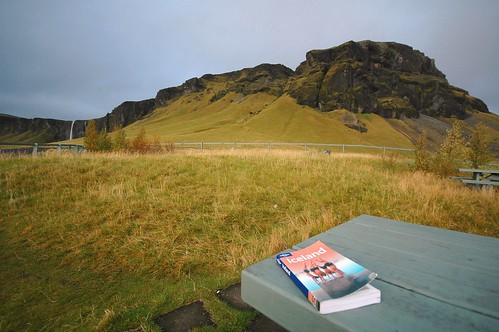
Hidden far away in the North Atlantic, Iceland may seem like one of the last outposts for globalization to reach. One economist stressed that a century ago, Iceland was essentially Ghana in terms of economic development. And even as late as the 1970s, Iceland still remained one of the poorest countries in Western Europe, with a major portion of its economy reliant on fishing. Yet today, Iceland is, according to the United Nations Human Development Index, the most developed country in the world, with one of the highest rates of life expectancy, literacy, and per capita GDP.

So how has Iceland gotten where it is today and what exactly went wrong in the last month?

The answer to both is financial globalization. The very forces of global integration, which led to deregulation of the banking sector and creation of a national stock exchange, nearly pushed this distinctly first-world country a few weeks ago into “national bankruptcy,” in the words of Prime Minister Geir Haarde.

What’s really scary is that the on-going Icelandic crisis has been in large parts an external crisis of confidence. Its three major banks were quite well-behaved, with little exposure to the “toxic” subprime loans we’ve all heard so much about. But ultimately foreign lenders to Iceland’s banks did not see the government as a credible lender of last resort. In other words, although the banks were too big to fail, they were also too big to bail (out).
On many fronts, Iceland’s economic report card is sparkling clean: the country boasts of a fully-funded pension, a strong financial regulatory agency, low unemployment, and high growth. In particular, Iceland’s banks have become a success story for financial integration, having fueled much of the country’s economic growth in the past decade. While the fishing industry’s share of GDP declined from 16% in 1980 to 6% in 2006, the finance, insurance, and real estate industries together saw an increase from 17% of GDP to 26% in the same period.

However, with a population of 300,000, or roughly one-fifth the population of Manhattan, this tiny island did not have the internal capital to support growth in the financial sector-they had to seek financial integration with the global system. Thus, these newly privatized banks quickly began to access foreign credit (and customers) in Scandinavia, the US, Japan, Canada, Australia, and the UK. One now-infamous Icelandic bank, Landsbanki, started IceSave, an UK-based Internet bank, in October 2006, which accumulated £7.3 billion deposits from 300,000 British and Dutch accounts. By the first quarter of 2008, assets of Icelandic banks had ballooned to 14,069 billion ISK (Icelandic krona) or $176 billion, roughly eleven times the size of the country’s 2007 GDP.

Though financial liberalization enabled capital to flow easily into the country, capital was able to flow out just as easily. Investors saw the country, even with its strong financial fundamentals, as the weakest link of the ongoing global financial crisis.

The most dramatic consequence of the collapse and subsequent nationalization of the big three Icelandic banks could be seen in the UK, where the British government had to resort to anti-terrorism laws to freeze $6.8 billion in Icelandic assets.

Iceland’s meltdown presents potential consequences beyond the global financial sector. Many of its domestic companies are now multinational corporations that depend on a viable currency regime and access to foreign credit for continued operation. Two particularly prominent businesses are Actavis and the Baugur Group. In the 1990s, Actavis, a generic-producing pharmaceutical, had less than 100 employees and served only the Icelandic market.

Now the company is active in 40 countries and employees 11,000 people. Its collapse would produce a spillover effect that could cause other associated businesses to go bankrupt. The greatest possibility of this domino theory at work is with Baugur Group, which directly owns a large number of UK retail conglomerates, including Woolworth’s and Somerfield (as well as an equity stake in Saks Fifth Avenue).

Ultimately, on October 25, Iceland became the first Western country since 1976 to accept an International Monetary Fund (IMF) bailout. Discussions are now on-going for an additional $4 billion loan by Norway, Sweden, Finland, and Denmark (after initial talks with Russia came under harsh fire).

Paradoxically, greater financial liberalization must be pursued to salvage Iceland’s economy. With its banking sector’s sheer size in comparison to the national economy, Iceland must abandon the krona in favor of the euro, as the EU is a much more credible lender-of-last-resort than the government of a small Scandinavian island.

One hedge fund manager earlier this year described the almost sure-fire profit of shorting Iceland as the “second coming of Christ.” Ironically, through the financial integration of the 1990s, the island’s banking sector had itself turned into a sort of bizarre hedge fund, with an enormous asset-liability mismatch to the size of the underlying economy.

Granted, although the three banks’ fundamentals were relatively strong, with little exposure to subprime securities, they were ultimately early victims of the global credit crunch. With no wholesale credit to roll over their loans, they had to be nationalized, which set off a chain-reaction of events that impacted the UK, Germany, and several other nations across the globe. Now, paradoxically, more financial integration, in the form of Iceland moving from the krona to the Euro, is needed in order to stave off another banking crisis and for long-term stability and growth of the Icelandic economy.

So what does all this mean to a seasoned traveler like you?

  • Book yourself on the next flight to Iceland. The krona has fallen in value by half over the last couple months. That means a national 50% off sale.
  • But this joyride may be over soon. The IMF $2 billion bailout is designed to stabilize their currency. Translation: things will cost more.
  • Set your net wider. Other European countries, particularly Hungary, Ukraine, Spain, and Germany, are financially weak right now.
  • And whatever you do, don’t put your money in an Icelandic bank. Even if they offer you a small village as collateral.