Travel Q&A with author & cook Tamara Reynolds

Tamara Reynolds is a the co-founder (with Zora O’Neill) of The Sunday Night Dinner, an Astoria, Queens-based supper club. The Sunday Night Dinner, which continues to thrive, was well ahead of what has become a supper club trend. Out of the Sunday Night Dinner came a fabulous cookbook, Forking Fantastic, which Reynolds co-authored with O’Neill. Travel is key to Reynolds’ imagination as a cook. She shops for food in the international food markets of Astoria and travels to countries with great food traditions.

Q: Sum up your professions in a few snappy words.

A: Cookbook author, cook for hire, cooking teacher, television show shopper, and Hostess with the Mostess of The Sunday Night Dinner.

Q: How did the Sunday night dinners come to happen? And how did Forking Fantastic emerge from the supper club?

A: SND began when Zora O’Neill and I met in 2002. We worked at Prune together and discovered we were neighbors and both loved to cook. We began cooking on Sundays for friends, and the next thing we knew, we were consistently feeding 15-20 people every Sunday. We began asking for donations so we could afford to keep doing it, and the next thing we knew, we were running an underground supper club.

We became convinced that the next step should be to write a cookbook, with encouraging words on entertaining, for real life. Zora and I felt that everyone was so hung up on the Martha Stewart perfection ideal that no one was actually cooking dinner for friends for the fun of it. Plus, we thought that if we wrote a kick ass guide to entertaining, detailing how we taught ourselves to cook and our many many mistakes along the way, maybe we would get invited to dinner more often.
Q: You told me that the fact that you’re based in Astoria has had a lot to do with the fact that the supper club took off.

A: It is funny, when we started our supper club, it was us and Ghetto Gourmet, a traveling club. Now I get a notice about every third day that another one is starting up, usually in Brooklyn. We remain one of the very few in Queens.

Queens is incredibly culturally diverse, but Brooklyn still seems to keep a headlock on “culinary coolness”. That said, I would never be the cook that I am or be able to feed people the way I do if I didn’t live in Astoria. I find the butchers and “old world” feel of Astoria’s food shops completely inspiring and refreshing. There are stores that only import Greek products, Italian products, Eastern European, North African, Middle Eastern, Brazilian, etcetera. Within a seven-minute walk from my house there are three butchers, all with whole lambs, goats and pigs hanging in the windows. These hanging animal carcasses aren’t decorative. People in my neighborhood cook these things on a daily basis. The produce markets burst with really excellent fresh produce, too. The first Long Island tomatoes and flat beans of the season just appeared last Friday and it looked like there was going to be a riot lead by the grandmothers of Astoria!

Q: Your Forking Fantastic co-author Zora O’Neill is also a travel writer. Did her perspectives on travel and food influence your own?

A: Absolutely. I went to grad school to be an opera singer; Zora went to grad school to study Classical Arabic poetry. Along the way we both learned to cook, but when I met her she had lived in Egypt and knew far more about Middle Eastern/North African cuisine than I did. I eagerly lapped up all of the information I could get out of her. She still travels far more than I do. My travel is mainly for pleasure while hers is for work. It is always nice to get a story of a great meal from her. It spurs my imagination.

Q: Where do you like to travel?

A: I feel like I am kind of done with Europe for now. I really want to concentrate on the US states I have not visited, North Africa, and Vietnam. February I am trying to put together a Vietnam/Cambodia/Laos trip. I think it is safe to say that I like to go anywhere where they are doing things differently than I do them at home.

Q: Have you ever traveled somewhere expressly to try a particular food?

A: You know, not exclusively, but I never go anywhere without considering where and what I will be eating, and cannot imagine traveling to a country with bad food. That said, I cannot wait to go back to Turkey to eat some more, and to Morocco, Tunisia, Syria, Sicily, Vietnam, Cambodia and Laos just to eat. I view sightseeing as a great way to burn off the last meal and get your body ready to eat the next one. I am also considering driving around the backwaters of Georgia in August to sample some Gullah specialties. I am fascinated the resilience of Gullah traditions.

Q: How do your travels influence your cooking?

A: People cannot cook without markets and grocery stores. Going into either can tell you so much about where you are, who lives there, and what happens in their kitchens. I love to visit grocery stores and markets in every town I am in, one-horse or otherwise. The fact that in other countries you can wander around and see meat sitting out in the open for hours and here we insist on shrink-wrapping everything is fascinating. Sometimes small observations can inform you that your accepted way of doing things at home is definitely not the only way.

Of course, places have particular smells. Every time I exit the airport in Phoenix, my hometown, it smells like home. The smells of cities often tell me what people are eating, and I love to try to recreate particular smells in my home kitchen.

Q: Do you have a favorite destination, secret or otherwise?

A: Secret? Are there any secrets left? Ha. I must say, I loved Ayvalik, a small town in Turkey. People were transporting goods through the cobblestone streets in the town in horse drawn wagons. And there was pickled watermelon rind everywhere. And the eggplant, tomatoes, melons and lamb were amazing. We took a boat from Mytilini, Greece to Ayvalik and stayed a few days on our way to Istanbul. I would love to return.

I also loved the plains of Portugal. I ended up there six years ago purely by accident; my drive down to the Algarve was scuttled by torrential rain, and we didn’t want rainy beach. So we ended up driving up and over from east to west: Evora, Elvas, Beja. So beautiful and so unexpected. We happened into an ancient Roman Meat Market that had at a later point been a Catholic Church and was now a local craft shop/art gallery. So many Roman Ruins and such beauty! For a few years I loved to say, “If you want to see Rome, go to Portugal!”
Travel Trends: The effect of Southwest Airlines’ cheap fares on competitor fares

The last time you wanted to book a trip somewhere in the U.S., what airline did you think of first? If you’re like thousands of U.S. air passengers, you checked to see if Southwest Airlines flew in and out of the city you wanted to visit. Since its inception almost forty years ago in 1971, Southwest has been providing passengers all over the country with low-cost travel options.

Southwest uses several strategies to lower its costs so they can, in turn, can offer cheap fares. Among them:

  1. They mostly fly in and out of secondary markets, which are less costly.
  2. They only use one type of plane, the Boeing 737, which keeps maintenance costs down.
  3. They only fly domestically.
  4. Southwest Airlines is a “low frills” airline, dispensing with extras like meals or in-flight movies.

The formula seems to be working. The average Southwest Airlines ticket can often be a fraction of the price of a ticket on another major airline. Further, many passengers will drive out of their way to a secondary market in order to be able to take a Southwest flight. As a result of this success, other airlines have been pressured to lower their prices in order to compete. The average ticket price in markets with Southwest in them has gone down in the last ten years, while many markets without Southwest have gone up.

Because of Southwest’s policy of serving secondary markets, however, it’s difficult to do a simple analysis of the data to see in which markets the price has gone down, and in which markets it has gone up. Take, for example, Chicago Midway Airport, into which Southwest flies. Southwest does not fly into Chicago O’Hare, but prices there are still likely to be affected, since airlines at O’Hare want to compete for passengers who might otherwise go to Midway and use Southwest.

For a simple analysis, we looked at four cities in which Southwest had started service in the last ten years, and then compared ticket prices ten years later.

Buffalo started Southwest service in 2000. By 2009, Buffalo’s average fare had plunged by 19%. Southwest entered the market in both Dulles and Denver in 2006. From 2006 to 2009, the average ticket price at Dulles went down 1%; in Denver, the average ticket price dropped 13%. In 2007, service to San Francisco started; between 2007 and 2009, the average airfare went down 21%. None of these data account for inflation either.

By contrast, we also looked at the airfares from 2000-2009 in markets that did not have Southwest. Although the gains were modest by some means, in a world where most airfares have gone down in the last ten years, they were still significant. Not only does Savannah, Georgia, not have Southwest, but Southwest does not operate anywhere in the entire state of Georgia. Therefore, it was no surprise to see a 6% increase in fares over the last ten years. Alabama and Tennessee are both under served by Southwest, as well, which is reflected by Memphis increasing by 3% and Huntsville increasing by 9%. Finally, Reagan (Washington DC), which competes with Dulles, went up by 2%.

All in all, it’s cheaper overall to fly now than it was in 2000; but for the markets served by Southwest, it is cheaper still. The advent of Southwest and other low-cost airlines such as Air Tran have lowered costs all over the nation. Many people have reported that flying Southwest is a more pleasant experience in other ways as well; the facts bear this out. Southwest has the lowest customer complaints in the industry (as of 2009).

So what are you waiting for? Grab your sun tan lotion and your swimsuit — your next vacation in the California sun just got a lot cheaper.

Data Sources:

See more Travel Trends.

Luxury pet hotel to open in Savannah

Pets need a little pampering, too, at least that’s what the owners of Catnip ‘n’ Biscuits believe. The new luxury pet ‘hotel’ is opening this Saturday in Savannah, Georgia, giving pet owners are new reason to leave town.

Catnip ‘n’ Biscuits, a doggie day care and luxury pet hotel, is similar to human hotels in that it has individual rooms for pets, heating and air conditioning, and recreational and eating areas, but the pet hotel offers something human hotels don’t: obedience school. “All pets are tested for temperament, and there’s an attendant on duty at all times,” said Cathi Denham, co-owner of the hotel. “We’re not a kennel with chain link fences and concrete floors. We have recycled rubber floors and theme rooms with toddler beds and TVs.” In addition, Denham says that pets older than 7 months must be spayed or neutered to attend the day care at her luxury camp (insert joke about illicit hotel room affairs here).

According to the website, dogs have their pick of luxury themed-boarding suites complete with a toddler bed and padded bedding and throw rugs, TVs and DVD players. Felines stay in kitty condos, a private area of the facility far away from all the dogs.

To make sure pets are well taken care of and to eliminate any parent-pet anxiety, parents can check in our their furry friends via Web cams, thanks to state-of-the-art equipment the owners installed in the camp area.

Laugh as you might over this new luxury amenity but there’s a simple fact that makes this hotel a cash cow: Data from the American Pet Products Association, a not-for-profit trade association, estimates that $47.7 billion will be spent on pets this year, up from $45.5 billion last year and $43.2 billion in 2008.

[via Savannahnow.com]

Daily Pampering: The Only Way to Fly to the Masters Golf Tournament

Have you ever flown into Augusta, Georgia? It’s a tiny airport, and you’re not going to get amazing flights. It just doesn’t work that way. This poses a problem for those planning to go to the Masters at Augusta National Golf Club, the most prestigious event the game has to offer. So, instead of dealing with the misery of airline travel – does it get worse than flying with the great unwashed? – fly down in style. Don’t let a cramped sweaty flight taint the experience of watching the coveted green jacket on the person who can only be described as golf‘s master.

Linear Air is ready to make your experience perfect. Book your trip by the end of March, and you’ll pick up a 10 percent discount … but that’s not the point of flying this way. Go the exclusive route, and you’ll have an incredible experience from start to finish, rather than merely from arrival to departure. The tournament may run from April 8 – 11, 2009, but your experience begins with wheels up – not tee off.

Want more? Get your daily dose of pampering right here.

The Summer Redneck Games: A Hootin’ Good Time!

Starting today, Gadling is taking a look at our favorite festivals around the world. From music festivals to cultural showcases to the just plain bizarre, we hope to inspire you to do some festival exploring of your own. Come back each week for our picks or find them all HERE.

Each July, nearly 100,000 visitors descend on East Dublin, Georgia to participate in a one-of-a-kind event known as the Summer Redneck Games. This unique festival is a celebration of “all things Redneck” including special feats of athleticism, a variety of culinary treats and plenty of fun.

The story of the Redneck Games begins in 1996 before the Atlanta Olympics. After outsiders began making fun of “Rednecks” who were hosting the games, a group of volunteers decided to do something about it. Enterprising locals took critics’ remarks as a challenge, organizing their very own “Redneck Games” and agreed to donate the proceeds from the event to charity. In its inaugural year, more than 5,000 visitors showed up. The organizers knew they were on to something. Over the last decade, the Redneck Games have continued to grow, with participation reaching 95,000 rednecks during the annual one-day July extravaganza.

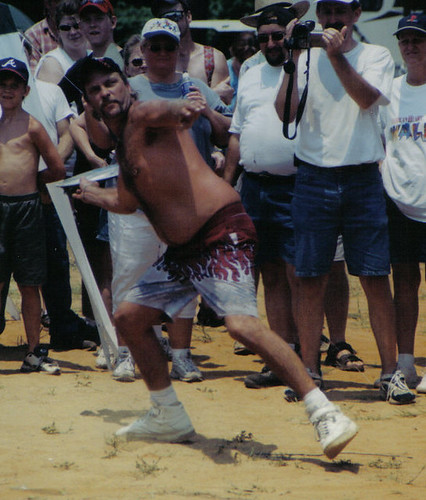
Much like the Olympic games, the Redneck Games hosts a number of challenging athletic events, but with a uniquely Redneck twist. Favorite contests include the Hubcap Hurl, the Bobbin’ for Pigs Feet Fest, Mud Wrestling, and a special contest called Redneck Horseshoes, which uses toilet seats in place of the standard iron game pieces. There’s also plenty of authentic Redneck foods for hungry spectators, including Corn Dogs, Alligator Kebabs and Elephant Ears. You’re also sure hear authentic Redneck slang like “y’all,” “fixin’ to,” “do what?,” and the all-time favorite (as coined by Redneck favorite, Larry the Cable Guy), “Git R’ Done!”

Though the Redneck Games would seem to be a decidedly local affair, it has slowly attracted fans from across the U.S. and around the world. As the event has become more popular, a steady stream of participants from “above the Mason-Dixon line” has joined in the fun, with events taking place as far away as Canada and a range of international media coverage.

There’s many misconceptions about the Games – critics decry the Redneck Games as nothing more than horseplay and drinking beer. But much like the comments the led to the event’s creation, event organizers and supporters have taken the remarks in stride. To its fans, the Redneck Games remain nothing but a silly, great time. Despite the increase in attendance and popularity, it remains much the same pure fun that it has always been.

Want to join in the craziness? Head down to Georgia this July 10th to check it out. Everyone is welcome – even Yankees…