Drives to pies and what’s nearby: Converse, Indiana

Herschberger Essen Haus is another worthy stop on the fabulous pie hunt. This restaurant, according to Aaron who left a comment on the strawberry-rhubarb pie post, serves up a strawberry-rhubarb pie to drive for–even though it’s 40 miles out of his way. When going from Indianapolis to Detroit, Aaron swings by Converse where there’s a slice of this very pie with his name on it.

The red dot in the white rectangle is where you’ll find the pie, or therabouts. The red rectangle in the map of Indiana marks Miami County where Converse is located.

I’m curious how Aaron found Herschberger Essen Haus. Was this a pie tip someone gave him? Converse isn’t exactly a tourist hot spot. I’m sure it’s a terrific place to live, but the population is teeny. At 1,147 in 2006, that’s smaller than most high schools. The Oak Hill Winery, also in town, looks like another worth-the-effort palate pleaser. Housed in a 1895 carriage house, the winery offers a pie wine chaser to fill out a decent afternoon.

If you pair your trip to Converse with a visit to the rest of Miami County, more specifically, Peru, Indiana, there are more reasons to travel this unbeaten path.

Cole Porter, for example, was born in Peru. You can see the house where he lived from 1891–1901, but restoration on the building isn’t finished. Unfortunately, it was divided into apartments and left to disrepair. Even worse, one of the apartments was used as a meth-amphetamine lab by a tenant. Tsk, tsk. The building, however, is lovely and worth saving. The committee that’s in charge of the project is in the process of turning it into a museum and bed & breakfast. The before and after pictures show progress. This is a project to root for. A big hurrah to the folks who are pouring their energies into it.

Also in Peru is the Grissom Air Museum at the Grissom Air Reserve Base. There are 25 aircraft and a F-4 you can climb into, plus little known details about World War II history.

Another stop is the Miami County Historical Society Museum where there is something to learn about everything. You can see some of Cole Porter’s belongings, including his Cadillac, plus learn about the rich history of the area. For starters, Miami County has a past linked with Native Americans, Tom Mix and the circus. As a fan of historical society museums, this one looks like it’s one of the best and the hours are plentiful.

Because Peru is the “Circus Capital of the World,” in the spirit of circus love, there is an amateur circus each July which includes the Circus City Festival. In addition to the displays at the historical society, you can learn more about Peru’s circus past and present at the Circus City Museum.

While in Peru, also check out the Crane’s Nest Store operated by the Miami Nation of Indians. There are affordable crafts like handwoven baskets and proceeds help out the Miami Nation of Indiana.

Whatever you do in Peru, don’t forget that pie in Converse–it’s the reason to head to Miami County, at least if you’re Aaron.
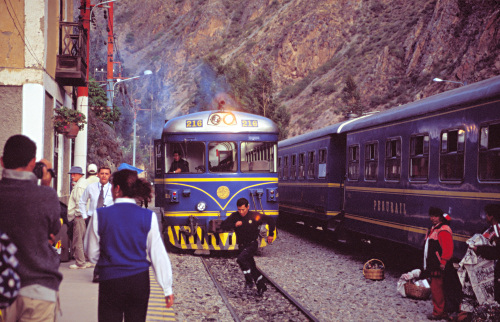
Photo of the Day (10.06.2008)


Where I live, it’s been raining for days. So I might be a bit biased but I love this photo taken in the Sacred Valley in Peru. I love the bright blue sky with fluffy white clouds, offset by the dry landscape. And I especially love the implication that Maras is up in the clouds, surrounded by angels and halos no doubt. Thanks to Dirty Dawg for submitting such a great photo.

Have a divine photo to share? Submit it to the Gadling Flickr Pool.

Murder on the Inca Trail

A divorced British banker died after a blow to the head on the Inca Trail and was found in a nearby river–and it’s raising more than a few eyebrows across the pond. Colin Murphy, 44, disappeared on News Year’s day during a Christmas holiday to Peru from the town of Aguas Calientes in the Andes, not far from the Machu Picchu.

The last hours of his life were spent with 14 other holidayers, who left their campsite on New Year’s Eve to grab a drink at the nearest watering hole. The next day, Mr. Murphy was not in his tent. It’s believed the last person to see him alive was fellow tourist Harvey Layton, a construction worker he had befriend on the trip.

Called “the life and soul of any gathering.”, Mr. Murphy’s body has since been flown back to England, and while investigators are looking into his suspicious death, they’re hesitant to speculate on what happened.

I guess I can stop complaining about how awful my New Year’s Eve was …

Train to Machu Picchu reopens

Peruvians ended two days of protests against new laws allowing more development near historic sites. Rail service to the Inca ruins at Machu Picchu reopened and the nearest regional airport at Cuzco also reopened. The airport had been closed since Thursday when protestors stormed the facility and piled rocks and trees onto roads, according to AP.

Local leaders protested two laws, originally approved late last year, that permit the construction of new hotels and restaurants near historic sites. Last week, lawmakers ratified the disputed laws, and then modified them three days later to let regional governments decide whether to apply them.

I can’t believe they want to develop the area more. I hope developers are not planning to replace the old train with some sort of highly efficient high-speed train. Hmmm. what would the Incas do?

Yellow Fever: Vaccine Deaths and Outbreaks in South America

Most travelers to Africa and South America have heard of Yellow Fever, even if only because there are countries within that have mandatory vaccinization requirements. People that live in these “Yellow Fever Zones” (an estimated 508 million in Africa alone) know this disease as a killer. This is also what is happening in Brazil.

ProMED mail, from the International Society of Infectious Disease, recently reported a third case and second fatality from YF since the new year. The latest case involved a 24-year-old man from the region of Goianesa. In 2008, there are 26 suspected cases, three confirmed, and 17 pending results of labwork. Six of the suspected cases have been excluded. Brazil also reported to the World Health Organization (WHO) that monkeys were dying of YF, in December 2007.

The Center for Disease Control (CDC) in Atlanta has also released an outbreak notice and stresses the importance of the vaccine for travelers heading to yellow fever areas.

Immunization is the traditional preventative measure against Yellow Fever, and the in Congonhas airport in Sao Paulo — a major travel hub for the region — 1000 people a day are receiving the free vaccine. Savvy travelers may have heard news of a few vaccine associated deaths recently, in Peru. The vaccines in question were manufactured in Brazil, by Bio-Manguinos. All deaths are still under investigation and believed to be associated with the same lot numbers. The vaccines used in North America are from a seperate manufacturer, Sanofi-pasteur. All vaccines from the batch in question, and several from related lots, have been removed.

The Yellow Fever vaccine is considered relatively safe and effective by the CDC. Administered as a single dose under the skin, the vaccine is a live virus. Contraindications to the vaccine are people who are pregnant, immunocompromised or less than 9 months old. Interestingly, the vaccine is grown in chicken eggs and is also to be avoided by those with egg allergies. WHO advises the vaccine be given routinely to children in endemic areas, around the age of 9 months to one year of age. For travelers who are not candidates for the vaccine, a waiver is possible.

Why do you need the vaccine? Besides the country requirements for entry, the disease can be fatal.

Here is some basic information on the disease:

Basics: An Arbovirus spread via arthropods (mosquitos) in the genus Flavivirus. Symptoms include fever, head and backaches, fatigue and nausea. May progress to hemorrhagic complications and/or liver failure. Jaundice is also common. This is a vaccine preventable disease and proof of vaccinization is often required at customs.

Location: Only in Africa and South America. No reported cases in Asia, although the required mosquito species is present to carry the disease.

Transmission/Incubation: Bites from infected Aedes species mosquitoes in cities or Haemagogus species in jungles. The main vector is Aedes Aegypti in urban areas and an incubation of 3-6 days.

Prevention: Vaccination lasts for 10 years and is a live virus. Contraindicated with egg allergy, immunocompromised, pregnancy or less that 9 months old individuals. Mosquito awareness/ bite prevention is the other key.

Diagnosis: Antibodies to YF through a blood draw.

Treatment: This is a vaccine preventable disease, treatment once infected is supportive.

Resources:

CDC Yellow Fever Page

WHO Yellow Fever Vaccine

Interactive Health Map of South America