Michelin’s star: Tokyo

Yet another reason why I must plan a trip to Japan soon:

Michelin Stars are scattered throughout the world, but they tend to be concentrated in the Western world. So it’s interesting that this time around, the place with the most stars is Tokyo. A number of Tokyo eateries have snagged the top Michelin rating — three stars. And while a number of the restaurants that made the list serve French food, the majority serve traditional Japanese dishes–Sushi, sashimi, tempura and such.

No doubt this will make it even harder to get reservations at some of these top-rated restaurants, most of which were already difficult to score a spot at before. But don’t worry — Tokyo boasts 160,000 restaurants, so you’re sure to find a table somewhere.

Big in Japan: Tuna fish will soon be extinct

Bluefin tuna are amazing creatures.

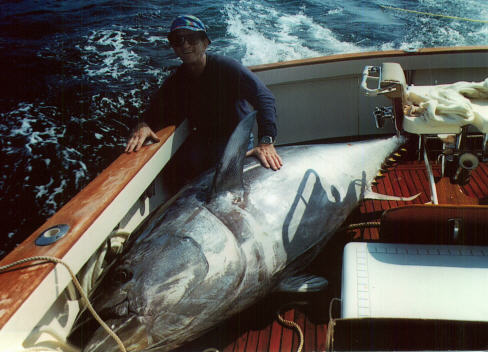
First of all, they’re freakin’ huge – a prize-catch can weigh nearly a ton, and stretch to nearly 10 feet.

Like human beings, they’re also warm-blooded, which allows them to live everywhere from the tropics to the poles.

They can also accelerate as fast as a sports car.

As any Japanese person can tell you, they’re also the centerpiece of the Japanese diet. Whether you’re partial to maguro (?????; tuna) or toro (????; fatty tuna belly), one thing is for certain – tuna are delicious.

Of course, this why bluefin tuna will most likely be extinct sometime in the next fifty years.

It’s hard to imagine a fish like tuna becoming extinct, especially since they’ve been so abundant in the world for most of recorded history. However, numbers are falling dramatically, and it’s very unlikely that the population can sustain itself for much longer.

In fact, fisheries have collapsed before, and it’s likely that they will do so again.

In 1993, the cod population vanished on the Grand Banks near Newfoundland in Canada, which has since then devastated the local economy.

So, are we perhaps the last generation ever to enjoy fresh sushi?

Perhaps.

Approximately one year ago, British scientists issued a report warning that within the next fifty years, there will most likely be nothing left to fish from the sea. According to the report, nearly one-third of historical sea fisheries have already collapsed, and the rate of decline is accelerating.

The scientists, who published their findings in the journal Science, partly attributed the fishery decline to the global increase in the popularity of sushi.

Despite the demand for more tuna, bigger vessels, better nets, and new technology for spotting fish are not resulting in bigger returns. On the contrary, the global catch of blue fin tuna fell by 13% between 1994 and 2003.

Dr. Steve Palumbi, a scientist at Stanford who worked on the project, told the press: “Unless we fundamentally change the way we manage all the ocean species together, as working ecosystems, then this century is the last century of wild seafood.”

Eeek.

Sadly, it may be to late to save the noble bluefin tuna.

Last month, Europea banned tuna fishing in the eastern Atlantic and Mediterranean for the rest of the year. The move was taken to curb over-fishing and dwindling stocks of fish after the EU reached its 2007 quota.

Atlantic bluefin tuna is the best quality tuna in the world, and fisheries earn top dollar exporting the fish to the lucrative Japanese market.

However, existing bluefin tuna stocks are being plundered, with high rates of overfishing being reported by virtually every single country in the European Union.

The International Commission for the Conservation of Atlantic Tunas (ICCAT) sets annual fishing quotas to be followed by all member countries.

With that said, conservation groups are cynical of ICCAT, and are partial to calling them the International Commission to Catch All Tuna!

Whether you loved canned tuna and mayo or fresh sashimi with a splash of soy sauce, it’s probably best to just enjoy the fish while it’s still around…
Big in Japan: What Exactly is Wasabi?

Did you ever wonder what exactly that green stuff is that you smear on your sushi?

I mean, we all know that wasabi (わさび, 山葵) burns like a hell-spawned wildfire, and clears the sinuses with a fiery vengeance. But, where does it actually come from, and how can something so seemingly innocent be so unbelievably potent?

For starters, the best wasabi comes from Japan (no surprise there), most notably the Izu peninsula in Shizuoka prefecture. Much like American horseradish, wasabi plants grow naturally in stream beds, particularly where there is clean water that is free of impurities.

If you’ve ever had the pleasure of smearing just a tad too much of the stuff on your tuna roll, wasabi is a nasal irritant that is more comparable to hot mustard than it is to chili pepper. That wonderful little chemical that can have you rolling your head on the sushi bar is called an isothiocyanate, which coincidentally inhibits microbe growth.

Although there’s no denying that wasabi brings out the flavors of sushi, it may have been traditionally added to raw fish in order to prevent it from spoiling.

%Gallery-6477%

Needless to say, you shouldn’t eat raw fish unless you’re absolutely confident in the quality of the fish. Just because sushi makes an appearance at an all you can eat buffet doesn’t necessarily mean that you should eat all you can!

Interestingly enough, most Americans have never actually eaten real wasabi as the stuff sold stateside is usually squeezed out of a tube. In fact, this stuff actually doesn’t even contain any real wasabi, and is usually nothing more than horseradish, mustard seed, and green food coloring.

Real wasabi, which I can assure you has no equal substitute, is sold in Japan in the form of a root.

Before it can be used, the wasabi plant is grated on a metal oroshigane (卸し金), which is a special kind of grater used solely for wasabi. Traditionally of course, the best graters were made of shark skin, and today upmarket sushi restaurants in Tokyo still grate wasabi according to this method.

(By the way, the lovely lady in the picture to the right is my dear mother, who is clearly showing her prowess at grating wasabi. Of course, not that she would ever touch the stuff, or sushi for that matter, but you can’t deny that she has good technique).

Once the wasabi paste is prepared, it should remain covered until served in order to protect the flavor from evaporation. In case you were wondering, this is the actual reason why sushi chefs always put the wasabi between the fish and the rice.

Well, I hope this little lecture on wasabi has been informative. Now that you know exactly what wasabi is, go ahead and impress your friends with some wasabi trivia the next time you’re sitting at a sushi bar.

But seriously – go easy on the stuff – it really does pack a serious punch!

Bluefin Tuna Fishing Banned in Europe

Blame sushi! The 2007 quota of nearly 17,000 tonnes of bluefin tuna has already been exhausted for this year, forcing the European commission to impose a ban on bluefin tuna fishing in Europe, specifically in Cyprus, Greece, Malta, Portugal and Spain for the rest of the year. Italy and France closed their own fisheries in July and August.

Experts say that the rising popularity of sushi is to be blamed for the rising demand for bluefin tuna. Unlike most tuna, bluefin grows slowly and matures late, making it vulnerable to intensive trawling. The typical size is 2 m (6.6 ft) at about 500 kg (1,100 lb).

Based on what I saw (or I should say did not see) diving in Crete last week, I seriously doubt there is a single fish of that size in the Mediterranean any more.

Blowfish sold as salmon kills 15, sickens over a hundred

As a frightening aside to my Big in Japan column on the subtle art of eating blowfish, MSNBC reported today that over the last three years, fugu meat that has been passed off as salmon in Thai markets has resulted in 15 deaths and over a hundred cases of food-poisoning.

As a result of a nationwide ban in Thailand on the selling of blowfish meat, some rather unscrupulous fishermen have taken to the practice of dying fugu and passing it off as salmon. The issue was brought to light following a report issued by Dr. Narin Hiransuthikul at Bangkok’s Chulalonkorn University Hospital.

As a warning to anyone travelling in Thailand, it’s probably best to skip on the salmon spring rolls!

** Photo by Flickr user Howdy, I’m H. Michael Karshis **