Prefer your lucky rat deep-fried or grilled?

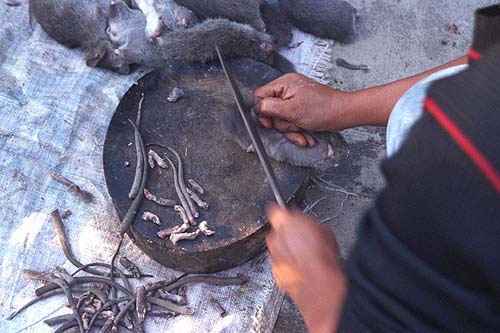
To welcome the Year of the Rat, some people in rural Taiwan and China have increased their rat consumption accordingly. Reuters reports that a rural eatery at Taiwan’s Chiayi county, serves 10 rat-themed dishes, including rat soup, black pepper-dipped and deep-fried rat. The diner goes through around 18 kg (40 lb) of rat meat per day.

Here is the “Rat-at-Chewy” video by Reuters, depicting the way rats are prepared and eaten. I wouldn’t suggest watching it before lunch.

Rat meat apparently became popular in rural Taiwan in the 1940s and 1950s among people who could not afford chicken or pork. At least we know that if the sub-prime mortgage crisis gets any worse, there are enough rats in New York to fill every American man, woman and child.

Po Chai Pills and Other Items of Interest

When I was reading National Geographic Traveler, I came across an essay by Daisann McLane, an American living in China who writes the blog, Learning Cantonese and is the “Real Travel” columnist for the magazine. Her essay was about getting sick and taking some mystery pills, meaning she didn’t know what they were exactly, but the doctor- told her-to-take-them pills. They were called Po Chai and they worked. Daisann’s experience reminded me of my own.

Getting medicine from in Asia facinated me when I lived there. In Singapore, the doctor I went to had an office in an apartment complex. This is typical in Singapore. Mega apartment complexes often have grocery stores, beauty parlors and a doctors office for anyone to use. You don’t need an appointment, you just show up. The doctor I went to was excellent. After she found out what was wrong with me,( nothing much really), she sometimes gave me a prescription.

Before I went on a trip, I’d also head to the doctor to get a supply of pills for stomach ailments. She’d count some out and put them into a tiny zip lock bag. By the end of the trip I never could remember which pills were for what problem. Once in awhile, I’d take my pill stash to her so she could again tell me what was what.

In Taiwan, the doctor, also a walk-in type, gave pills in a strand of packets, each packet a separate dose. If there was a 10-day dose, there would be 10 little pouches attached together. When you got to the last pouch you were on the last dose. If two or more pills were to be taken together, and there always seemed to be two or more, those were in the same pouch. There was never an indication of which pill went to which purpose. The advantage of this method is there weren’t a lot of bottles to keep track of. The disadvantage is those packets could take up a lot of room.

Daisann’s subject matter goes beyond medicine, each month she adds new essays with photographs, and provides some language lessons besides. Her recent essay, “Hong Kong is Always With You” is linked to another essay she wrote that was recently published in Slate.
The Year of the Pig is Here

Chinese New Year is here so the Year of the Pig has arrived. The pig, also referred to as a boar, is the last animal of the 12 year lunar cycle. There is a folk tale that explains the order the animals appear in the Chinese zodiac. If you’ve ever read a placemat at many Chinese restaurants you already know that each animal has distinct personality characteristics and the animal sign you are born under influences the life you will have.

Wherever there is a large Chinese population, you can bet you’ll find a celebration. Some places like in Singapore and Taiwan have celebrations over a 15 day period. This is a major time for folks to head out on vacation. I know, I used to live in both countries. We headed out ourselves along with everyone else scrambling for plane tickets. If you’re traveling to any of these places, be prepared that some businesses may not be open, at least not if they are run by a Chinese person. This is the time for visiting family and relaxation.

Here are some things to look for to help you celebrate.

  • Hung Bao (Ang Pow)– Red envelopes mean prosperity, long life and good fortune. Usually adults put money in the envelopes and pass them out to children.
  • Firecrackers – Their loud bang scares away evil spirits and bad luck and also brings spring rain for crops.
  • Lion Dance– The dancers wear a stylized lion’s head mask and mimic the movements of a lion. (It’s actually more involved than that). The lion scares away evil spirits and brings happiness and good fortune.
  • Live flowers stand for rebirth and growth.
  • Oranges and tangerines stand for “abundant happiness.”

A traditional Chinese New Year food to look for is zong zi which is glutinous rice wrapped up in leaves and steamed. Some have peanuts, egg and meat inside and can be found at many Asian grocery stores. I even can get them in Columbus, Ohio.

Here are links to various Chinese New Year celebrations around the world.

The photo is of a card designed by Chia-yi Fan for a New Year card design contest in Taiwan.