Forget flying around Europe. Take the train

For the eco-sensitive traveler, there is no excuse now for not taking the more environmentally friendly route through Europe, writes The Independent, among others. Rail companies are starting to advertise to the eco-conscious traveler as well. Who knew they cared so much about the environment, wink wink.

The truth is, Europe has been pumping a lot of money into upgrading its railways and encouraging people to take the train, rather than flying, especially if traveling only a short distance. With the budget airlines making it affordable, it is not uncommon for Europeans to fly from place to place even if it is only as little as 150 miles away because it is cheaper than taking the train.

Some of these new upgrades, however, might really make it better to take the train:

  • High-speed link between Madrid and Barcelona now only takes 2 and a half hours
  • The new east-west, Paris-toward the Rhine TGV route cruises at over 200mph and offers WI-Fi from Paris-Frankfurt
  • The new Lotschberg Base Tunnel through the Alps cuts an hour off the time of Basel-Milan trains

More upgrades, such as the long awaited Moscow-St. Petersburg fast train should be done next year.
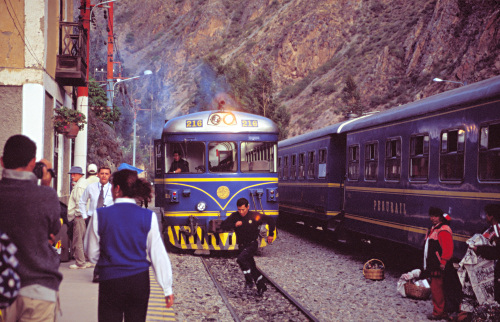
Train to Machu Picchu reopens

Peruvians ended two days of protests against new laws allowing more development near historic sites. Rail service to the Inca ruins at Machu Picchu reopened and the nearest regional airport at Cuzco also reopened. The airport had been closed since Thursday when protestors stormed the facility and piled rocks and trees onto roads, according to AP.

Local leaders protested two laws, originally approved late last year, that permit the construction of new hotels and restaurants near historic sites. Last week, lawmakers ratified the disputed laws, and then modified them three days later to let regional governments decide whether to apply them.

I can’t believe they want to develop the area more. I hope developers are not planning to replace the old train with some sort of highly efficient high-speed train. Hmmm. what would the Incas do?

Spain’s new high speed train connects Madrid and Barcelona

Spain’s high speed link between Madrid and Barcelona is finally open, after more than two decades of construction and administrative delay. Transporting passengers at 300 kilometers per hour (186 miles per hour), and at a price of 180 euros round-trip, the train is expected to compete with air travel.

Madrid and Seville have been connected by high speed bullet train since 1992. Motivated by the addition of the new Madrid-Barcelona line, the Spanish government says that it will have more high speed train lines than anywhere else in the world by 2010, as reported by the BBC. France recently unveiled its latest contribution to the industry of high speed trains, meaning that we can probably look forward to an even better, and certainly faster, train-connected Europe.

[Thanks, Moody75!]

North Korea, South Korea and a closely watched train

Well, it hasn’t taken a long time before the “most closely watched train” in the world may need to cut back its service.

Last month, North and South Korea started a symbolic rail service connecting the heavily fortified joint North-South industrial complex in Kaesong, just north of the border. Although the train served only to ship goods, it seemed like a start of some sort of communication. After all, it was the first train connecting the two countries since the Korean War in 1950-53.

Now, North Korea has proposed cutting the service down, citing a lack of cargo to transport. South Korea says buses are, in fact, more convenient. And that is, probably, the end of the closely watched train fairytale.

India’s Heritage on Wheels

You’ve probably heard of India’s famous Palace on Wheels train ride which takes you through main points of northwest India in a week. It’s been around for a while, has a minimum set course of 7-days, and is luxuriously out of reach for the average upper-middle class Indian which makes it more popular with tourists rather than locals.

A similar yet more down-to-earth 3-day journey available on India’s Heritage on Wheels is increasingly becoming popular amongst Indian families not wanting to spend so much for Palace on Wheels, yet want a cultural and comfortable train trip with family. It covers 3-cities in Rajasthan: Jaipur, Shekhawati and then Bikaner where you can visit the most famous sanctuaries, palaces, and forts of the state.

At US$150-300 per night, it is not cheap, but it costs less than half the day price of Palace on Wheels. The train is targeted to (rich) Indian families rather than international tourists, so perhaps it will give you a slightly more authentic experience of that part of India.