Watch out for middle-aged British binge-drinkers

Here is the question. Why do British people like to binge-drink so much? Just when you think American college students are bad, go to any British pub at about 10pm and you will probably see more drunks than at an average American fraternity house.

In addition to all the young people in Britain drinking too much, there are the middle-aged folks to worry about. A record number of middle-aged people are drinking themselves to death, according to latest figures published in The Independent. A report shows that 8,758 people died from excessive alcohol intake in 2006, twice the number in 1991. The biggest increase was among people aged 35 to 54 and among women than men.

Binge-drinking was one of the reasons why Britain decided to change their “must-drink-fast” 11pm closing time for pubs and introduced 24-hour licenses for pubs and clubs in 2005. There is no hard evidence whether binge-drinkers have transformed to 24-hour drinkers, although streets of London are still rowdier than normal after the 11pm spill-out-on-the-street tradition.

Exposed in a Travelpod: The world’s first mobile hotel room

Writing about normal rooms reminded me of another possible (albeit odd) sleeping alternative to traditional hotels. I first learned about the Travelpod from this Age article by Benji Laynado: For those too posh to pitch recounts Benji’s experience sleeping in one of Travelodge’s mobile hotel rooms — a transparent glass structure with clear polycarbonate walls, carpeting, AC, double bed and other furniture, but no shower. This is the second generation Travelpod, a revised version of the original room that was trialed in 2006, with added design features.

For about $65 bucks a night, the mobile hotel room can be transported from one of Britain’s Travelodge hotels to any destination that allows permission for the room to be placed there. Benji chose a field for his out-of-the-box-while-in-a-box travel experience, and had a good night’s rest in what he calls “the top of the camping chain.” Interesting concept, but confusing, as Benji notes: “I came here to get outdoors, yet everything around me is trying to convince me indoors is great, too.”

The book Sex in a Tent reviews love-making tips for locations other than a typical tent — canoe, beach, sturdy tree — but what about the Travelpod? Would hooking-up in one of these count as an outdoor sexual experience if the structure was simply plopped down in a rural location? Something unimportant to ponder, eh? And how come I can’t find anything about similar structures in the US? Has any American hotel chain experimented with transportable hotel rooms yet? The whole thing seems quite silly to me, but still fascinating to follow these outlandish travel trends.

One for the Road: Virago Book of Women Travellers

Virago is a Latin word for woman, and Virago Press is a U.K. publisher known for its titles written by female authors. Several years back, travel writer Mary Morris (author of River Queen) edited the beautiful Illustrated Virago Book of Women Travellers, which was subsequently released in paperback.

It’s a lovely collection of stories by and about some of the greatest female explorers: Gertrude Bell, Freya Stark, Edith Wharton, Leila Philip, Emily Carr and Mary Wollstonecraft (mother of Frankenstein author Mary Shelley.) The book claims to capture “300 years of wanderlust as women travel the world for pleasure and peril.” Some things never change, huh? No matter the decade, there have always been adventurous women out there doing their own thing. Nice to see this tribute to some of the bravest from years gone by.

One for the Road: Walking Haunted London

We’ve already mentioned some spooky travel-related titles for folks who may find themselves in Louisiana, California or Indiana this Halloween. But how about a suggestion for folks who may be visiting our pals across the pond? Walking Haunted London is a collection of 25 walks that explores the city’s ghostly past.

Home to Sweeney Todd and Jack the Ripper, London is considered to be one of the most haunted capitals in the world. This guide features original walks that highlight this sinister side of the city. Author Richard Jones (who looks scared silly and/or really creepy in this photo) is owner of a tour company that organizes ghost walks and other London tours. The book features easy-to-follow route maps for each walk, as well as information on dates and times when ghosts are most likely to appear. Which is handy to have, of course, because you wouldn’t want to travel all that way and miss out on a paranormal sighting, right?

From narrow alleyways to the Tower of London, this ghostly guide will take you on a spine-chilling journey into the darkest parts of the city, ensuring a hair-raising look at London.

The World’s Longest Tunnels

The Gotthard Base Tunnel (map), a railway tunnel in Switzerland, isn’t complete yet, but in 2015 — after 22 years of construction — it will be the longest transportation tunnel in the world, running 35 miles through the Swiss Alps. It will eventually cut the travel time between Zürich and Milan from 3.5 hours to 2.5. Four tunnel boring machines are working the job: “2 southbound from Amsteg to Sedrun, 2 northbound from Bodio to Faido and Sedrun,” according to Wikipedia. The machines cut away at the rock at a rate of 100 feet per day in optimal conditions. That explains the 22 years of construction!

The Seikan Tunnel in Japan is the current world record holder, clocking in at 33.49 miles. Almost half of the length runs under the Tsugaru Strait, which connects the island of Honshū to Hokkaidō in northern Japan, and bridges the Sea of Japan with the Pacific Ocean. The tunnel opened on March 13, 1988, after 17 years of construction. Two stations are located in the tunnel: Tappi-Kaitei Station and Yoshioka-Kaitei Station, both of which were the first train stations in the world built under the sea. Yoshioka-Kaitei has since been demolished to make way for the Hokkaido Shinkansen project, which will eventually facilitate high-speed trains in the Seikan.

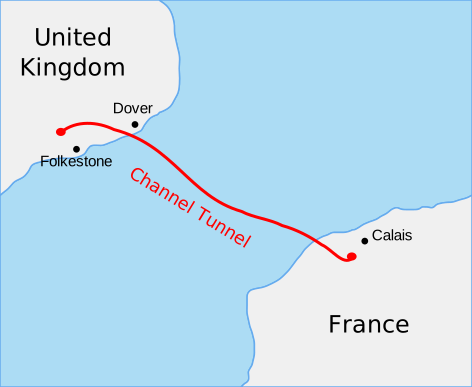
The Channel Tunnel, or Chunnel (map), linking the United Kingdom and France under the English Channel, takes the second (completed) spot at 31 miles long. While it’s a few miles shorter than the Seikan Tunnel, the Chunnel’s underwater segment is longer than that of the Seikan, making it the world’s longest underwater tunnel. The construction took 13 7 years, from 1987 to 1994, with over 13,000 workers involved in construction. Eleven tunnel boring machines were used — 6 on the English side, and 5 on the French side — and the sides met on December 1, 1990. 8.2-million passengers traveled the Chunnel via Eurostar in 2005, and numbers are expected to grow even larger when the Channel Tunnel Rail Link extends to London later this year. When the link is completed, a train trip from London to Paris will take 2 hours and 15 minutes.

The Lötschberg Base Tunnel in Switzerland runs 21.5 miles from Frutigen, Berne to Raron, Valais. When it opens in December of 2007, it will be the longest land tunnel in the world until the Gotthard Base Tunnel opens in 2015. “To dig the Loetschberg, some 16 tons of explosives were used and enough rock was excavated to pack a freight train 2,500 miles long – stretching across Europe from Lisbon, Portugal, to Helsinki, Finland,” according to this report from MSNBC.