Bluefin Tuna Fishing Banned in Europe

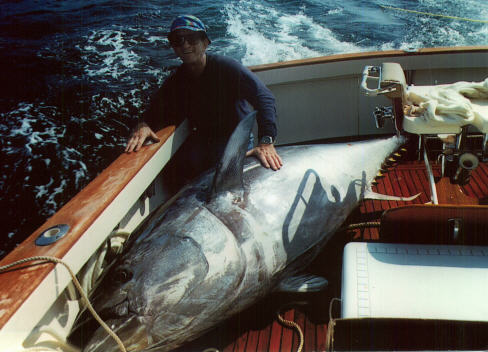
Blame sushi! The 2007 quota of nearly 17,000 tonnes of bluefin tuna has already been exhausted for this year, forcing the European commission to impose a ban on bluefin tuna fishing in Europe, specifically in Cyprus, Greece, Malta, Portugal and Spain for the rest of the year. Italy and France closed their own fisheries in July and August.

Experts say that the rising popularity of sushi is to be blamed for the rising demand for bluefin tuna. Unlike most tuna, bluefin grows slowly and matures late, making it vulnerable to intensive trawling. The typical size is 2 m (6.6 ft) at about 500 kg (1,100 lb).

Based on what I saw (or I should say did not see) diving in Crete last week, I seriously doubt there is a single fish of that size in the Mediterranean any more.

Reminder: Call For New Blogger Ends This Friday!

Just a quick reminder: the deadline to submit your application to become our newest blogger is this Friday, September 21 at 8:00 PM EST.

We need someone who knows the airline industry inside and out — someone who flies regularly, keeps themselves informed of the happenings of airlines both domestically and worldwide, and is comfortable expressing their well-formed opinion to our readers. Did Southwest detain another questionably-clothed passenger? Did another South American plane overshoot the runway? We want someone who keeps up with the latest news, oddities, and everything else under the airline industry umbrella, and can report back to our readers quickly. Prospective bloggers should be willing to write anywhere between 7 and 15 article per week (each which ranges anywhere from 150-400 words). This is a paid, freelance position.

For full details, visit the original post.

To Talk Like a Pirate, Go Where the Real Ones Are–Or Not

Catherine posted the scoop on International Talk Like a Pirate Day, even translating boardroom talk into pirate lingo–impressive, but for some honest to goodness pirate talk, head to the Straits of Malacca. Pirates still sail the waters here, wrecking havoc by capturing crews, taking over ships, and stealing their goods. The goods might be three million dollars of diesel fuel, for example. Just in case you’re a bit fuzzy about where this is exactly, (I even looked it up to be clear and I used to live in the region), here’s a map. The Sraits of Malacca is the stretch of water between Sumatra in Indonesia and the west coast of Malaysia. Singapore is at one end of it.

Marilyn Terrell, chief researcher for National Geographic Traveler, sent us a link to a National Geographic magazine article that details the history of and the current practice of honest-to-goodness pirates in this part of the world. It’s a fascinating read made more interesting by the account of the writer Peter Gwin who travels to where the pirates are. He interviews various players along the way, starting with one who is in jail. The pirate, like many other pirates, is from Batam, Indonesia. This is where Peter Gwin’s journey takes him, until he eventually learns, first-hand, the ropes of pirate living–part of it involves a karaoke bar.

I’ve been to Batam, Indonesia. At the time, it was a popular quick getaway from Singapore because of it had a decent resort hotel and a golf course. The school where I taught had a three-day retreat here. When I was at the retreat bonding with co-workers, I had no idea pirates were making their thievery plans close to where people recreate. I’ve also been to the west coast of Malaysia near to where pirates roam. Malacca is one of my most favorite towns, one I’d love to go back to and I recommend without reservations. My husband did say that Medan in Sumatra, also close to the straits, is, to paraphrase, “the armpit of hell.” He went there on a school trip with high schoolers. The night before their return flight, all 20 kids, plus the other chaparone got food poisoning. It was a real barf fest. Sorry, but it’s true.

When I read this article about the Straits of Malaysia and pirates, it reminded me about how little one can know about where one lives and travels sometimes. There are so many different realties. My version of Singapore and travel to the places near it, was mostly the clean cut version, although I could go on about some of the seamier details. Most of the time, however, I was busy with my job and with friends during the week. Holidays and weekend travel was a chance to unwind and have a bit of adventure–safe adventure. If I walked by a pirate, I wouldn’t have noticed.

If you have a notion to head through this part of the world, keep your eyes open. If you’re traveling through on the water, stay off of tankers. And if you get stopped by a pirate, refer to Catherine’s post. Maybe talking like one will help.

The photo is a montage created by Tarky7 and posted on Flikr today. The decription talks about Talk Like a Pirate Day and Modern piracy.
Expat Newspapers in Central Europe and Russia

When I lived in the Czech Republic, I relied quite heavily upon the local English language newspaper to keep me up to date and fill me in on happenings around town.

For someone who understood Czech very, very poorly, this was indeed a godsend.

The Prague Post was one of the very first English language expat newspapers to emerge in the former Warsaw Pact during the post communist era. Many others soon followed its example as more and more foreigners moved into the region to live, work, and play.

Today there is an English language newspaper in nearly every former communist capital. While this is a great resource for foreigners living aboard, most of these papers also provide a bounty of information for visitors. Better yet, many are online as well.

Here is just a short list of the largest newspapers in the region:

Prague: Prague Post
Budapest: Budapest Sun
Moscow: Moscow Times, Exile
St. Petersburg: St. Petersburg Times
Warsaw: Warsaw Voice
Slovakia: Slovak Spectator
The Baltics: Baltic Times

Southwest Airlines Reaches Decision on Boarding Process

“To assign, or not to assign,” the Southwest Airlines blog reads. “That is the question.”

I’ve always been a fan of Southwest for two reasons: they’re generally cheaper than other carriers in my neck of the woods, and I enjoy the open seating and boarding process. Why? Because it rewards those that make an effort to get a good seat instead of randomly assigning them. Why should Joe Blow get the emergency exit row? He showed up at the airport late, held up the security line with his 18-hole boots, and made it to the gate in a breathless, mad dash. With Southwest, because I’m dedicated (read: anal) to being a part of the elite “A” group, I’m rewarded with the first pick of seats. I like that.

I’d be lying if I said I wasn’t a little worried as I read Southwest Airline’s blog post this morning stating they had reached a decision. Would they adopt the standard assigned-seating boarding process? Would they do away with open seating? The tension was building.

“Southwest has decided to keep open seating, but to adopt a new and improved boarding process,” writes Gary Kelly, Southwest Airlines CEO. [We wrote about the improved boarding process here.] “These decisions were based on the input we got from you, our Customers, through this blog, written correspondence, and surveys taken during the tests. While a substantial majority of our Customers prefer the ability to select their own seats onboard the aircraft, many of those folks have told us they don’t like our existing boarding procedure that sometimes has Customers doing everything possible to be at the front of their boarding group.”

This is perfect. No longer do you have the line sitters (okay fine, I admit it — I was one of them), the people who cut in line (never did that, of course), or the people who stand in the “B” line even though they have a “C” boarding pass, hoping the ticket agent will say, “Oh, sorry you have a ‘C’ boarding pass… but that’s okay, come on through!” Thankfully every time I saw this happened, the agent kindly sent them to the line they belonged in.

Anyway, good job Southwest. To read the details of the new boarding process, visit the Southwest Airlines blog.