Cockpit Chronicles: Miami Closed? You’re pulling my leg!

Occasionally international pilots at our company will fly domestic trips, and a Miami turn I had on my schedule last week is a good example of that. Fly down and an hour later, come back to Boston. When you live somewhat close to the airport, these trips are a great way to avoid being away from home so much.

It would also give me a chance to fly with a domestic captain, Frank, who I had never flown with before. This can be good or bad, since you have no idea what kind of personality you’ll be sitting next to for the next 7 hours. Most captains I’ve flown with can be grouped into five different personalities:

• The quiet type – who manages a few words an hour.

• The thinker– who engages you with conversation about the industry or politics and keeps you pondering the future, asking questions like, “Do you think people are genetically predisposed to favor monarchies over democracies?”

• The grump– who can’t come up with anything positive to say about the day.

• The comedian– who keeps you smiling for the entire trip.

Or

• The control freak– who makes sure that his method of flying becomes YOUR method of flying.

Fortunately in our base we have very few grumps or control freaks. I’m not sure if that ratio holds up at the other bases or not.

For this one-day trip to Miami, I really lucked out. Captain Frank is a comedian. There wasn’t anything subtle about his sense of humor, as this example shows:

Often a captain will turn to ask at some point in the preflight what leg a co-pilot prefers. That is to say, which leg of a flight would they wold like to fly the aircraft while the other pilot talks on the radio. Once this is decided at the beginning of a trip, we usually trade off the flying duties for the rest of the legs. The decision as to who starts off is really up to the captain — as is the choice of meals — but if the he has no preference he may defer the choice to the co-pilot. Frank’s method of asking this question is by pulling out a plastic leg from what I presume was a very chubby doll and saying, “Whose leg is this?” with a puzzled look.

I couldn’t think of a better way to start off a trip than this. It tends to break the ice and makes for a fun day. And a fun day we had.

Halfway into the flight, I was coming back to the cockpit after using the restroom when Frank announced, “The Miami Airport is closed.”

“Yeah, Right.” That Frank is pretty funny, I thought.

“No, it really is. It’s completely fogged in,” he said, pointing to the ATIS (the current airport weather report) that we can print up inflight.

Sure enough, Miami was socked in. The second picture above shows the visibility in feet at the touchdown, midfield and roll out areas on each runway. We commented on how rare of an event this was, since neither of us had actually seen fog in Miami in our careers. It’s so rare, in fact, that the Miami airport doesn’t have an approach system called a CAT III ILS which would allow us to land by using the airplane’s autopilot down to visibilities as low as 500 feet.

So we had to enter yet another holding pattern just abeam Fort Lauderdale while we waited for the fog to clear. Fortunately we had plenty of fuel and we could literally see the FLL airport next to us, which was clear.

We did some quick calculations to figure that we could hold for more than 50 minutes given our current fuel before we would be burning into the reserve needed to go to our furthest alternate airport, fly the approach and still have 45 minutes to play with.

The next calculation was if this extra flight time was going to cause me to exceed 30 hours of flight time in 7 days, which would cause me to lose the three day London trip scheduled the next day. I might have been able to find another trip to pick up, but I had already made plans for the long layover in England. It took just a little bit of adding to discover that I wasn’t going to lose any flying the next day.

The Miami airport opened up after thirty minutes. By the time it was our turn to land, the fog had completely lifted and we were sure that passengers would question the reason for the late arrival. While that wasn’t the case, we did have a couple of people complain, one even saying, “I refuse to say thanks since you got us here late.”

I couldn’t help thinking that we could have certainly got him on the ground on time, only it would have been at the Fort Lauderdale airport.

After this trip, I’ve added Frank to my list of captains that I’ll go out of my way to fly with. Thanks, Frank, for making the day such a pleasure. And thanks to the passengers who understand that we don’t really have much control over the weather.

Cockpit Chronicles takes you along on each of Kent’s trips as a co-pilot on the Boeing 757 and 767 out of Boston.
First A380 flight in Europe: March 18

Singapore Airlines currently flies both of the only two operating Airbus A380 airplanes in the world on the Sydney-Singapore route. The third plane, also purchased by Singapore Airlines, will operate on the London – Singapore route, starting March 18. This will be the first commercial flight with the world’s biggest plane in Europe.

Tickets for this flight are already on sale, starting at 550GBP (approx. $1100). First class tickets have not been priced yet. The Singapore Airlines A380 has 471 seats available in three classes: 12 seats in their ultra-luxury suites (see picture), 60 seats in business class and 399 in economy.

Those luxury suites don’t look too bad. I don’t think I want to know how much they go for.

%Gallery-9672%

Not exactly your regular LAX ‘stripper plane’

Neil has written about the infamous Los Angeles to Las Vegas “stripper plane” run by Southwest. From what he said, it seems to be a completely legitimate operation.

This stripper plane, however, was not. Recently on a French airline, a couple of flight attendants were caught–on film–giving a saucy striptease to the pilots in the cockpit. The video was subsequently leaked (though it did take a whole three minutes of Googling for me to find it — NSFW), and now there’s a widespread investigation all across Europe to track down these folks.

The incident follows right on the heels of another piloting fiasco–this one on a Heathrow flight, when the co-pilot decided to have a mental breakdown at 35,000 feet. Ahh… reminds me of the year of the drunken pilots. Was that ’05? Last year?

%Gallery-15203%

Delta passenger gets half of a seat

Overweight airline passengers are a tricky issue. Some airlines stipulate that extra large passengers must pay more, sometimes even the price of two tickets, as they take up additional space. This obviously leads to a mess of questions regarding discrimination and customer service. Recently the Canadian Transport Authority mandated that national carriers were not allowed to institute a “fat surcharge.” Yet these kinds of decisions don’t do much to quell a complicated situation. Take the recent case of Julie from Henderson, Nevada.

Julie wrote in to MSNBC‘s Travel Troubleshooter with a complicated query. On a Delta flight from Philadelphia to Atlanta, Julie was placed next to a very large woman, who was filling up not only her own space, but also half of Julie’s. Much to Julie’s dismay, there was no extra room in first class or in the rest of the plane. The flight attendant’s solution? “Find a cute boy or girl” and sit in their lap.

As ridiculous as that statement probably sounds, Julie’s predicament is not uncommon, and when planes are fully booked there are not any simple solutions. When she emailed Delta to complain about paying for a whole seat and only getting half of one, they politely responded by thanking her for the input but that the airline could not do anything about it. I personally would feel pretty frustrated if I paid for a full price ticket and then had to squeeze myself into half of a seat; a lot of people would.

Should Delta be held responsible? What do you think the solution to the complicated question of overweight travelers in the sky is?

Will fingerprinting replace need for a passport?

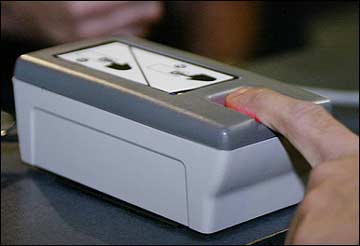
Scandinavian airline SAS has introduced finger-print check-in on a domestic flight from Stockholm to Gotenburg in Sweden. Its purpose at the moment is to make sure that the person who checks-in luggage is the same as the person boarding the flight, a sure advantage for airport /on-flight security.

On a domestic level, this makes sense as check-in procedures are relatively lax when traveling within the country, and even within the EU for that matter; but they plan to eventually make it an international check-in system.

Fingerprinting at airports is not new. The US introduced it a while ago as an added security check for visitors to the country; the UK has a similar system, but not restricted to visitors; and Dubai has had a retina scan system for a while now. This makes it impossible for people to travel with fraudulent documents.

Dubai went beyond finger-printing for security purposes when they introduced the eGate card — a check-in option for Dubai-based frequent travelers who don’t want to stand in line to get their passport stamped. If you have this card, you swipe it to enter/exit the airport, match your finger-print on a screen and you are through.

So the question is: will we eventually be able to travel without any printed form of identification? If you are finger-printing and retina-scanning anyway, other than to have a stamp, what do we need passports for?