The most remote (and beautiful) corner of Costa Rica

If you want to experience Costa Rica for its natural parks and avoid beautiful-but-touristy places (such as Quepos) head over to Osa Peninsula, home of Corcovado National Park, which is the largest park in the country (and much of Central America). I was just there in November and would recommend it to anybody who is looking for adventure travel. November is a good time to go, too, because it is the end of their rainy season but not quite their high season yet. You will end up doing a lot of trekking–both in jungle and on the beach–so plan accordingly and bring a lot of sunscreen.

We took a local flight on Sansa from San Jose to Puerto Jimenez and rented a 4X4 car from there. You can also take a “colectivo” shuttle bus (cheaply) or a taxi (expensively). It is about a three hour drive to Carate. This is where “the road ended” and we hiked 3 miles on the beach to the eco lodge. The beaches are amazing and so are most of the eco lodges. Still, the key here is modest: tents, simple meals and lots of scenery. Anyone looking to get “eco-pampered” with a massage in the sunset should probably go to Quepos instead.

Costa Rica is a beautiful country that has so much to offer to different types of travelers. Don’t get discouraged just because your neighbor told you it is getting touristy. There are still real gems to find in Costa Rica.

###

Also: Check out the story + gallery (below) of Gadling blogger Jerry Guo catching bats in Costa Rica.

%Gallery-14442%
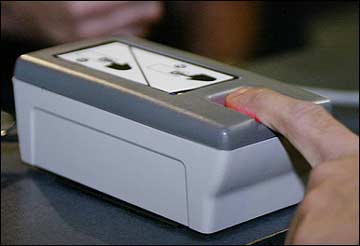
Will fingerprinting replace need for a passport?

Scandinavian airline SAS has introduced finger-print check-in on a domestic flight from Stockholm to Gotenburg in Sweden. Its purpose at the moment is to make sure that the person who checks-in luggage is the same as the person boarding the flight, a sure advantage for airport /on-flight security.

On a domestic level, this makes sense as check-in procedures are relatively lax when traveling within the country, and even within the EU for that matter; but they plan to eventually make it an international check-in system.

Fingerprinting at airports is not new. The US introduced it a while ago as an added security check for visitors to the country; the UK has a similar system, but not restricted to visitors; and Dubai has had a retina scan system for a while now. This makes it impossible for people to travel with fraudulent documents.

Dubai went beyond finger-printing for security purposes when they introduced the eGate card — a check-in option for Dubai-based frequent travelers who don’t want to stand in line to get their passport stamped. If you have this card, you swipe it to enter/exit the airport, match your finger-print on a screen and you are through.

So the question is: will we eventually be able to travel without any printed form of identification? If you are finger-printing and retina-scanning anyway, other than to have a stamp, what do we need passports for?

More on global happiness

Since Eric Weiner’s book, The Geography of Bliss tops all kinds of bestseller lists, the concept of happiness–and the concept of measuring it–seems to be high priority. Why we are so obsessed with happiness is certainly interesting, but even more interesting, I think, is that–contrary to the spiritual teachings out there–money apparently does buy happiness.

As reported by the Holland Herald, using data from the World Database of Happiness, the top 5 happiest countries are also some of the wealthiest countries in the world, despite their lack of sunshine:

  1. Denmark
  2. Switzerland
  3. Austria
  4. Iceland
  5. Finland

On the flip side, the bottom 5 are some of the poorest:

  • Tanzania
  • Zimbabwe
  • Moldova
  • Ukraine
  • Armenia

The interesting part is that most people experience a happiness dip between the ages of 30 and 50. Those are generally not the happiest years in a person’s life. Those are also, paradoxically, the wealthiest years or a person’s life. Hmmm.

###

The happiest fliers in the world are the ones riding on the new Singapore Airlines A380:

%Gallery-9672%

TSA hops on the blogging bandwagon

Yesterday I wrote about a CNN video that documented an undercover Transportation Security Administration official making it past security with a fake bomb. After a lot of comments in reference to that post, I got the general sense that the recent mishaps at airport security checkpoints have started to make people question the TSA’s legitimacy.

Don’t think that the TSA doesn’t know it has made some serious foul-ups in the past few months. In response to the CNN video, the TSA wrote a long explanation on their website regarding covert testing — what it is, how it is done, etc. It was a gentle reminder that the much talked about government organization wants us to feel safe.

Today the TSA stayed on that track when it took a small step as an administration, but a giant leap for traveling kind: it started a blog.

What? Yes, you read correctly, the TSA launched its Evolution of Security blog, possibly making it one of the hippest and tech savvy arms of the government. Why call it the Evolution of Security? because as the blog’s motto states, “Terrorists evolve. Threats evolve. Security must stay ahead. You play a part.”

Don’t worry, there’s some entertainment involved. Beyond playing a part in the evolution, you can also meet the bloggers to find out some fun facts: Ethel loves ice cream and Bob is a record collector. They’re not just TSA officials; they’re people.

Much like we here at Gadling encourage comments on our posts, the TSA blog is set up in order to “facilitate an ongoing dialogue on innovations in security, technology and the checkpoint screening process.” Forget risking having your frustrations lost in the maze of cyberspace on lesser known blogs; make your way straight over to Evolution of Security and tell the TSA what you really think.

U.S. passport fees go up February 1, 2008

Mardi Gras isn’t the only place to spend your money this weekend. As of Friday February 1, 2008, U.S. passport fees are going up.

A new passport for an adult (16 years and older) will now cost a whopping $100. Granted the old fee was $97, meaning only a $3 increase, but somehow my eyes widen just a little more than usual when they see a three digit figure. For your kids, plan on paying $85, also a $3 increase over the old fee.

Getting a new passport is obviously expensive, but if you already have one, renewing it seems like something that should only cost some pocket change. The U.S. Department of State doesn’t feel the same way; it increased renewal fees from $67 to $75.

If all of these fees are a source of frustration, you aren’t alone. Last fall, CNN reported that U.S. Senators initiated a congressional investigation to determine whether or not the “execution fee” ($30 of the old fee) was justified. And what did they conclude? That fee was double the actual cost when imposed in 2002; in that year alone, it was estimated that the government overcharged travelers $112.7 million. The U.S. State Department responded, and the new fees that take effect on Friday comprise only a $25 execution fee. But I did my math, and despite the fact that the execution fee is less, paying for a passport is still going to cost you some bucks.

Given that passports are necessary for international travel, and since January 2007, for all air travel to the Caribbean and Canada, the new fees are all part of a bigger mess that can be discouraging for anyone who just wants to make a quick jaunt out of the country.

Or you can spend a little bit less money getting the brand new passport card.

Have you seen the biggest, baddest new airplane yet? Check it out:

%Gallery-7089%

Can new U.S. passports trigger bombs?