Belize it or not: Top Surprizing Things About Belize

Greetings from Belize.

Those of you who have been to Belize before might not find these surprising, but this is my first time here and they surprised me. Here is a brief laundry list:

  • The U.S. Dollar is widely accepted. With the Belize Dollar pegged at 2:1 to the U.S. Dollar, it’s not surprising. Guess where you should be traveling when the U.S. Dollar is practically worthless? Where they accept dollars, of course! Although Belize is pretty expensive comparing to other Central American countries, the cheap dollar makes it affordable.
  • English is all you’ll ever need. While guidebook after guidebook tell you people speak Spanish or Creole, Belizeans almost universally speak perfect English. It’s the official language, don’t forget.
  • It’s not all jungle. While the UN pegs forest cover at 79% in Belize and the country itself claims to have 44% of its land under some legal land-protection regime, there are whole sections of the country that are open, rolling hills and farmland.
  • It’s not just the Blue Hole. There’s great diving all up and down the world’s second-largest barrier reef. The terrain is varied, and so is the wildlife. I can tell you that first hand, as I squeezed in 5 dives in 2 days off two different islands.
  • There’s a surprising level of development. Literacy is above 75% (depending on the source). The economy is rapidly growing. While the UN’s human development index generally puts the country at about number 80 of 177 countries studied (in terms of education, GDP per person, etc.), life expectancy here is in the top 40 worldwide.
  • The population density is one of the lowest in the world. With 300,000 or so people in an area the size of the state of New Jersey (which has almost 9 million folks), and 1/3 of people living in Belize City, it’s not surprising, really.
  • The rainy season (May-November) is quite pleasant here, especially if you stay in the north. We are in the middle of it right now. It rains about once a day, if that, for a while and then it’s sunny again. The benefit over the dry season? It’s cheaper and there are hardly any tourists.
  • People are really friendly, helpful and pleasant. The islands have a Caribbean feel, while the inland is more Spanish-influenced.

I give Belize two thumbs up.
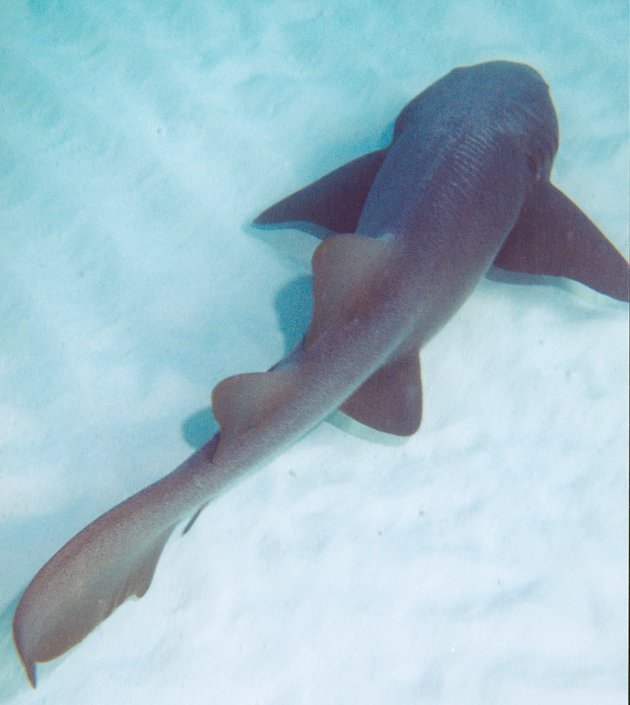
Belize it or not: The shark petting zoo

Hello from Belize! What a beautiful little country this is.

I have wanted to come here forever, being a diver and all. As you probably know, the Belize Barrier Reef (stretching from Yucatan all the way to the coast of Guatemala) is the second largest reef in the world, after the Great Barrier Reef.

We took our first dive trip today, right off the Ambergris Caye island. It was just a shallow dive with a bunch of snorkelers who desperately wanted to “see some sharks.” This part of the reef is know for its abundance of nurse sharks, pretty harmless types of sharks who eat by suction (hence the name). Still, they are sharks, aka beautiful creatures.

The dive instructor threw in some bait (an enormous fish head) and a few minutes later, a bunch of sharks (I saw five, the largest at least two meters long) and sting rays (the largest was over a meter across) came by for the feast. It was an incredible sight.

I don’t know how I feel about the whole “petting the shark and sting ray” aspect of the whole thing. The instructors caught a couple of the sharks by the fin and let everyone in the group touch them. Same with the sting rays. I felt a little bad for them. I can’t be good for them to have a hundred people a day touch them, right?

US diver accused of drowning his wife on honeymoon in Australia

They had been married for exactly 11 days and the husband already wanted to kill his wife? When they say everything happens faster nowadays, they are not kidding.

Yesterday, four and a half years after the Gabe and Gina Watson incident, a warrant was issued for Gabe. Australia has asked for his extradition from the US to stand trial for killing his young wife while diving in an apparent attempt to secure her life insurance payout, The Guardian reports.

The US newlyweds were on their honeymoon. Gabe Watson, an experienced rescue diver, was exploring a submerged wreck with his wife when she died. It was her first big diving trip, after she had been persuaded by her husband to explore the deep, turquoise waters of the Great Barrier Reef.

One witness said the couple appeared to be locked in an unnatural embrace at a depth of about 50ft before they separated, with Watson heading to the surface while his wife sank to the ocean floor. A leader of the dive spotted the stricken woman and brought her to the surface, but she could not be revived.

Gabe, however, severely underestimated the prevalence of underwater cameras these days. A couple people in their group just happened to take some revealing pictures (and videos) of the scene…

One for the scrapbook.

Cemetery near Miami is a diving attraction

I think I just figured out where I want to be buried when I die. Check out this underwater cemetery, which opened last fall about about 3 miles off the coast of Key Biscayne.

The Neptune Memorial Reef was built as the “perfect final resting spot for those who loved the sea”, AP reports. Its creators hope that one day the reef will cover 16 acres and have room for 125,000 remains. The artificial reef’s first phase allows for about 850 remains.

In March, the remains of 93-year-old diver Bert Kilbride – who called himself “The Last Pirate of the Caribbean” – were placed atop a column of the reef’s main gate, because of his contributions to the sea. Kilbride was named the oldest living scuba diver in this year’s Guinness Book of World Records.

I have to tell my Mom about this guy. She might appreciate that he made it to the age of 93, being a diver and all. A fortune-teller once told her that “danger awaits me in the water.” Ever since then, she expects I’ll get eaten by a shark every time I dive. How cool would it be to get eaten by a shark after you are already dead a buried? I can’t wait to tell my Mom about it. Tomorrow. I don’t think she would appreciate the sentiment on Mother’s Day.

Happy Mother’s Day!

[via ABC News]

Palau: the ultimate dive-spot?

I’ve been doing a lot of reading on Palau for a possible magazine story somewhere. It seems in a single decade this tiny island (the last colonial territory to gain its independence, in 1994) has almost switched its entire economy from fishing to tourism, in the form of diving.

Now it’s arguably the hottest dive site in the world, mostly because of the sheer numbers and variety of fish (1,500 species) and coral (700 species). This year, Palau began linking up all of its scattered marine protected areas (MPA) in the world’s largest campaign to thwart coral bleaching. Though they’ve had a long history of sustainable fishing (codified in ancient fishing laws known as tabu), the country’s recent emphasis on ocean conservation and eco-tourism is refreshing, to say the least, especially after all that we’ve read on the demise of coral reefs by global warming.

I’ve posted before about sustainable dive-trips. I feel like this may be one of the few places you could go to for scuba diving, and not feel that bad about really screwing up the environment. They’re just so far ahead of the crowd when it comes to balancing tourism with conservation.